
Govardhan Puja and Annakut 2026 in the USA: Monday 9 November, a Day Before India, with a Home Annakut Guide
In the USA, Govardhan Puja and Annakut 2026 fall on Monday 9 November, one day before India's Tuesday 10 November. This guide explains the date, the story of Krishna lifting Govardhan as commonly told, how to make a Govardhan hill and Annakut at home without cow dung, temple Annakut darshan and the Gujarati New Year and Bali Pratipada.
In the USA, Govardhan Puja and Annakut 2026 fall on Monday 9 November, one day before India's Tuesday 10 November. This guide explains the date, the story of Krishna lifting Govardhan as commonly told, how to make a Govardhan hill and Annakut at home without cow dung, temple Annakut darshan and the Gujarati New Year and Bali Pratipada.
Quick answer: Govardhan Puja 2026 USA falls on Monday 9 November 2026, one day before India, where Govardhan Puja and Annakut are on Tuesday 10 November. That is the Drik Panchang date for the USA, the same in every US time zone.
In the US, Govardhan Puja comes the very next day after Diwali (Sunday 8 November). In India there is a one-day gap: Diwali on Sunday, then Govardhan Puja on Tuesday. Monday is a working and school day in the US, so most families will keep a simple home puja that evening and join a bigger temple Annakut when they can.
Govardhan Puja 2026 USA date compared with India
| Day | USA (2026) | India (2026) |
|---|---|---|
| Narak Chaturdashi | Sat 7 Nov | Sun 8 Nov |
| Diwali (Lakshmi Puja) | Sun 8 Nov | Sun 8 Nov |
| Govardhan Puja / Annakut | Mon 9 Nov | Tue 10 Nov |
| Bhai Dooj | Tue 10 Nov | Wed 11 Nov |
Source: Drik Panchang dates for the USA and India.
Why the US date is a day earlier
Govardhan Puja falls on Pratipada, the first lunar day of the bright half of Kartika. Panchangs choose the civil day by checking how that tithi lines up with local sunrise and the morning hours. The tithi changes at the same instant everywhere, but the US is many hours behind India, so its mornings come at a different point in the lunar day.
In 2026 Drik Panchang's calculation puts the deciding morning on Monday for the USA and on Tuesday for India. That is why US families do Govardhan Puja a day before their relatives in India. Follow the date for where you live.
The Govardhan story as commonly told
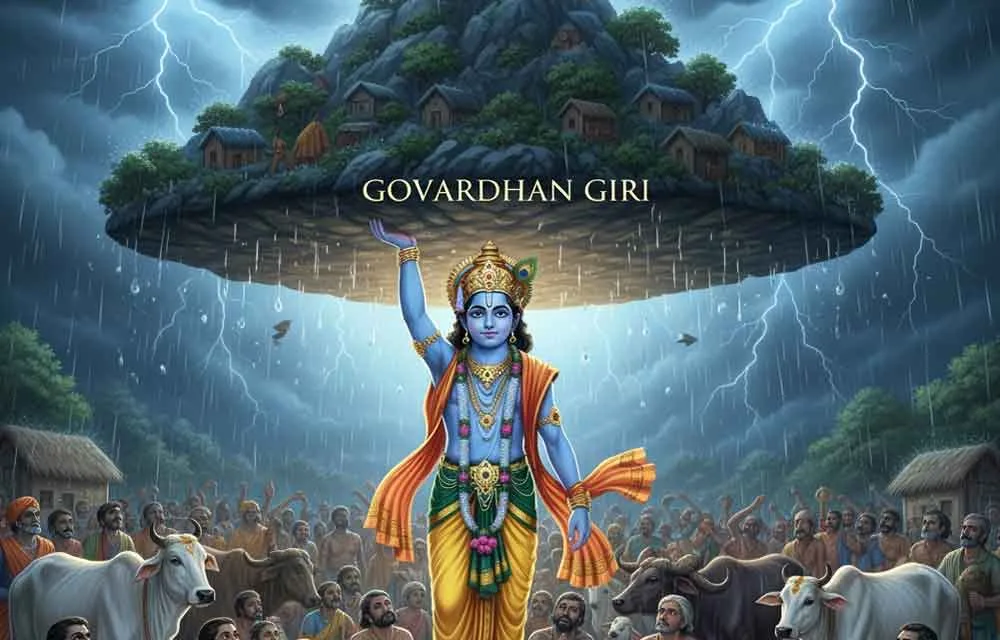
As the story is commonly told, the people of Vraj used to offer a great yearly worship to Indra, the god of rain. The young Krishna asked them to worship Govardhan Hill instead, because the hill gave their cows grass and water. Indra was angered and sent days of storm and flood. Krishna lifted Govardhan Hill on the little finger of his left hand and held it up like an umbrella, and all the people and cows sheltered beneath it. Many tellings say he held it for seven days. In the end Indra understood his mistake and bowed to Krishna.
The festival celebrates Krishna as protector, gratitude to nature, and the idea that humility wins over pride. The Annakut, meaning a mountain of food, recalls the offering the villagers prepared for the hill.
A home Govardhan and Annakut without cow dung
In Braj villages, the Govardhan hill is shaped from cow dung in the courtyard and decorated with flowers. In an American apartment or suburban home that is neither practical nor hygienic, and many HOAs and landlords would not allow it outdoors. Families in the US use simple alternatives:
- Dough hill: shape a small hill from wheat-flour dough on a tray. Children enjoy adding little cows, trees made from mint or tulsi sprigs, and a Krishna figure on top.
- Food hill: heap cooked rice or a pile of sweets into a mountain, with the other dishes arranged around it.
- Rangoli: draw Govardhan with rangoli powder or rice flour on a board, and place the offerings in front.
- Parikrama: walk around the small hill or the home altar, traditionally seven times, chanting Krishna's names.
For the Annakut, cook as many vegetarian dishes as you can manage: a mixed vegetable sabzi, kadhi, rice, puris, dal, pickles and sweets. Temples sometimes offer 56 dishes (chhappan bhog), but at home a few lovingly made dishes are enough. Offer them to Krishna, then share them as prasad.
Fitting Govardhan Puja into a US Monday
- Make extra sweets and savouries on Diwali Sunday so the Annakut plate is half ready by Monday.
- Shape the dough hill on Sunday night and keep it covered; do the puja after work on Monday.
- If you cannot cook many dishes, buy a few from an Indian sweet shop and cook one or two yourself.
- Pack Annakut prasad for colleagues or neighbours. It is a friendly way to explain the festival.
- Light the lamp on a metal tray and keep it away from smoke detectors.
Annakut at temples
Many Hindu temples across the US hold an Annakut, where dozens or even hundreds of vegetarian dishes are arranged before the deities in tiers. Some hold it on the festival day and many on the nearest weekend. Times and arrangements differ, so check your own temple's website or newsletter rather than relying on dates from India. Volunteering to cook or serve is a good way to take part.
Gujarati New Year and Bali Pratipada
For Gujarati families, the day after Diwali is also Bestu Varas, the Gujarati New Year, when people greet each other with "Saal Mubarak" and visit elders. In Maharashtra and Karnataka the same Pratipada is Bali Pratipada or Diwali Padwa, which recalls King Mahabali. In India both are on Tuesday 10 November 2026. Because these are linked to the same Pratipada as Govardhan Puja, check your temple or Gujarati calendar for the date it uses in the US.
Frequently asked questions
What is the date of Govardhan Puja 2026 in the USA?
Drik Panchang gives Monday 9 November 2026 for the USA. In India Govardhan Puja is on Tuesday 10 November.
Why is Govardhan Puja a day earlier in the USA?
Govardhan Puja is kept on Kartika Shukla Pratipada, chosen by how that tithi falls against local sunrise. Because the US is many hours behind India, the deciding morning falls on Monday in the US and on Tuesday in India. Follow the US date.
What is the Govardhan Puja muhurat in the USA?
We do not list a clock time. Check Drik Panchang for your city. Please do not use the muhurat printed for India.
Can I make the Govardhan hill without cow dung?
Yes. Wheat-flour dough, cooked rice, a heap of sweets or a rangoli drawing are all used by families abroad. What matters is the devotion, not the material.
When is the Gujarati New Year in 2026?
In India, the Gujarati New Year (Bestu Varas) and Bali Pratipada are on Tuesday 10 November 2026. It is linked to the same Pratipada as Govardhan Puja, so check your temple or Gujarati calendar for the US date.
Do US temples hold Annakut on Monday?
Some do, and many also hold an Annakut darshan on a nearby weekend so that more families can come. Check your own temple's calendar.
Editor's note
Editor's note (6 October 2026): This guide has been restored at its original address after the earlier version was lost. Dates are from Drik Panchang for the USA and India. We have not listed a clock muhurat or any specific temple event; check Drik Panchang for your city and your temple for its plans. The story is given as commonly told.
Related guides
You might also like

Dev Uthani Ekadashi and Tulsi Vivah 2026 in Singapore: Saturday 21 and Sunday 22 November, a Day After India
Dev Uthani Ekadashi and Tulsi Vivah 2026 in Australia: Date City-Wise, Why It Is a Day Later Than India, Puja at Home
Dev Uthani Ekadashi and Tulsi Vivah 2026 in Europe: Date City by City (Friday 20 November)