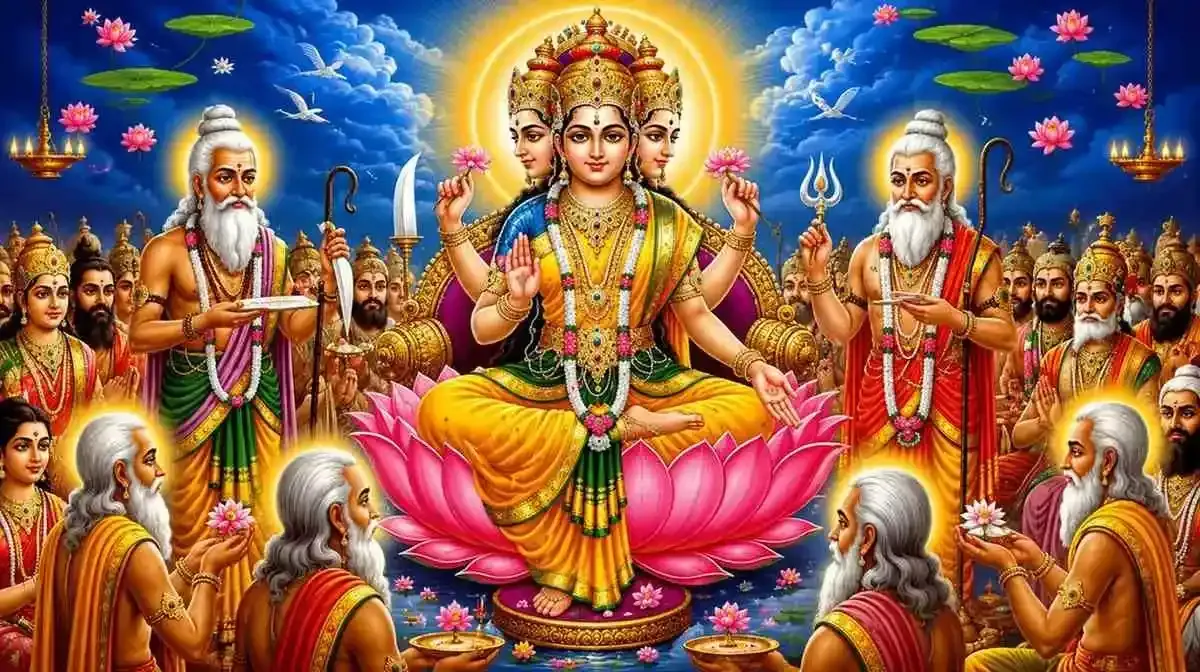
Nirvana Shatakam (Atma Shatakam): Full Sanskrit Text, Transliteration and Meaning
All six verses of Nirvana Shatakam (Atma Shatakam), traditionally attributed to Adi Shankaracharya, in Devanagari with transliteration and a faithful English meaning, plus the story of its origin, its Advaita teaching in simple words and practical chanting guidance.
All six verses of Nirvana Shatakam (Atma Shatakam), traditionally attributed to Adi Shankaracharya, in Devanagari with transliteration and a faithful English meaning, plus the story of its origin, its Advaita teaching in simple words and practical chanting guidance.
Quick answer: Nirvana Shatakam, also called Atma Shatakam, is a six-verse Sanskrit hymn traditionally attributed to Adi Shankaracharya. Each verse lists what we are not (the mind, the senses, the elements, the breath, likes and dislikes, merit and sin, birth and death, family and relationships) and ends with the same refrain, "Chidananda rupah Shivoham Shivoham": I am of the nature of consciousness and bliss; I am Shiva, I am Shiva. It is one of the clearest short statements of Advaita Vedanta, the teaching that our true Self is pure awareness. The full text, transliteration and meaning are below.
The story behind Nirvana Shatakam
According to tradition, the young Shankara left his home in Kaladi, Kerala, as a boy renunciant in search of a guru. He travelled north and reached the banks of the Narmada, where the sage Govinda Bhagavatpada lived in a cave. The site is traditionally identified with Omkareshwar in present-day Madhya Pradesh (see our Omkareshwar Jyotirlinga guide).
When the boy arrived, Govinda Bhagavatpada asked him, "Who are you?" Instead of giving his name, family or village, Shankara is said to have replied with these verses: I am not the mind, not the body, not the elements; I am consciousness and bliss, I am Shiva. Moved by the answer, Govinda accepted him as a disciple.
This story comes from the traditional Shankara biographies. It is tradition rather than documented history, and some accounts connect the same episode with another short Shankara work, the Dasha Shloki. Either way, the question "Who are you?" is the heart of the hymn.
Nirvana Shatakam: full text with transliteration
The text below is the widely accepted version. Small variant readings exist, especially in verses 5 and 6; these are noted after the meaning section.
Verse 1
मनोबुद्ध्यहङ्कारचित्तानि नाहं
न च श्रोत्रजिह्वे न च घ्राणनेत्रे ।
न च व्योम भूमिर्न तेजो न वायुः
चिदानन्दरूपः शिवोऽहं शिवोऽहम् ॥१॥
Transliteration: Mano buddhy ahankara chittani naham / na cha shrotra jihve na cha ghrana netre / na cha vyoma bhumir na tejo na vayuh / chidananda rupah shivoham shivoham
Verse 2
न च प्राणसंज्ञो न वै पञ्चवायुः
न वा सप्तधातुर्न वा पञ्चकोशः ।
न वाक्पाणिपादं न चोपस्थपायू
चिदानन्दरूपः शिवोऽहं शिवोऽहम् ॥२॥
Transliteration: Na cha prana sangyo na vai pancha vayuh / na va sapta dhatur na va pancha koshah / na vak pani padam na chopastha payu / chidananda rupah shivoham shivoham
Verse 3
न मे द्वेषरागौ न मे लोभमोहौ
मदो नैव मे नैव मात्सर्यभावः ।
न धर्मो न चार्थो न कामो न मोक्षः
चिदानन्दरूपः शिवोऽहं शिवोऽहम् ॥३॥
Transliteration: Na me dvesha ragau na me lobha mohau / mado naiva me naiva matsarya bhavah / na dharmo na chartho na kamo na mokshah / chidananda rupah shivoham shivoham
Verse 4
न पुण्यं न पापं न सौख्यं न दुःखं
न मन्त्रो न तीर्थं न वेदा न यज्ञाः ।
अहं भोजनं नैव भोज्यं न भोक्ता
चिदानन्दरूपः शिवोऽहं शिवोऽहम् ॥४॥
Transliteration: Na punyam na papam na saukhyam na duhkham / na mantro na tirtham na veda na yajnah / aham bhojanam naiva bhojyam na bhokta / chidananda rupah shivoham shivoham
Verse 5
न मे मृत्युशङ्का न मे जातिभेदः
पिता नैव मे नैव माता न जन्म ।
न बन्धुर्न मित्रं गुरुर्नैव शिष्यः
चिदानन्दरूपः शिवोऽहं शिवोऽहम् ॥५॥
Transliteration: Na me mrityu shanka na me jati bhedah / pita naiva me naiva mata na janma / na bandhur na mitram gurur naiva shishyah / chidananda rupah shivoham shivoham
Verse 6
अहं निर्विकल्पो निराकाररूपो
विभुत्वाच्च सर्वत्र सर्वेन्द्रियाणाम् ।
न चासङ्गतं नैव मुक्तिर्न मेयः
चिदानन्दरूपः शिवोऽहं शिवोऽहम् ॥६॥
Transliteration: Aham nirvikalpo nirakara rupo / vibhutvach cha sarvatra sarvendriyanam / na chasangatam naiva muktir na meyah / chidananda rupah shivoham shivoham
Line-by-line English meaning
| Verse | Meaning |
|---|---|
| 1 | I am not the mind, the intellect, the ego or the memory (chitta). I am not the ears or the tongue, nor the nose or the eyes. I am not space, earth, fire or air. I am of the nature of consciousness and bliss; I am Shiva, I am Shiva. |
| 2 | I am not what is called the life-breath (prana), nor the five vital airs. I am not the seven constituents of the body (dhatus), nor the five sheaths (koshas). I am not speech, hands or feet, nor the organs of procreation and excretion. I am consciousness and bliss; I am Shiva, I am Shiva. |
| 3 | I have no aversion or attachment, no greed or delusion. I have no pride, nor any feeling of envy. I am not dharma, artha, kama or even moksha (the four goals of human life). I am consciousness and bliss; I am Shiva, I am Shiva. |
| 4 | I am not merit or sin, pleasure or pain. I am not the mantra, the holy place, the Vedas or the sacrifices. I am not the act of eating, nor the food that is eaten, nor the one who eats. I am consciousness and bliss; I am Shiva, I am Shiva. |
| 5 | I have no fear of death and no distinctions of birth or caste. I have no father, no mother, no birth. I have no relative or friend, no guru and no disciple. I am consciousness and bliss; I am Shiva, I am Shiva. |
| 6 | I am free of all mental modifications (nirvikalpa) and without form. Being all-pervading, I am present everywhere, behind all the senses. I am never attached, nor is there liberation for me, nor can I be measured as an object. I am consciousness and bliss; I am Shiva, I am Shiva. |
Variant readings: In verse 5 some editions read "na me mrityur na shanka" (I have no death and no fear) and "pita naiva me naiva mata cha janma". In verse 6 a common alternative for the second and third lines is "vibhur vyapya sarvatra sarvendriyani" and "sada me samatvam na muktir na bandhah" (I am always the same; for me there is neither liberation nor bondage). The meaning is the same in each case.
What the hymn teaches, in simple words
Nirvana Shatakam uses a classical method of Vedanta called "neti, neti" (not this, not this). We usually identify with our body, thoughts, moods and roles. The hymn removes each of these one by one and asks: what is left when everything that comes and goes has been set aside?
- Verses 1 and 2 set aside the inner instruments (mind, intellect, ego, memory), the senses, the elements and the physical and subtle body. What we experience cannot be the experiencer.
- Verse 3 sets aside emotions and even the goals of life. Likes and dislikes arise and fade; awareness stays.
- Verse 4 goes further and sets aside religious categories: merit and sin, mantras, pilgrimages, Vedas and rituals. This does not reject practice: practice purifies the mind so the Self, which is never produced, can be recognised.
- Verse 5 sets aside birth, death, caste, family and even the guru-disciple relationship. These are real at the level of daily life but do not touch the Self.
- Verse 6 gives the positive statement: the Self is formless, all-pervading, free of mental modifications, beyond bondage and liberation.
The refrain "Chidananda rupah" means "whose nature is consciousness (chit) and bliss (ananda)". "Shivoham" means "I am Shiva", where Shiva stands for the auspicious, pure reality. In Advaita, this is the teaching of the Upanishadic sayings such as "Aham Brahmasmi" (I am Brahman): the individual Self and the ultimate reality are not two.
Teachers point out that the hymn is not meant to make us careless about body, family or dharma; the point is to act in the world without being imprisoned by identification with it.
How and when to chant Nirvana Shatakam
- Time: Early morning, after bathing, or in the evening at dusk are traditional times for chanting. It is also chanted before meditation, on Mondays, on Maha Shivaratri and during Karthika Masam.
- Place: A quiet, clean place, facing east or north if possible. A Shiva image helps devotees but is not required.
- Method: Chant slowly. Pause after each verse and reflect for a few breaths on what was negated. Many people chant once, others three or more times.
- With meditation: After chanting, sit in silence and simply notice awareness itself, the knower of thoughts.
Devotees and teachers describe chanting Nirvana Shatakam as calming, as a help in loosening anxiety and over-identification with problems, and as a strong support for meditation. These are personal and traditional experiences, not guaranteed outcomes, and the hymn is not a substitute for medical or psychological care.
Common mistakes to avoid
- Chanting without the meaning: The hymn is a teaching. Even a basic understanding of each verse makes a large difference.
- Mispronunciations: Common slips include "budhi" for buddhi, "ahankar" for ahankara, and dropping the "h" in "chidananda rupah".
- Reading it as nihilism: The verses negate the changing, not existence itself; what remains is consciousness and bliss.
- Using it to dismiss duties: "I am not the body" is no reason to neglect health, family or work.
Frequently asked questions
Who wrote Nirvana Shatakam?
It is traditionally attributed to Adi Shankaracharya, the teacher of Advaita Vedanta. Many hymns carry his name, and scholars debate which of them he actually composed, so the attribution is best described as traditional. Its teaching is fully in line with Shankara's Advaita.
Is Nirvana Shatakam the same as Atma Shatakam?
Yes. The six-verse hymn is known as Nirvana Shatakam ("six verses on liberation") and as Atma Shatakam ("six verses on the Self"). Both names refer to the same text ending in "Chidananda rupah Shivoham Shivoham".
Does "Shivoham" mean I am Lord Shiva the deity?
Not in the sense of claiming to be a person with a trident and a form. Here Shiva means the auspicious, pure consciousness that is the ground of everything. The hymn says your true Self is that pure awareness, not the body or the ego. Devotees also hear it as a hymn to Shiva, and the two readings sit together comfortably.
Can women, children and non-initiated people chant Nirvana Shatakam?
It is a stotra (hymn), not a Vedic mantra requiring initiation, and it is widely chanted by men, women and children in homes, schools and satsangs. If your family or teacher follows a particular custom, follow that.
How long does it take to chant?
At a steady pace, one recitation of all six verses usually takes a few minutes. Sung versions with music are longer. There is no fixed duration.
Why are there slightly different versions of some lines?
Like many hymns passed down orally and in manuscripts, Nirvana Shatakam has small variant readings, especially in verses 5 and 6. The meaning is the same in every common version. Learn the version your teacher or family uses and stay with it.
Editor's note
Editor's note (5 October 2026): This guide has been restored at its original hindutone.com address after the earlier version was lost. The Sanskrit text follows the commonly published version, with the main variant readings noted. The story of the hymn's origin is presented as tradition, and the attribution to Adi Shankaracharya is traditional. Descriptions of benefits reflect what devotees and teachers report, not guaranteed results.
Related guides
You might also like
Shiva Tandava Stotram — Full Text, Meaning & Benefits
Aditya Hridayam Complete Guide: All 30 Verses Sanskrit, Transliteration, Meaning, Chanting Method & Benefits
Gayatrirahito Vipro Na Sprushet Tulasi Dalam – Meaning and Importance of Gayatri Mantra Japa