
Damodar Month 2026: Kartik Dates, the Damodara Lila, Damodarashtakam and Lamp Offering at Home
Damodar month 2026 (Kartik) runs approximately from Monday 26 October to Tuesday 24 November 2026 in the purnimanta and Gaudiya reckoning. Learn the Damodara lila, the first verse of the Damodarashtakam, the daily lamp offering, Vrindavan and Radha Kund customs, and how to keep the month at home abroad.
Damodar month 2026 (Kartik) runs approximately from Monday 26 October to Tuesday 24 November 2026 in the purnimanta and Gaudiya reckoning. Learn the Damodara lila, the first verse of the Damodarashtakam, the daily lamp offering, Vrindavan and Radha Kund customs, and how to keep the month at home abroad.
Quick answer: Damodar month 2026 (the month of Kartik) runs approximately from Monday 26 October to Tuesday 24 November 2026 in the purnimanta and Gaudiya reckoning followed in Vrindavan and by many Vaishnava temples. ISKCON calendars may differ by a day, so follow your temple's calendar. Every evening of the month, devotees offer a small ghee lamp to Krishna as Damodara and sing the Damodarashtakam.
This guide explains what the name Damodara means, the story behind it as commonly told, the daily lamp offering, the customs of Vrindavan and Radha Kund, and a simple plan for keeping the month at home, wherever you live.
Damodar month 2026 dates
Kartik is the eighth lunar month. In North India and in the Gaudiya Vaishnava tradition, a month ends on the full moon (purnimanta). In Telugu, Kannada, Marathi and Gujarati calendars, it ends on the new moon (amanta). That is why the same month has two sets of dates.
| Day or period | Date (India) | Source / note |
|---|---|---|
| Damodar (Kartik) month, purnimanta / Gaudiya | Approximately Mon 26 Oct to Tue 24 Nov 2026 | Temple calendars may differ by a day |
| Ahoi Ashtami | Sun 1 Nov 2026 | Drik |
| Rama Ekadashi | Thu 5 Nov 2026 | Calculated, confirm on Drik |
| Diwali | Sun 8 Nov 2026 | Drik |
| Govardhan Puja / Annakut | Tue 10 Nov 2026 | Drik |
| Gopashtami | Tue 17 Nov 2026 | Drik |
| Devutthana Ekadashi | Fri 20 Nov 2026 | Drik |
| Bhishma Panchak | Fri 20 to Tue 24 Nov 2026 | Drik |
| Vaishnava Devutthana Ekadashi / Tulasi Vivah | Sat 21 Nov 2026 | Drik |
| Kartika Purnima (end of the month) | Tue 24 Nov 2026 | Drik |
| Karthika Masam (amanta, South and West India) | Tue 10 Nov to Tue 8 Dec 2026 | Drik New Delhi amanta month |
Notice that two Ekadashi dates are listed in the third week. Drik Panchang gives Devutthana Ekadashi on Friday 20 November and the Vaishnava Devutthana Ekadashi on Saturday 21 November. Vaishnava communities usually fast on the Vaishnava date, but please follow your own temple's calendar.
The Damodara lila, as commonly told
The story comes from the tenth book of the Bhagavata Purana. As it is commonly told, Mother Yashoda was churning butter one morning while the child Krishna drank her milk. When the milk on the stove began to boil over, she put him down and ran to save it. Krishna was upset. He broke the pot of yoghurt, took some butter and fed it to the monkeys.
Yashoda came back, saw the broken pot and followed him with a stick. Krishna ran away in fear. When she caught him, she decided to tie him to a heavy wooden mortar. But every rope she brought was too short by the width of two fingers. She joined rope after rope, and it was always two fingers short. At last, seeing his mother tired and sweating, Krishna allowed himself to be tied.
Tied to the mortar, the child crawled between two tall arjuna trees. The mortar got stuck and the trees crashed down. From them came two divine beings, the sons of Kubera, who had been cursed to stand as trees. They were freed by Krishna's touch. Because a rope (dama) was tied around his belly (udara), Krishna is called Damodara.
Devotees see in this story a simple lesson: God, who cannot be bound by anything, allows himself to be bound by pure love.
The daily lamp offering (deepa daan)
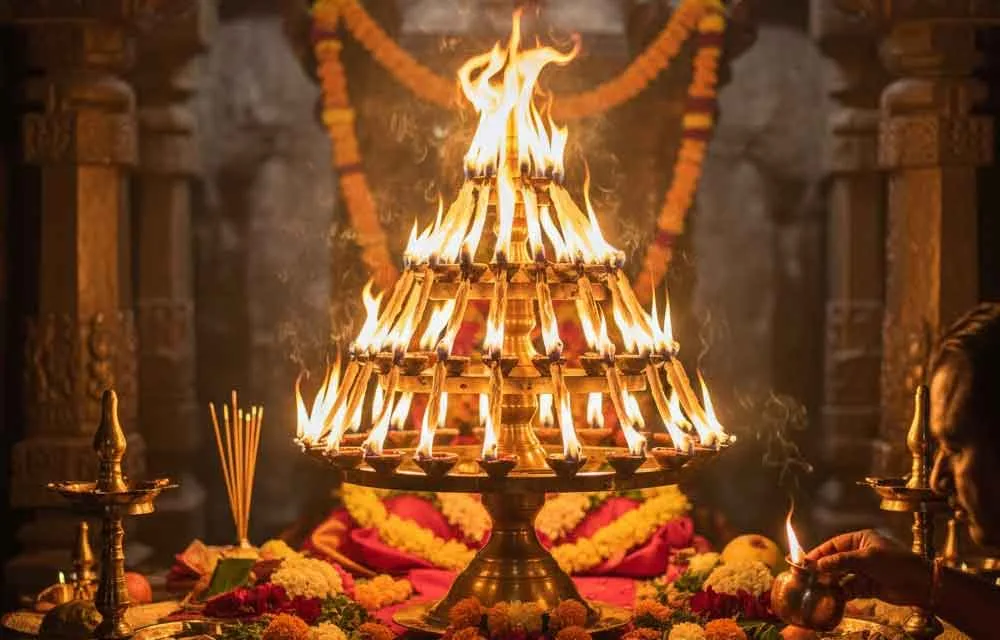
The heart of Damodar month is a small lamp offered every evening. In temples and homes, devotees take turns to wave a ghee lamp before Krishna as Damodara while the Damodarashtakam is sung. The tradition holds that a lamp offered in Kartik is very dear to the Lord, and that even a small offering made with love is valued.
- Use a small clay or brass lamp with a cotton wick and ghee. Sesame oil is a common alternative.
- Offer it after sunset, before a picture of Yashoda and Damodara, or any picture of Krishna.
- Wave the lamp gently in small circles, clockwise, while the song is sung.
- Let children offer a lamp too. Many families invite friends to offer lamps during the month.
- Never leave a lamp burning unattended, especially indoors.
Damodarashtakam: the first verse
The Damodarashtakam is a hymn of eight verses. It is traditionally attributed to the sage Satyavrata Muni and is commonly said to come from the Padma Purana. Here is the first verse, which describes the scene from the story:
नमामीश्वरं सच्चिदानन्दरूपं लसत्कुण्डलं गोकुले भ्राजमानम् । यशोदाभियोलूखलाद्धावमानं परामृष्टमत्यन्ततो द्रुत्य गोप्या ॥
Transliteration: namāmīśvaraṁ sac-cid-ānanda-rūpaṁ lasat-kuṇḍalaṁ gokule bhrājamānam / yaśodā-bhiyolūkhalād dhāvamānaṁ parāmṛṣṭam atyantato drutya gopyā
Meaning: I bow to the Supreme Lord, whose form is eternal, full of knowledge and full of bliss. His earrings swing and shine, and he is radiant in Gokula. Afraid of Mother Yashoda, he has jumped down from the wooden mortar and is running away, but she runs after him very fast and catches him from behind.
For the remaining seven verses, use a printed songbook or your temple's version, and learn the tune from your temple's evening programme.
Vrindavan and Radha Kund in Kartik
Many pilgrims spend the whole of Kartik in the Braj region. In Vrindavan, temples hold kirtan and lamp offerings every evening, and pilgrims walk the parikrama (circuit) around the town. Many also visit Govardhan Hill, especially around Govardhan Puja on Tuesday 10 November 2026.
At Radha Kund, near Govardhan, a holy bath is traditionally taken at midnight on Bahulashtami, the Krishna Ashtami of Kartik. In 2026 this corresponds to the night of Ahoi Ashtami, Sunday 1 November (Drik). The crowds are very large, so follow the local authorities' arrangements and announcements.
The last five days of the month, from Devutthana Ekadashi to Kartika Purnima, are Bhishma Panchak (20 to 24 November 2026). Some devotees keep a stricter fast in these days.
Keeping Damodar month at home abroad
- Set up a small altar: a picture of Krishna, a lamp, a few flowers and, if you have one, a tulsi plant.
- Fix a time: offer the lamp after sunset at the same time each day, for example after dinner with the family.
- Learn one verse at a time: start with the first verse above and add a verse each few days.
- Use your own city's calendar: Ekadashi and Purnima dates abroad can differ by a day from India, so check your temple's calendar or Drik Panchang for your city.
- Join your local temple: many temples outside India hold evening Damodar lamp offerings during Kartik. Check the temple's official website.
- Stay safe: in apartments, use a closed lamp holder or an LED lamp near smoke alarms, and never leave a flame unattended.
Frequently asked questions
When is Damodar month 2026?
In the purnimanta and Gaudiya reckoning, Damodar (Kartik) month 2026 runs approximately from Monday 26 October to Tuesday 24 November 2026. ISKCON and other temple calendars may differ by a day, so follow your temple's calendar.
Why is Kartik called Damodar month?
Damodara means "the one with a rope around his belly". It refers to the childhood pastime in which Mother Yashoda tied the child Krishna to a wooden mortar. In the Vaishnava tradition, Kartik is dedicated to Krishna in this form, so it is called Damodar month.
Who wrote the Damodarashtakam?
The Damodarashtakam is traditionally attributed to the sage Satyavrata Muni. It is commonly said to be found in the Padma Purana. It has eight verses and is sung every evening of Kartik while lamps are offered.
How do I offer a lamp to Damodara at home?
Light a small ghee lamp (or a lamp with sesame oil) in the evening. Hold it before a picture of Krishna, often a picture of Yashoda and the child Krishna. Wave it gently in small circles while singing the Damodarashtakam or chanting Krishna's names. Children and guests can each offer a lamp too.
Is Damodar month the same as Karthika Masam?
Both are the lunar month of Kartik, but the dates differ. North Indian and Gaudiya calendars end the month on the full moon, so it runs about 26 October to 24 November 2026. Telugu, Kannada, Marathi and Gujarati calendars end it on the new moon, so Karthika Masam runs from 10 November to 8 December 2026.
Can I keep Damodar month if I live abroad?
Yes. The main practice, a lamp offered with the Damodarashtakam each evening, needs only a small lamp and a picture of Krishna. Check your local temple's calendar for the start and end dates in your country, because dates abroad can differ by a day.
Editor's note
Editor's note (6 October 2026): This guide has been restored at its original address after the earlier version was lost. The Damodar month dates follow the North Indian purnimanta Kartik (about 26 October to 24 November 2026); ISKCON and other temple calendars may differ by a day, so follow your temple. Festival dates are India dates from Drik Panchang, and Rama Ekadashi is calculated. The story is given as commonly told. We do not list temple timings or event schedules; check official sources.
Related guides
You might also like
Karthigai Month 2026: Tamil Festival Dates, Karthigai Deepam, Somavarams and Ayyappa Mala
Margazhi 2026: Tamil Month Dates (16 December to 14 January), Festivals, Kolam, Tiruppavai and Music Season
December 2026 Hindu Festivals in UK: Local Dates for London, Leicester, Birmingham and Manchester