
Dussehra 2026 Singapore: Area-by-Area Guide, Dates and Vijay Muhurat
Navarathri begins on Sunday 11 October and Vijayadashami falls on Tuesday 20 October 2026 in Singapore. The Vijay Muhurat is 2:50–3:38 PM, but Dashami only begins at 3:20 PM. Here is what that means, plus a guide to the Central, East, North, North-East and West regions.
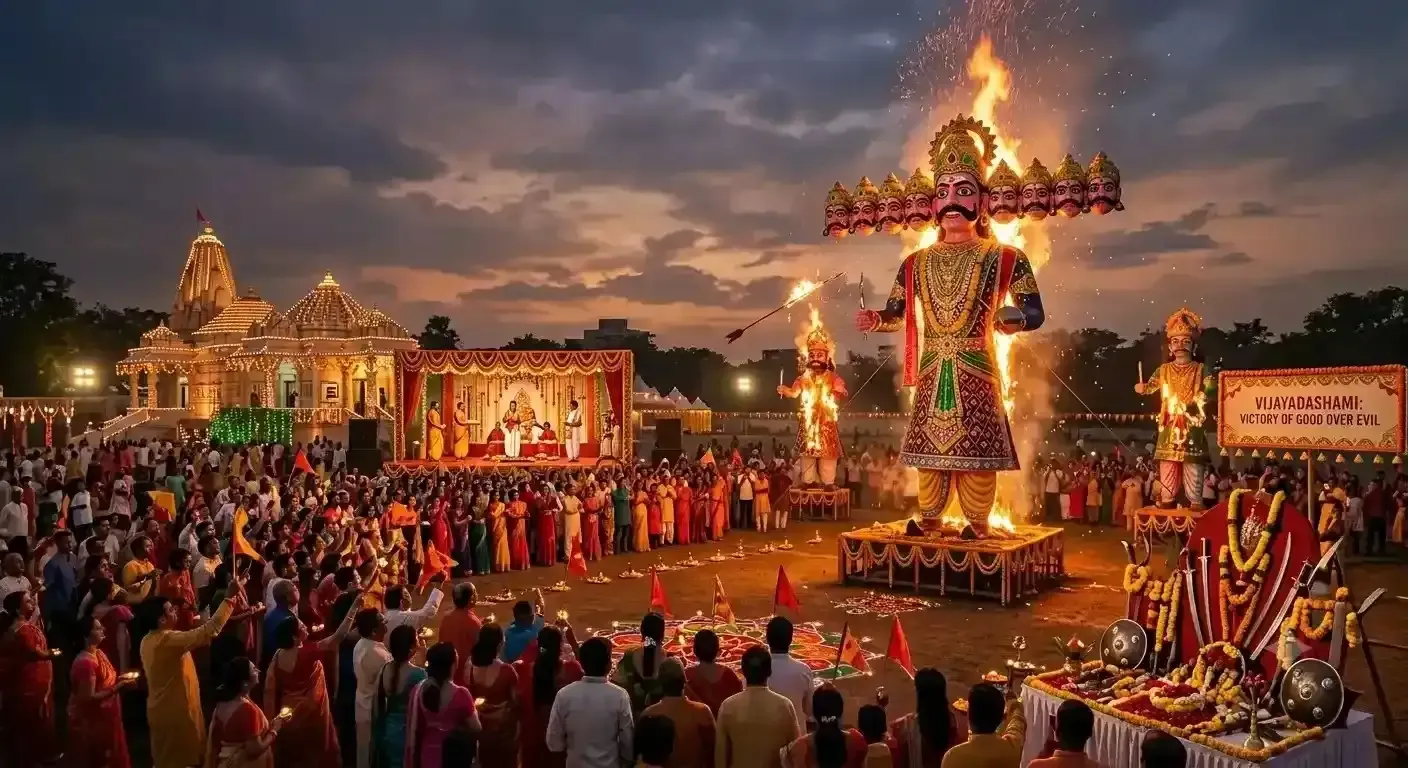
Navarathri begins on Sunday 11 October and Vijayadashami falls on Tuesday 20 October 2026 in Singapore. The Vijay Muhurat is 2:50–3:38 PM, but Dashami only begins at 3:20 PM.
Quick answer: Dussehra (Vijayadashami) 2026 is on Tuesday 20 October in Singapore. Navarathri starts on Sunday 11 October, and Durga Ashtami and Maha Navami both fall on Monday 19 October. The Vijay Muhurat is 2:50–3:38 PM (Drik Panchang), but Dashami begins at 3:20 PM, so only 3:20 PM to 3:38 PM, about 18 minutes, falls inside Dashami. The window is the same across all five regions. Do not use India's window (1:59–2:45 PM IST) converted to Singapore time: it is not the right window here.
Navarathri and Dussehra 2026 dates in Singapore
Singapore follows the same tithi dates as Malaysia this year. Because the Ashtami tithi begins at 8:27am IST on 18 October, it starts after sunrise on the 18th in Singapore, so panchangams list Durga Ashtami on Monday 19 October, the same day as Maha Navami. The dates below follow Drik Panchang for Singapore.
| Day | Date | Notes |
|---|---|---|
| Navarathri begins | Sunday 11 October | Ghatasthapana; Golu displays go up in many homes |
| Durga Ashtami | Monday 19 October | Falls on the same day as Navami in Singapore |
| Maha Navami (Saraswathi and Ayutha Pooja) | Monday 19 October | Books, instruments, tools and vehicles are blessed |
| Vijayadashami (Dussehra) | Tuesday 20 October | Vidyarambham; Vijay Muhurat 2:50–3:38 PM |
| Deepavali | Sunday 8 November | Public holiday |
If your family follows the Telangana calendar, Saddula Bathukamma is on Sunday 18 October. Singapore panchangams keep Ashtami on the 19th; both dates are correct for their own calendars. Our Bathukamma and Dasara 2026 Singapore guide covers the Telangana side in detail.
The 3:20 PM caution: what it means for your puja
Vijay Muhurat is the 11th of the 15 daytime muhurtas, so it is worked out from local sunrise (6:47 AM on 20 October) and sunset (6:52 PM). That gives 2:50–3:38 PM.
Separately, the Dashami tithi begins at 12:50pm IST, which is 3:20 PM in Singapore. The first half-hour of the muhurat window therefore still falls in Navami. Only 3:20 PM to 3:38 PM combines Dashami and the Vijay Muhurat.
- If you want both, plan your Aparajita puja, Shami-leaf exchange, vehicle puja or a child's first lesson for 3:20 PM to 3:38 PM.
- If that is impossible because of work or school, temples generally hold the main Vijayadashami puja in the evening, and that is a perfectly valid way to observe the day.
- If your temple publishes its own muhurat, follow it: priests may use a different method or tradition.
Why not India's time? India's window is 1:59–2:45 PM IST. The muhurat depends on the sun at your location, so a time-zone conversion of the Indian window gives a meaningless figure. Every HinduTone guide makes the same point: use your local window.
Vijay Muhurat at a glance
| Place | Vijay Muhurat | Date | Inside Dashami |
|---|---|---|---|
| Singapore (all regions) | 2:50–3:38 PM | Tue 20 Oct | Dashami begins 3:20 PM, so only 3:20 PM–3:38 PM falls inside Dashami |
| Johor Bahru (for cross-border families) | 2:50–3:39 PM | Tue 20 Oct | Dashami begins 3:20 PM, so only 3:20 PM–3:39 PM falls inside Dashami |
| India (for reference only, IST) | 1:59–2:45 PM | Tue 20 Oct | Not valid in Singapore; do not convert |
Central Region
The Central Region is where most of Singapore's best-known Hindu temples stand, and it is the busiest area during Navarathri.
- Little India (Serangoon Road): the Sri Srinivasa Perumal Temple and the Sri Veeramakaliamman Temple are focal points through the nine nights. The Sri Veeramakaliamman Temple, dedicated to Kali, is a natural place for the Devi-centred worship of Navarathri, while Perumal temples mark Vijayadashami with special alankaram.
- Chinatown: the Sri Mariamman Temple on South Bridge Road holds Navarathri pujas for the goddess; it is also a heritage site, so dress modestly and expect visitors.
- Tank Road: the Sri Thendayuthapani Temple is known for its Navarathri cultural programmes, with music and dance on successive evenings. Check the temple's own announcements for the 2026 line-up.
- Getting around: Little India and Chinatown MRT stations serve the main temples. Evening crowds on Navami (Monday 19 October) and Vijayadashami (Tuesday 20 October) can be heavy, so allow extra time after work.
East Region
Bedok, Tampines, Pasir Ris, Katong and Geylang have long-standing temples and many Tamil, Telugu and Malayalee households.
- Katong: the Sri Senpaga Vinayagar Temple on Ceylon Road holds Navarathri pujas; Vinayagar temples typically begin each evening's worship with Ganapati before the Devi rituals.
- Geylang East: the Sri Sivan Temple marks the festival with nightly pujas for Parvati in her forms as Durga, Lakshmi and Saraswathi.
- Tip: East-side families working in the CBD can reach the 3:20 PM to 3:38 PM window more easily from a city temple than by travelling home first.
North Region
Woodlands, Sembawang, Yishun and Admiralty have a large Indian population, including many recent arrivals from Telangana, Andhra Pradesh and Tamil Nadu.
- Woodlands and Marsiling: the Sri Siva-Krishna Temple serves the area and typically holds evening Navarathri pujas. Neighbourhood temples nearby publish their schedules in early October.
- Sembawang: the Telangana Cultural Society Singapore (TCSS) has held Bathukamma in the north in past years; its 2026 date has not yet been announced.
- Cross-border families: if you travel to Johor Bahru, the window there is 2:50–3:39 PM, almost the same as Singapore's.
North-East Region
Serangoon, Hougang, Sengkang and Punggol are home to many young Indian families in HDB estates and condominiums. Celebrations here are often home- and community-based.
- Golu: Golu displays in flats are a strong tradition in Tamil households; many families invite neighbours on weekend evenings, which this year means Saturday 17 and Sunday 18 October fall in the middle of the festival.
- Garba and dandiya: Gujarati and North Indian associations often hire community halls or school halls for garba nights during Navarathri. Watch your association's channels for 2026 dates.
- Temples: check your nearest neighbourhood temple for the Vijayadashami timing, or travel to the Little India temples, which are a short MRT ride away on the North East Line.
West Region
Jurong, Clementi, Bukit Batok, Choa Chu Kang and the areas near the universities and business parks have a large professional Indian community.
- Bukit Batok: the Sri Murugan Hill Temple serves families in the West and holds festival pujas through the year; check its notices for Navarathri timings.
- Students and young professionals: university Indian cultural societies sometimes hold garba or Durga Puja evenings; ask your society or hall.
- Home observance: a simple Saraswathi Pooja on Monday 19 October, placing books and laptops before the goddess, and taking them back on Vijayadashami, is easy to do in a flat.
How Singapore Hindus mark the nine nights
- Golu: stepped displays of dolls, set up by Sunday 11 October and kept until Vijayadashami.
- Devi worship in three parts: traditionally the first three nights for Durga, the next three for Lakshmi and the last three for Saraswathi.
- Saraswathi and Ayutha Pooja (Monday 19 October): books, instruments, tools, computers and vehicles are blessed. Shops and small businesses often hold a short Ayutha Pooja.
- Vidyarambham (Tuesday 20 October): children write their first letters in rice or sand, usually at a temple in the morning. Ask in advance if registration is needed.
- Durga Puja and garba: Bengali and Gujarati associations typically hold their own programmes; check directly with them for 2026.
Temple etiquette during Navarathri
Singapore temples are busy, multi-community spaces during the festival, and a little preparation makes visits smoother for everyone.
- Dress modestly: shoulders and knees covered. Remove footwear at the entrance; most temples have racks outside.
- Bring a small offering if you wish (flowers, fruit, a coconut or a garland). Flower stalls around Little India are busiest on Navami and Vijayadashami evenings.
- For archanai or a special puja on your family's behalf, buy the ticket at the temple counter; prices and timings are set by each temple.
- Photography rules differ between temples, and many do not allow photos of the main shrine. Ask before taking pictures.
- If you are bringing young children for Vidyarambham, arrive early: morning sessions can be crowded and are often first-come, first-served unless the temple asks you to register.
- Expect road closures or heavy foot traffic near the larger temples on festival evenings, and use the MRT where possible.
Events in Singapore for 2026
We have not yet confirmed any specific Singapore Dussehra event for 2026. Rather than list unverified programmes, we suggest:
- Check the website, Facebook page or notice board of your nearest temple for its Navarathri and Vijayadashami schedule.
- Follow your language or regional association (Tamil, Telugu, Malayalee, Gujarati, Bengali, Punjabi) for cultural nights and garba.
- For Bathukamma, watch for the TCSS 2026 announcement, and see our Singapore Bathukamma guide.
- Plan around a working Monday and Tuesday: the big evenings this year are 19 and 20 October.
A practical plan for a working Tuesday
- Monday 19 October: Saraswathi and Ayutha Pooja at home or at the office; place books and tools for blessing.
- Tuesday 20 October, morning: short prayer at home; Vidyarambham at the temple if your child is starting school.
- Tuesday 20 October, 3:20 PM to 3:38 PM: a lamp, a few minutes of prayer or the Shami-leaf exchange, if you can step out.
- Tuesday 20 October, evening: temple visit for the Vijayadashami puja; take back the books from the Saraswathi Pooja.
- Then look ahead to Deepavali on Sunday 8 November.
Frequently asked questions
When is Dussehra 2026 in Singapore?
Vijayadashami (Dussehra) falls on Tuesday 20 October 2026 in Singapore. Navarathri begins on Sunday 11 October, and Durga Ashtami and Maha Navami (Saraswathi and Ayutha Pooja) both fall on Monday 19 October.
What is the Vijay Muhurat in Singapore on 20 October 2026?
The Vijay Muhurat is 2:50–3:38 PM Singapore time, matching Drik Panchang. Dashami tithi begins at 3:20 PM, so only 3:20 PM to 3:38 PM falls inside Dashami. That is the part to aim for if you want the muhurat and the tithi together.
Does the Vijay Muhurat change between the East and West of Singapore?
Not meaningfully. Singapore is small enough that sunrise and sunset differ by well under a minute across the island, so the same window, 2:50–3:38 PM, applies in Jurong, Tampines, Woodlands, Punggol and the city centre.
Can I use India's Vijay Muhurat in Singapore?
No. India's window is 1:59–2:45 PM IST, calculated for Indian sunrise and sunset. Converting it to Singapore time does not give a valid window. Use 2:50–3:38 PM, and the part after 3:20 PM, or the time your temple announces.
Is Dussehra a public holiday in Singapore?
No. Vijayadashami is a working day in Singapore. Deepavali, on Sunday 8 November 2026, is the Hindu festival with a public holiday.
Editor's note
Editor's note (4 October 2026): dates follow Drik Panchang for Singapore and the Vijay Muhurat (2:50–3:38 PM) matches Drik's published window. Temple schedules and community programmes for 2026 are still coming in, and organisers are still publishing 2026 flyers; we will update this guide.
Related guides
- Dussehra / Vijayadashami 2026: the complete guide
- Bathukamma and Dasara 2026 Singapore
- Dussehra 2026 Malaysia, state by state
- Dussehra 2026 Australia, city by city
- Navarathri 2026 Tamil Nadu, district wise
- Navratri 2026: the NRI and diaspora guide
- Diwali 2026 in Australia, UAE and Singapore
- October 2026 Hindu festival calendar
You might also like
Dussehra 2026 Malaysia: State-by-State Dates and Vijay Muhurat
Dussehra 2026 Europe: Country-by-Country Dates, Vijay Muhurat and Events
Bathukamma and Dasara 2026 in Singapore: Dates, Vijay Muhurat and Where to Celebrate