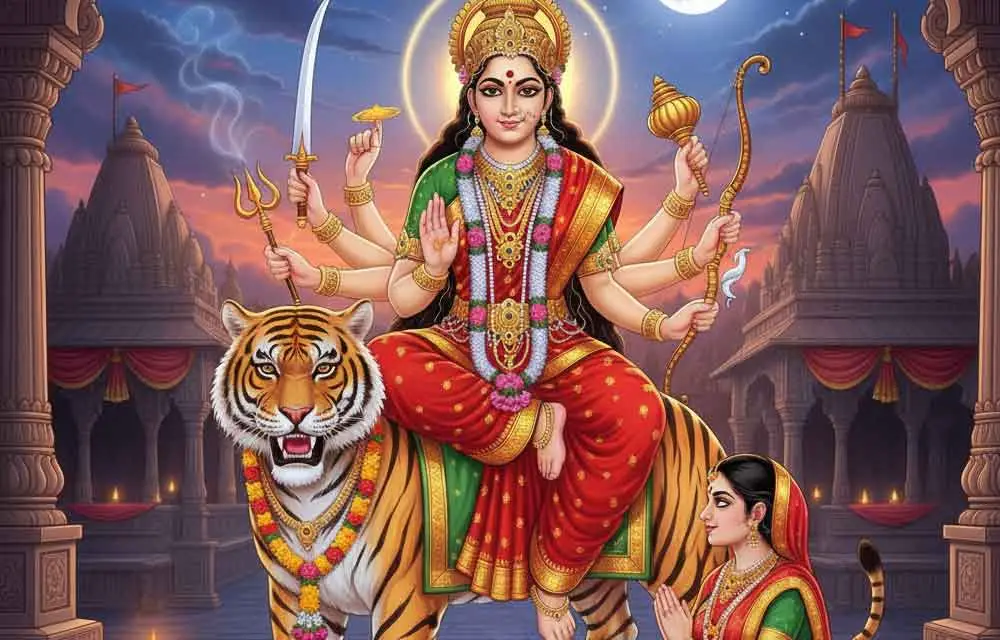
Navratri 2026 Day 9: Maa Siddhidatri Mantra, Colour, Bhog and Puja Vidhi (Monday 19 October, Ashtami and Navami)
Navratri Day 9 is Monday 19 October 2026. In India, Durga Ashtami and Maha Navami both fall that day (Ashtami until about 10:52 AM IST, then Navami), so Maa Mahagauri and Maa Siddhidatri are often worshipped together, usually with Kanya Pujan. Here are Siddhidatri's story as commonly told, her mantras with meaning, colour, bhog and a simple home puja.
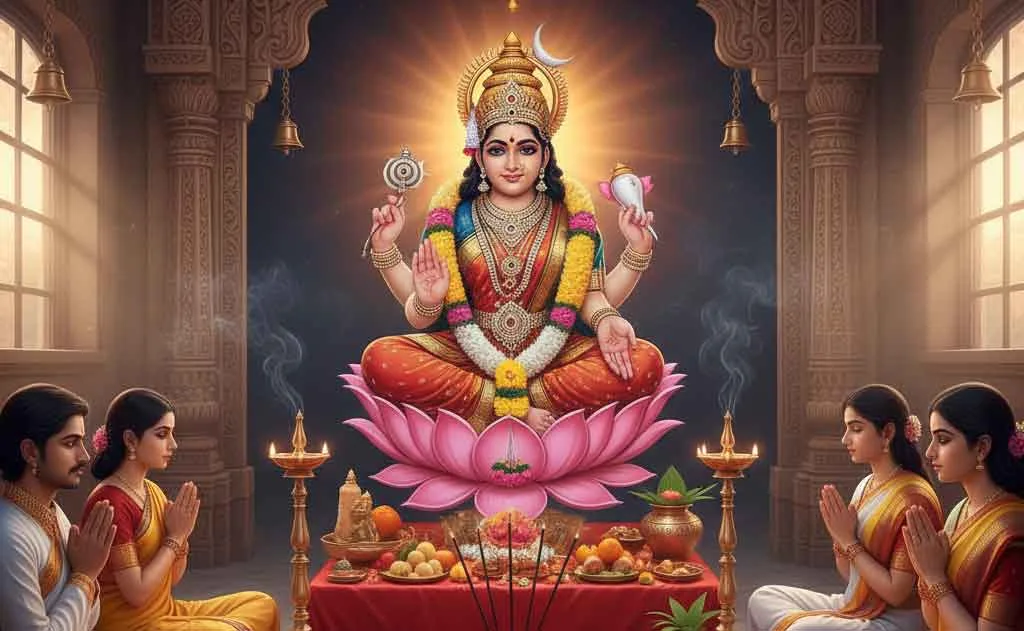
Navratri Day 9 is Monday 19 October 2026. In India, Durga Ashtami and Maha Navami both fall that day (Ashtami until about 10:52 AM IST, then Navami), so Maa Mahagauri and Maa Siddhidatri are often worshipped together, usually with Kanya Pujan.
Quick answer: Navratri Day 9 2026 is Monday 19 October 2026, dedicated to Maa Siddhidatri. In India, Durga Ashtami and Maha Navami both fall on this day (Ashtami until about 10:52 AM IST, then Navami), so many families worship Maa Mahagauri and Maa Siddhidatri together and do Kanya Pujan the same day. The colour is purple, pink or peacock green (lists differ), the customary bhog is sesame (til) or halwa-puri-chana, and her naam mantra is "Om Devi Siddhidatryai Namah". Vijayadashami follows on Tuesday 20 October.
Siddhidatri is the Mother who completes the journey. Nine nights ago the festival began with Shailaputri, the daughter of the mountain; it closes with Siddhidatri, the giver of fulfilment, seated on a lotus and worshipped, as the tradition says, by gods, sages and all beings alike.
Navratri Day 9 2026 at a glance
| Detail | Day 9 |
|---|---|
| Date (India) | Monday 19 October 2026 |
| Tithi note | Durga Ashtami and Maha Navami both on 19 October (Drik); Ashtami until about 10:52 AM IST, then Navami |
| Goddess | Maa Siddhidatri (ninth Navadurga); Maa Mahagauri often honoured the same day |
| Colour (popular custom) | Purple, pink or peacock green (lists differ) |
| Bhog (common) | Sesame (til) or halwa-puri-chana |
| Naam mantra | Om Devi Siddhidatryai Namah |
| Next day | Vijayadashami / Dussehra, Tuesday 20 October 2026 |
Colours and bhog follow popular custom and lists vary. See the Navratri 2026 colours list.
Ashtami and Navami on one day: what it means for your puja
In 2026 the Saptami tithi spans two sunrises in India (17 and 18 October). Ashtami begins later on 18 October and is the tithi at sunrise on Monday 19 October, but it ends at about 10:52 AM IST that morning, when Navami begins. Navami does not reach the following sunrise, so Drik Panchang lists both Durga Ashtami and Maha Navami on Monday 19 October.
In practice this means:
- Mahagauri and Siddhidatri together: families who follow the tithi honour Mahagauri with the Ashtami puja in the morning and Siddhidatri with the Navami puja later in the day. Families who counted one form per night will already have worshipped Mahagauri on Sunday 18 October.
- Kanya Pujan: usually done on 19 October this year. Those who keep it on Ashtami often finish it in the morning; those who keep it on Navami do it later. See our Kanya Pujan 2026 date and vidhi.
- Sandhi Puja: the special puja at the junction of Ashtami and Navami falls on the morning of 19 October in India. The exact window depends on your city, so check Drik Panchang or your temple.
- Ayudha Puja: in South India, Ayudha Puja is also kept on Monday 19 October. See Ayudha Puja 2026.
- Bengal: Drik's Durga Puja calendar for Kolkata keeps Maha Ashtami, Kumari Puja and Sandhi Puja on 19 October and Maha Navami on Tuesday 20 October, with Bijoya Dashami on Wednesday 21 October. See the Durga Puja 2026 dates.
Abroad the dates differ: in the USA, Canada and the UK, Drik Panchang lists Durga Ashtami on Sunday 18 October and Maha Navami on Monday 19 October, so overseas families usually keep the two on separate days. Follow your local temple's calendar.
Who is Maa Siddhidatri? Form and iconography
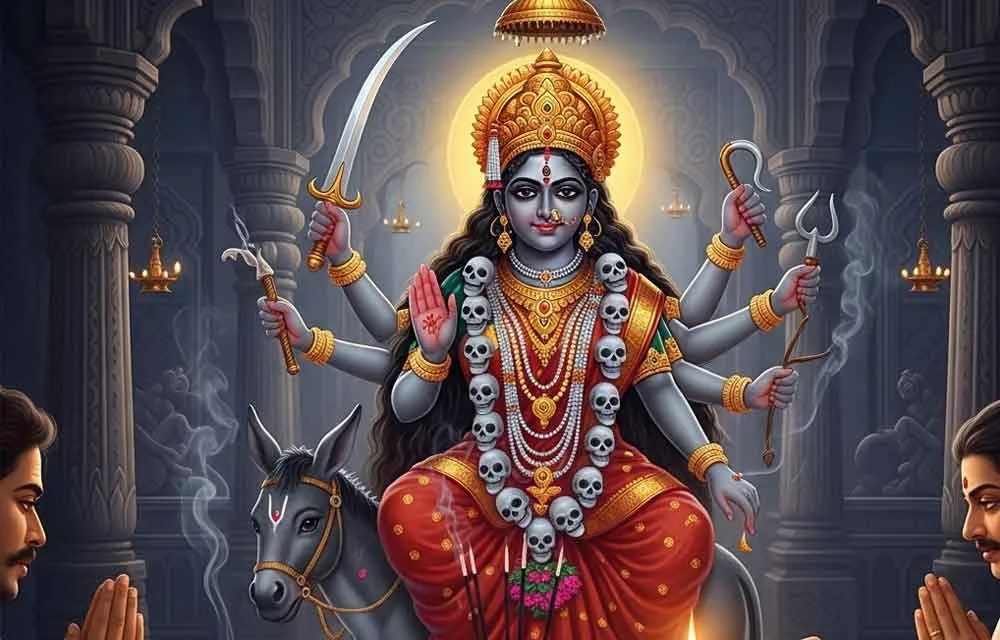
Siddhidatri is usually shown seated on a fully open lotus, sometimes riding a lion. She has four hands, commonly holding a discus (chakra), a conch (shankha), a mace (gada) and a lotus. Her face is calm and gracious, and she is often pictured surrounded by devotees: gods, sages, siddhas, gandharvas and even asuras, all worshipping her.
Her name means "the giver of siddhis", the spiritual perfections or accomplishments. Tradition lists eight great siddhis, such as anima (becoming subtle) and mahima (becoming vast), but devotees understand her highest gift as inner completeness.
The story of Maa Siddhidatri, as commonly told
As commonly told, at the beginning of creation Lord Shiva worshipped the Adi Shakti, the primordial Mother, and through her grace received all the siddhis. It is said that half of his body then became hers, and he came to be worshipped as Ardhanarishvara, the Lord who is half woman. This form of the Mother, who bestowed perfection even on Shiva, is revered as Siddhidatri.
Regional and Puranic versions differ in detail, but the message is the same: every power and every fulfilment flows from the Mother, and she gives most freely to a humble heart.
Spiritual significance of Day 9
As traditionally described, Siddhidatri represents completion and fulfilment. In some yoga-oriented Navratri teachings she is associated with the highest state beyond the crown, sometimes called the Nirvana chakra, though teachers map these differently. Devotees believe her worship brings the nine days of discipline to a peaceful close. Many families use Day 9 to give thanks: for health, for family, and for the chance to have kept Navratri at all.
Maa Siddhidatri mantras for Navratri Day 9
Texts are given exactly as traditionally recited, with plain-English meanings. The naam mantra alone, chanted with love, is a full offering. See also Navratri day-wise mantras and their significance.
Naam mantra of Maa Siddhidatri
ॐ देवी सिद्धिदात्र्यै नमः॥
Om Devi Siddhidatryai Namah
Meaning: Om, salutations to Devi Siddhidatri.
How to chant: after lighting the lamp, 108 times on a mala, or 11 or 21 times if time is short.
Dhyana shloka (meditation verse)
सिद्धगन्धर्वयक्षाद्यैरसुरैरमरैरपि। सेव्यमाना सदा भूयात् सिद्धिदा सिद्धिदायिनी॥
Siddha-gandharva-yakshadyair asurair amarair api, sevyamana sada bhuyat siddhida siddhidayini.
Meaning: May she who is ever served by siddhas, gandharvas, yakshas and others, by asuras and by the gods too, Siddhidatri, the giver of perfection, be ever gracious.
How to chant: once or three times before japa, picturing her on the lotus.
Stuti: Ya Devi Sarvabhuteshu Maa Siddhidatri
या देवी सर्वभूतेषु माँ सिद्धिदात्री रूपेण संस्थिता। नमस्तस्यै नमस्तस्यै नमस्तस्यै नमो नमः॥
Ya Devi sarvabhuteshu Maa Siddhidatri rupena samsthita, namastasyai namastasyai namastasyai namo namah.
Meaning: To the Goddess who abides in all beings in the form of Mother Siddhidatri: salutations to her, again and again.
How to chant: 3, 11 or 21 times before the aarti.
Navarna mantra
ॐ ऐं ह्रीं क्लीं चामुण्डायै विच्चे॥
Om Aim Hreem Kleem Chamundayai Vichche
Meaning: the nine-syllable mantra of the Devi from the Chandi (Durga Saptashati) tradition, saluting Chamunda; Aim, Hreem and Kleem are traditionally linked with Mahasaraswati, Mahalakshmi and Mahakali. Navami, the ninth day, is a natural day to complete a nine-day japa of it.
How to chant: 108 times; some traditions prefer it be learned from a guru.
Om Dum Durgayai Namah
ॐ दुं दुर्गायै नमः॥
Om Dum Durgayai Namah
Meaning: Om, with Durga's seed syllable Dum, salutations to Goddess Durga.
How to chant: 108 times, or let the children lead it.
Sarva Mangala Mangalye
सर्वमङ्गलमाङ्गल्ये शिवे सर्वार्थसाधिके। शरण्ये त्र्यम्बके गौरि नारायणि नमोऽस्तु ते॥
Sarva-mangala-mangalye shive sarvartha-sadhike, sharanye tryambake gauri narayani namostu te.
Meaning: O auspiciousness of all that is auspicious, O gracious one who fulfils every good aim, O refuge, three-eyed Gauri, O Narayani, salutations to you. (Narayani Stuti, Devi Mahatmya.)
How to chant: three times to close the puja.
Ya Devi Sarvabhuteshu Shakti-rupena
या देवी सर्वभूतेषु शक्तिरूपेण संस्थिता। नमस्तस्यै नमस्तस्यै नमस्तस्यै नमो नमः॥
Ya Devi sarvabhuteshu shakti-rupena samsthita, namastasyai namastasyai namastasyai namo namah.
Meaning: To the Goddess who abides in all beings as power: salutations to her again and again. (Aparajita Stuti, Devi Mahatmya.)
How to chant: 3 or 11 times.
Simple home puja vidhi for Day 9 (apartment-friendly)
- Morning (Ashtami, if you keep it): bathe early, light the lamp, recite Mahagauri's naam mantra and offer coconut. If you do Kanya Pujan on Ashtami, this is the time.
- Sankalpa: with water in your right palm, say your name and that you are worshipping Maa Siddhidatri on Maha Navami, and release the water.
- Invocation: recite Siddhidatri's dhyana shloka and offer kumkum, turmeric, sandal paste and akshata.
- Flowers: by popular custom, lotus if you can find one, or any fresh red or white flowers.
- Japa: her naam mantra 108 times, the stuti, and the Devi mantras above.
- Bhog: sesame (til) sweets, or halwa, puri and black chana. Offer with water, then share as prasad.
- Kanya Pujan (if Navami is your custom): wash the girls' feet, apply kumkum, offer the meal and a small gift, and touch their feet.
- Aarti and close: sing the Durga or Ambe aarti your family knows, close with Sarva Mangala Mangalye, and ask forgiveness for any mistakes in nine days of worship.
- Kalash and sprouts: many families keep the kalash until Vijayadashami and immerse the sprouts or place them in a plant pot the next day. Follow your family custom.
More detail: Navratri 2026 apartment-friendly puja vidhi and our evergreen Maa Siddhidatri puja rituals guide.
Fasting on Day 9: what to do and avoid
- Phalahar foods such as fruit, milk, curd, nuts, sabudana, kuttu and singhara flour remain the norm for those still fasting.
- Many families break the Navratri fast after Navami puja and Kanya Pujan with the halwa-puri-chana prasad; others continue until Vijayadashami. Follow your tradition.
- Commonly avoided: grains (until the fast is broken), onion, garlic, meat, eggs and alcohol.
- After nine days, break the fast gently with light food. Anyone with a health condition should take medical advice about fasting.
Ideas: Navratri prasadam recipes.
A short prayer for Day 9
"Maa Siddhidatri, giver of all fulfilment, I bow to you at the close of these nine nights. Thank you for every blessing, seen and unseen. Forgive what I did wrongly and accept what I offered with love. Make this home complete with your presence. Jai Maa Siddhidatri."
NRI tips for Navratri Day 9
Monday 19 October is a working day in most countries. If you follow India's calendar, a short morning puja and Kanya Pujan in the evening with friends' daughters is a practical plan. If your temple follows the overseas calendar described above, Monday is simply Navami. Either way, plan your Vijayadashami rites for Tuesday 20 October.
More in our Navratri 2026 NRI guide.
Previous and next
- Previous: Navratri 2026 Day 8: Maa Mahagauri
- Next: Vijayadashami 2026 mantras, Aparajita and Shami puja vidhi
Frequently asked questions
When is Navratri Day 9 2026?
Navratri Day 9 is Monday 19 October 2026 in India. It is the last day of Sharad Navratri, dedicated to Maa Siddhidatri, and Dussehra (Vijayadashami) follows on Tuesday 20 October.
Are Durga Ashtami and Maha Navami on the same day in 2026?
Yes, in India. Drik Panchang lists both Durga Ashtami and Maha Navami on Monday 19 October 2026. The Ashtami tithi runs until about 10:52 AM IST that morning, after which Navami begins, so both are observed on the same day.
When should I do Kanya Pujan in 2026?
In India most families will do Kanya Pujan on Monday 19 October 2026, since both Ashtami and Navami fall that day. Those who prefer the Ashtami tithi often do it in the morning before about 10:52 AM IST; others do it later as Navami puja. Follow your family custom.
What is the mantra of Maa Siddhidatri?
Her naam mantra is "Om Devi Siddhidatryai Namah" (ॐ देवी सिद्धिदात्र्यै नमः॥). Devotees also recite her dhyana shloka "Siddha-gandharva-yakshadyair" and the stuti "Ya Devi sarvabhuteshu Maa Siddhidatri rupena samsthita".
What bhog is offered on Navratri Day 9?
Sesame (til) is a common offering for Maa Siddhidatri, and many North Indian families prepare halwa, puri and black chana, which is also the classic Kanya Pujan meal. Bhog lists vary by tradition.
What is the colour of Navratri Day 9 2026?
Lists differ for Days 8 and 9 this year: purple, pink or peacock green are all commonly given. Follow the one your family or community uses.
Editor's note
Editor's note (6 October 2026): This guide has been restored at its original address. India dates, including Durga Ashtami and Maha Navami on 19 October, are from Drik Panchang; the approximate Ashtami end time is from our panchang calculator for New Delhi. The mantras are traditional texts as commonly recited, given without additions. Customs vary; please follow your family priest or temple.
Related guides
You might also like
Navratri 2026 Day 2: Maa Brahmacharini Mantra, Colour, Bhog and Puja Vidhi (Monday 12 October)
Navratri 2026 Day 8: Maa Mahagauri Mantra, Colour, Bhog and Puja Vidhi (Sunday 18 October)
Navratri 2026 Day 7: Maa Kalaratri Mantra, Colour, Bhog and Puja Vidhi (Saturday 17 October)