Garba Meaning and Spiritual Significance: Why We Dance Garba in Navratri
Garba is far more than a festive dance. Its name is traditionally linked to Garbha, the womb, and to the Garbo, the clay pot with a lamp burning inside. This guide explains the meaning and spiritual significance of Garba, why it is danced on the nights of Navratri in honour of Amba, the symbolism of the circle, and how families abroad keep the devotional heart of Garba alive in 2026.
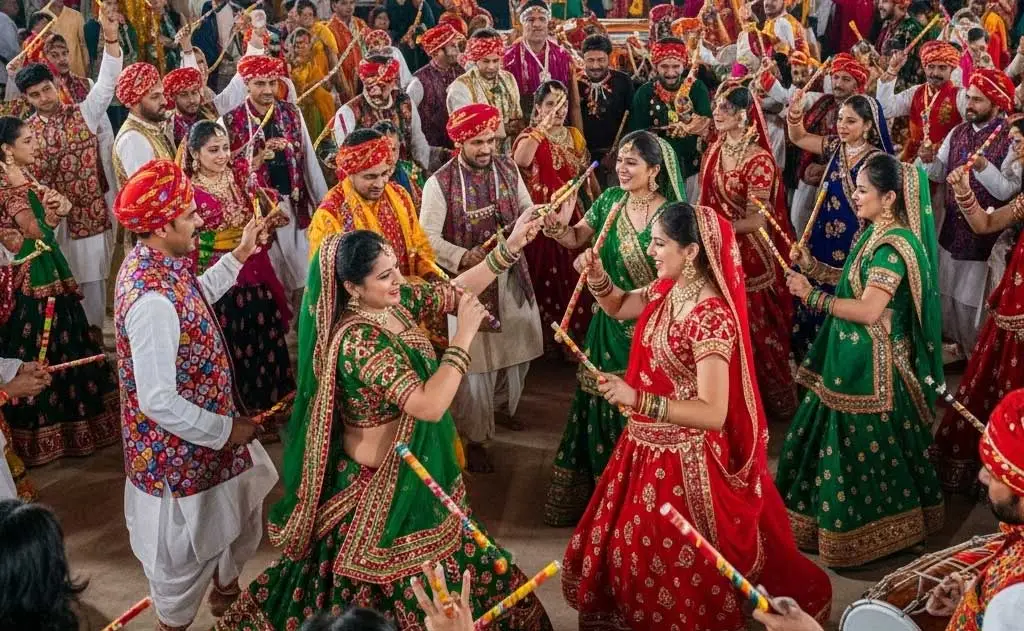
Garba is far more than a festive dance. Its name is traditionally linked to Garbha, the womb, and to the Garbo, the clay pot with a lamp burning inside.
Quick answer: Garba is the devotional circle dance of Gujarat performed on the nights of Navratri in honour of the Divine Mother, worshipped as Amba, Durga and Shakti. The name is traditionally linked to Garbha, the womb, and to the Garbo, a clay pot with a lamp burning inside that stands for life and for the Devi present within every being. Dancers circle the Devi's image or the lamp, clapping and singing her praises. In 2026, Navratri runs from Sunday 11 to Monday 19 October in India, with Dussehra on Tuesday 20 October.
For many people outside Gujarat, Garba first appears as a riot of colour: swirling chaniya cholis, a packed hall, a singer and a dhol driving the rhythm faster and faster. All of that is real. But beneath the music lies something older and quieter, a circle of devotees moving around a single flame in honour of the Mother. This guide explains what Garba means, where its symbols come from and how families, in India and abroad, keep its devotional core alive. For the festival as a whole, see our Navratri 2026 NRI guide.
What does Garba mean?
The word Garba is traditionally derived from the Sanskrit Garbha, meaning womb. The connection runs through the dance's central object, the Garbo (also called Garbi or Garba deep): an earthen pot pierced with small holes, with a lamp burning inside it. The pot is the womb; the flame inside is life, the soul, and, as devotees understand it, the Devi herself dwelling within.
Linguists and folklorists discuss the exact history of the word, and Gujarati usage is rich: Garbo can mean the lamp pot, the dance or a devotional song, and Garbi can refer to a song form or a men's style of the dance in some regions. What is consistent across these meanings is the link between the dance, the lamp and the Mother.
| Term | What it refers to | Spiritual association (as traditionally understood) |
|---|---|---|
| Garbha | Sanskrit for womb | Creation, life, the Mother as source of all beings |
| Garbo / Garbi / Garba deep | Clay pot with holes and a lamp inside | The body as a vessel; the Divine light within |
| Garba (dance) | Circular dance around the Devi or the Garbo | Worship in movement; devotees revolving around the Divine |
| Mataji / Amba | The Goddess honoured at Garba | Shakti, the power behind creation, protection and renewal |
| Aarti | Waving of lamps with song | Formal worship that opens and often closes the night |
The Garbo: a lamp inside a clay pot
In many Gujarati homes, the Garbo is set up at the start of Navratri, often alongside the ritual installation of the Devi, and the lamp inside is kept burning through the nine nights. On the first evening, women have traditionally carried the lit Garbo on their heads through the neighbourhood, or placed it at the centre of the courtyard where the dance would begin.
The image is simple and powerful. Light streams out through dozens of tiny holes into the dark. As traditionally explained, the pot is the human body, perishable and made of earth, and the flame is the divine spark that gives it life. Dancing around the Garbo is a way of honouring that spark: the Mother who gives life to every being, and who is present in every dancer in the circle.
Today the centre of a Garba circle may hold a framed image or murti of Amba, a decorated Garbo, a small shrine with several lamps, or all of these. In a large hall abroad it may be a temporary altar at the front of the room. The meaning is the same: the Devi is at the centre.
Why Garba is danced during Navratri
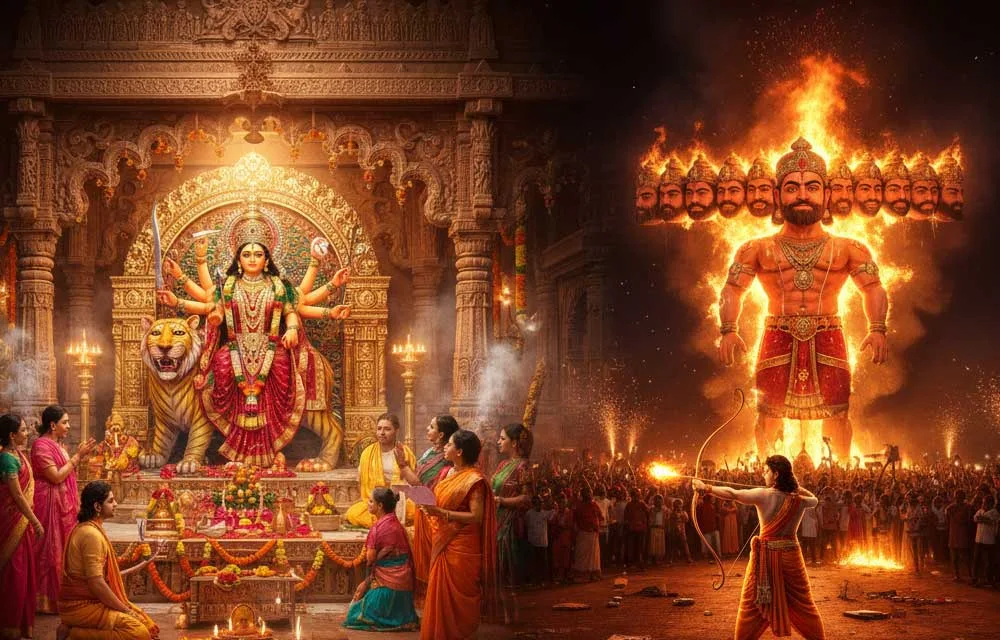
Navratri, the nine nights of the bright fortnight of Ashwin, is the season of the Divine Mother. Across India she is worshipped in many forms: as Durga, slayer of the buffalo-demon Mahishasura; as the nine forms of Navadurga, one for each day; as Amba, the beloved Mother of Gujarat's great shrine at Ambaji. For the story behind the festival, see our explainer on Durga vs Mahishasura and Rama vs Ravana.
In Gujarat, the night-time devotion of Navratri takes the form of Garba. As traditionally told, the Goddess is invited into the home or village on the first day, honoured each night with lamps, songs and dance, and bid farewell after the nine nights. Garba songs praise her beauty and strength, recount her victories, and speak to her with the intimacy of a child calling its mother. Dancing for her is not a performance for an audience; she is the audience.
Because the festival follows the lunar calendar, the dates move each year. In 2026, Sharad Navratri runs from Sunday 11 October to Monday 19 October in India (Ashtami and Navami both fall on 19 October), with Dussehra on Tuesday 20 October. Our Navratri 2026 colours list shows the colour of each day if you like to dress to match.
The circle, the clap and the centre: symbolic readings
Teachers, priests and writers have offered many readings of Garba's form. These are interpretations rather than fixed doctrine, and families explain them in their own ways, but several recur often:
- The circle as the cycle of time. Dancers keep moving around the centre, never reaching an end, much as life moves through birth, growth, death and renewal. The Divine at the centre does not change.
- The Mother at the centre. Every dancer is at an equal distance from the Devi. However different their lives, all revolve around the same source.
- The clap as attention. The rhythmic clap gathers the mind, keeps the circle together and, for many dancers, works like a chant performed with the hands.
- The lamp as the self. The flame inside the Garbo reminds dancers that the Divine light is within them, not only on the altar.
Whatever reading you prefer, one practical rule follows from all of them: the centre is sacred. Dancers do not cut across it, do not leave bags or drinks near the image, and keep the area around the lamp clear.
Garba as worship, not just a party
Modern Garba has grown enormously, with amplified music, professional singers and large venues. Joy is part of the tradition; the Goddess is honoured with celebration. But many families take care to keep the devotional core:
- Aarti first. Traditional Garba opens with aarti to Mataji. Everyone stops, faces the Devi, and joins in or stands quietly. Many evenings close with aarti too.
- Songs to the Mother. Traditional Garba songs praise Amba and her forms. Even when film songs are played later, many circles begin with devotional Garbas.
- Purity and restraint. Many venues are alcohol-free, and many dancers keep a Navratri fast or eat simple food during the nine days.
- Respect for the image. Dancers often bow to Mataji on entering the circle and before leaving.
Seen this way, a Garba night is a form of collective puja: hundreds of people offering their energy, voice and movement to the Mother at once.
How families abroad keep the devotional core
Outside India, Garba usually happens wherever there is space: community halls, school gyms, temple halls, hired banquet rooms and, in warmer places, open grounds. Many Garba nights abroad fall on weekends, which in 2026 means many communities will gather on the weekends of 10-11 and 16-18 October; check your local temple or association for its own schedule. Our city-by-city guides for the USA, the UK and Canada cover dates and local timings.
Families and organisers abroad often keep the spirit of Garba in simple ways:
- Placing Mataji's image or a lit Garbo at the centre of the hall, even in a school gym, so the circle has a true centre.
- Beginning with aarti before the music starts, and asking everyone to put phones away during it.
- Setting up a Garbo at home for the nine nights and doing a short aarti before leaving for the hall.
- Explaining the meaning to children before their first Garba, so they know why they are dancing; our parents' guide to explaining Navratri and Dussehra to children is a good starting point.
- Welcoming friends who are new to Garba, including non-Gujarati and non-Hindu friends, and showing them the basic step and the etiquette around the centre.
If you are a first-timer abroad, the most important thing is not the steps. It is to arrive in time for the aarti, stand respectfully, and then join the circle with a willing heart. Our sibling guides on the history of Garba from Gujarat to the world and Garba vs Dandiya Raas will help you understand what you are seeing.
Garba in Gujarat today
In Gujarat itself, Garba ranges from small neighbourhood and society circles around a Garbo to large organised grounds. Village and family Garba, with songs sung live around the lamp, remain the root of the tradition. In December 2023, the Garba of Gujarat was inscribed on UNESCO's Representative List of the Intangible Cultural Heritage of Humanity, recognising it as a living tradition. For practical details of Garba in Gujarat this year, see our Navratri 2026 Gujarat Garba guide and Dussehra 2026 in Gujarat.
Also read: Garba 2026 events in Europe.
Also read: Garba 2026 worldwide: all countries.
Frequently asked questions
What is the meaning of the word Garba?
The word Garba is traditionally linked to the Sanskrit word Garbha, meaning womb. It is also connected to the Garbo or Garbi, a clay pot with small holes and a lamp burning inside, around which the dance is performed. As traditionally understood, the lamp in the pot stands for life within the womb and for the Devi's presence in every being.
Why is Garba danced during Navratri?
Navratri is the nine-night festival of the Divine Mother, worshipped in Gujarat as Amba, Durga and other forms of Shakti. Garba is danced on these nights as an offering to her: devotees circle her image or the lit Garbo, singing songs in her praise and clapping in rhythm. In 2026, Sharad Navratri runs from Sunday 11 to Monday 19 October in India, with Dussehra on Tuesday 20 October.
What is the significance of the circle in Garba?
Dancers move in a circle around the Devi or the lamp at the centre. A common interpretation is that the circle represents the cycle of time, of birth, life and death, while the Divine at the centre is unchanging. These are symbolic readings rather than fixed doctrine, but they help explain why the centre is treated with such respect.
What is the Garbo or Garba deep?
The Garbo, also called Garbi or Garba deep, is an earthen pot pierced with small holes, with an oil lamp or diya burning inside. In many homes it is placed at the start of Navratri and kept lit through the festival. Light shining through the holes is traditionally seen as the Devi's energy radiating outwards.
Is Garba a religious dance or just a party?
At its heart Garba is worship. Traditional Garba begins with prayer and aarti to Mataji and the songs praise the Goddess. Modern Garba nights can be large and festive, and joy is very much part of it, but many families still treat the dance as an offering and the evening as sacred time.
Can non-Gujaratis or non-Hindus join Garba?
Generally, yes. Garba circles in India and abroad usually welcome anyone who comes with respect: join the aarti or stand quietly during it, follow the circle, avoid crossing the centre and observe any dress or alcohol-free rules of the venue. Asking a friend or organiser to show you the basic step is the best way to start.
Editor's note (7 October 2026)
We rewrote this guide in October 2026. Navratri and Dussehra dates are from Drik Panchang for India. Meanings and symbolism are presented as traditionally understood; where scholars or communities differ, we say so, and customs vary between families and regions. We do not list specific events, venues or prices. Please check with your local temple or community association for Garba timings near you.
Related guides
- Navratri 2026: complete guide for NRIs and the diaspora
- Navratri 2026 Gujarat Garba guide
- History of Garba: from Gujarat to the world
- Garba vs Dandiya Raas: the difference explained
- Garba for beginners: steps, etiquette and kids
- Navratri mantras and prayers before Garba
- Navratri 2026 colours: the 9-day list
You might also like
History of Garba: How Gujarat's Navratri Dance Travelled the World
Garba vs Dandiya Raas: The Difference Explained for Navratri 2026
Garba for Beginners: Easy Steps, Circle Etiquette and Garba with Kids (Navratri 2026)