Umamaheshwara Vratam: Significance (Vishishtata), Procedure and NRI Guide
Umamaheshwara Vratam honours Shiva and Parvati together and is traditionally observed on Bhadrapada Purnima. This guide explains its significance (vishishtata), the meaning of worshipping Uma and Maheshwara as one, a simple and widely followed puja procedure, how to approach the vrata katha, and how families outside India can observe it.
Umamaheshwara Vratam honours Shiva and Parvati together and is traditionally observed on Bhadrapada Purnima. This guide explains its significance (vishishtata), the meaning of worshipping Uma and Maheshwara as one, a simple and widely followed puja procedure, how to approach the vrata katha, and how families outside India can observe it.
Quick answer: Umamaheshwara Vratam is a vow of worship offered to Shiva (Maheshwara) and Parvati (Uma) together. It is traditionally observed on Bhadrapada Purnima, the full moon of the month of Bhadrapada, as commonly cited from the Bhavishya and Skanda Purana traditions. Devotees fast, worship an image of Shiva and Parvati seated together, read the vrata katha and pray for marital harmony, family well-being and spiritual progress. Because the date changes each year and by location, check a local panchang such as Drik Panchang for your city, or ask your temple priest.
This guide has been restored at its original hindutone.com address. It explains the significance (vishishtata) of the vratam, a simple and widely followed procedure, and how families outside India can observe it.
What 'Umamaheshwara' means
Uma is a name of Parvati, daughter of the Himalaya, who won Shiva through intense tapas. Maheshwara, 'the great Lord', is Shiva. Worshipping them as Umamaheshwara means worshipping the divine couple as a single, inseparable reality: Shiva as pure consciousness and Parvati as the power (Shakti) through which that consciousness acts. The same idea is expressed in the form of Ardhanarishvara, half Shiva and half Parvati.
The well-known opening verse of Kalidasa's Raghuvamsha compares Parvati and Shiva, the parents of the world, to a word and its meaning: always united, never separate. That image captures the spirit of this vratam.
The significance (vishishtata) of Umamaheshwara Vratam
- Worship of the divine couple: Most vratas focus on one deity. This vow honours Shiva and Parvati together, and so is especially associated with harmony between husband and wife and unity in the family.
- The power of Purnima: Full-moon days are traditionally considered auspicious for vows, fasting and worship. Bhadrapada Purnima falls just before Pitru Paksha begins, at the close of a month rich in observances such as Ganesh Chaturthi and Anant Chaturdashi.
- Grace for the household: According to tradition, the vratam is observed for a happy married life, the well-being of the spouse and children, and the removal of obstacles in family life.
- Inner discipline: Like every vrata, it is also a practice of self-restraint: simple food or fasting, truthful speech and a day spent in remembrance of the Lord.
These are the benefits described by tradition and in devotional literature. A vratam is an act of devotion, not a guarantee of a particular worldly result.
When to observe it
The vratam is traditionally observed on Bhadrapada Purnima. In the Gregorian calendar this usually falls in September, but the exact date, and whether the Purnima tithi prevails at sunrise or at moonrise, differs by year and by place. We deliberately do not give a date or puja times here.
- Open Drik Panchang or another reliable panchang and set the location to your own city, not to an Indian city.
- Look for Bhadrapada Purnima (Purnima vrat) in the month view and note the tithi start and end times shown for your location.
- If the tithi spans two days, ask your family priest or temple which day your tradition observes.
A simple puja procedure
Procedures vary by region and family. The following outline follows the general pattern of shodashopachara (sixteen-step) worship that most vrata books share. Where your family's vrata book differs, follow it.
- Preparation: Bathe early, wear clean clothes, and clean the puja space. Many devotees observe a fast or eat only simple sattvic food until the puja is complete.
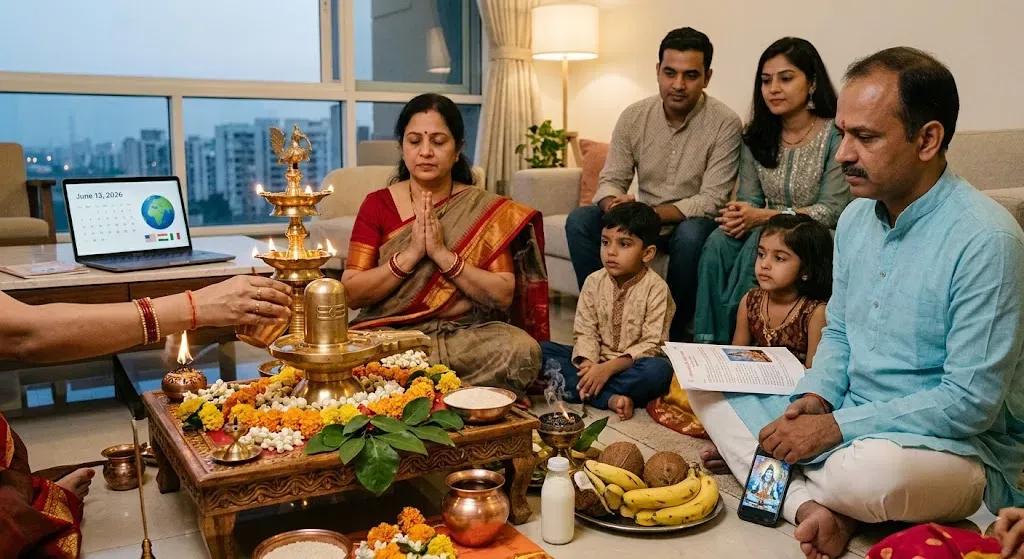
- Altar: Place a picture or murti of Shiva and Parvati together, or a Shivalinga with an image of Parvati, on a clean cloth. A kalasha with water, mango leaves and a coconut may be set up.
- Ganapati puja: Begin by worshipping Ganesha to remove obstacles.
- Sankalpa: With water and akshata in the right hand, state the date, your name and gotra if known, and the intention to perform Umamaheshwara Vratam.
- Avahana and upacharas: Invite Uma and Maheshwara and offer the upacharas: seat, water, abhisheka, cloth, sandal paste, flowers, incense, lamp and naivedya.
- Offerings: Bilva leaves are traditionally offered to Shiva, and kumkum, turmeric and flowers to Parvati. Repeat 'Om Namah Shivaya' and the names of the Goddess.
- Vrata katha: Read or listen to the vrata katha from your tradition's vrata book.
- Aarti and prayer: Perform aarti, offer prostrations and pray for the well-being of the family.
- Dana and conclusion: Many families honour a married couple or a Brahmin with food, cloth or dakshina, and then break the fast with prasadam.
About the vrata katha
Like most vratas, Umamaheshwara Vratam has a katha read during the puja. Versions differ between regional vrata books, and many simplified retellings found online cannot be traced to a reliable source. Rather than repeat an unverified story here, we suggest using the vrata kalpa or katha book your family or temple follows. If you have none, a priest at a Shiva temple will usually be able to guide you.
Whatever the version, the message is the same: sincere worship of Shiva and Parvati together brings their grace to the home, and the vow should be kept with devotion, purity and humility.
Materials checklist
| Item | Purpose | If unavailable abroad |
|---|---|---|
| Image or murti of Shiva and Parvati | Focus of worship | A printed picture is fine |
| Bilva leaves | Offering to Shiva | Dried bilva from Indian stores, or offer other fresh leaves and flowers with devotion |
| Kumkum and turmeric | Offering to Parvati | Widely sold in Indian grocery stores |
| Flowers, incense, lamp, camphor | Upacharas and aarti | Use an LED lamp where flames are not allowed |
| Fruits, milk, simple sweet | Naivedya | Any fresh, sattvic offering |
| Vrata katha book | Reading the katha | Ask your temple or family elders |
Observing the vratam outside India
- Use your own city's panchang: Do not copy the India date or times; the tithi can fall on a different day in North America, the UK or Australia.
- Fit it to the workday: If the day falls on a weekday, a short morning sankalpa and evening puja after work is a practical and accepted approach.
- Fire and smoke: In apartments, keep lamps attended, use small amounts of camphor, and be aware of smoke alarms.
- Eco-friendly offerings: Compost flowers and leaves afterwards rather than discarding them in water. See our eco-friendly puja items guide.
- Involve the family: Let children help with flowers and the aarti, and tell them the story of Parvati's tapas to win Shiva.
- Your local temple: Many Hindu temples abroad perform Shiva-Parvati pujas on Purnima. Check your temple's official website for its schedule.
Frequently asked questions
When is Umamaheshwara Vratam observed?
It is traditionally observed on Bhadrapada Purnima, the full moon of the lunar month of Bhadrapada, as commonly cited from the Bhavishya and Skanda Purana traditions. The Gregorian date changes every year and depends on your location, so check a reliable local panchang such as Drik Panchang, set to your own city, or ask your temple priest.
Who can observe Umamaheshwara Vratam?
It is widely observed by married couples praying for harmony and the well-being of the family, but tradition does not limit Shiva-Parvati worship to them. Unmarried devotees, elders and whole families also take part. Follow the custom of your family and community.
Is fasting compulsory?
Fasting is a common part of the vow, but its form varies, from a full fast until the puja to a single simple meal or fruit and milk. Elders, children, pregnant women and anyone with a medical condition should choose a gentle form or simply perform the puja with devotion, and consult a doctor where health is concerned.
Where can I find the vrata katha?
The katha is read from the vrata kalpa or vrata book used in your tradition, often printed in Telugu, Kannada, Marathi, Hindi or Sanskrit. Ask your family elders or temple priest for the version your family follows rather than relying on retellings of uncertain origin.
Can I perform the vratam if I live outside India?
Yes. Observe it on the Purnima date given by a panchang set to your own city, use what pure materials are available locally, and keep the focus on sincere worship of Uma and Maheshwara. Many temples abroad can also guide you or perform the puja on your behalf.
Editor's note
Editor's note (5 October 2026): This guide has been restored at its original address after the earlier version was lost. Umamaheshwara Vratam is traditionally observed on Bhadrapada Purnima, as commonly cited from the Bhavishya and Skanda Purana traditions. We have deliberately not given a specific 2026 or 2027 date or puja times, because the date and tithi timings depend on your location; check Drik Panchang for your own city or ask your temple priest. The procedure here is a general outline; follow your family's vrata book where it differs. Benefits described are those stated by tradition, not guarantees.
Related guides
You might also like

Chhath Puja 2026 in Europe: Sandhya and Usha Arghya Times for 18 Cities
Dev Uthani Ekadashi and Tulsi Vivah 2026 in Europe: Date City by City (Friday 20 November)
Karwa Chauth 2026 in Europe: Date (Thursday 29 October) and Moonrise Time in 18 Cities