Navratri 2026 for Women: Devi Worship, Daily Rituals, Colours, Fasting and Mantras (11–19 October)
A warm, practical guide to Navratri 2026 for women: why the festival honours Shakti, the nine Devis with dates and colours, daily routines of 15, 30 and 60 minutes, morning puja and evening diya, canonical mantras, the Devi Mahatmya, optional fasting with health first, clothing for work and Garba, mothers and daughters, Kanya Pujan, and celebrating abroad.
A warm, practical guide to Navratri 2026 for women: why the festival honours Shakti, the nine Devis with dates and colours, daily routines of 15, 30 and 60 minutes, morning puja and evening diya, canonical mantras, the Devi Mahatmya, optional fasting with health first, clothing for work and Garba, mothers and daughters, Kanya Pujan, and celebrating abroad.
Quick answer: Navratri 2026 runs from Sunday 11 to Monday 19 October in India (Drik Panchang), with Durga Ashtami and Maha Navami both on 19 October and Dussehra on Tuesday 20 October. For women, Navratri 2026 can be as simple as a morning diya, the day's Devi mantra and an evening prayer. Fasting, colours and longer rituals are optional, and your health and family tradition come first.
Every autumn, millions of women light a small lamp and welcome the Goddess home for nine nights. Some do it before a commute, some with a baby on one hip, some in a student hostel in Toronto or a flat in Leicester. This guide is for all of them: what Navratri means, how to keep it in a way that fits a real life, and how to honour the Divine Mother with devotion rather than pressure.
A note on how to read it: we mark clearly what is a fact (dates from Drik Panchang), what is tradition (practices described in texts or long family custom), what is regional custom, what is popular practice (like the colours of the day) and what is devotional belief. None of it is a rule you must follow.
Why Navratri is associated with the Divine Feminine
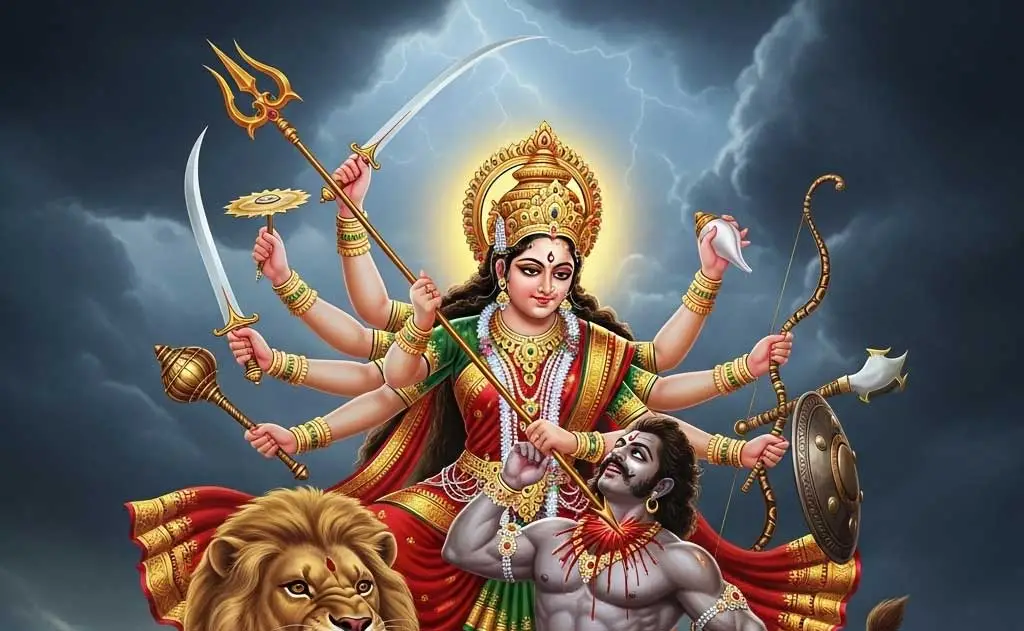
Short answer: Navratri is the festival of Devi, the Divine Mother, worshipped as Shakti, the power behind all creation. Over nine nights devotees honour her in nine forms, the Navadurga, and recall her victory over the buffalo demon Mahishasura as commonly told. Its heart is reverence for the feminine divine, open to every devotee.
In Hindu thought, Shakti is energy, power and creative force. As traditionally explained, even the great gods act through Shakti; without her, nothing moves. The Devi Mahatmya, the central text of Devi worship, describes the Goddess as the supreme reality who takes form to protect the world whenever it is threatened.
The story most associated with Sharad Navratri, as commonly told, is that the gods could not defeat Mahishasura, so their combined radiance took shape as Durga. She fought him for nine days and nights and triumphed on the tenth, which many celebrate as Vijayadashami. In much of North India, Dussehra also marks Rama's victory over Ravana, and both stories meet on the same day.
For many women, this is personal. The Goddess is not a distant ideal; she is mother, daughter, warrior and teacher in one. Devotees often describe Navratri as a time to recognise those same qualities in themselves: courage, compassion, steadiness and clarity. That is a devotional belief, held with love, and it does not make anyone spiritually higher or lower than anyone else. The Devi is worshipped by women, men and children alike.
Women and Devi worship through history, as commonly described
Women have long been at the centre of how Navratri is lived in homes, even when temple rituals were led by priests. As commonly described:
- Home altars: in many families the daily lamp, the flowers and the naivedya for the Goddess have been kept by the women of the house, and recipes, songs and stories have passed from grandmother to mother to daughter.
- Gujarat (regional custom): Garba is danced in circles around a lamp or a decorated pot, the garbo, and women's singing and dancing are at its heart.
- Telangana (regional custom): Bathukamma is a women's flower festival in the Navratri season, in which women stack seasonal flowers into a tower and sing as they circle it. See Bathukamma 2026 dates, Engili Pula to Saddula.
- Tamil Nadu, Karnataka and Andhra Pradesh (regional custom): the Golu or Bommala Koluvu doll display is often arranged by the women of the family, who invite friends and neighbours to see it and share sundal and songs. See Bommala Koluvu / Golu 2026.
- Bengal (regional custom): married women take part in Sindoor Khela on Bijoya Dashami. In Kolkata in 2026, Drik Panchang lists Bijoya Dashami and Sindoor Khela on Wednesday 21 October.
These are customs, not obligations. They show how women have shaped the festival over generations, through devotion, hospitality, music and community.
The nine forms of Devi in Navratri 2026: dates, qualities and colours
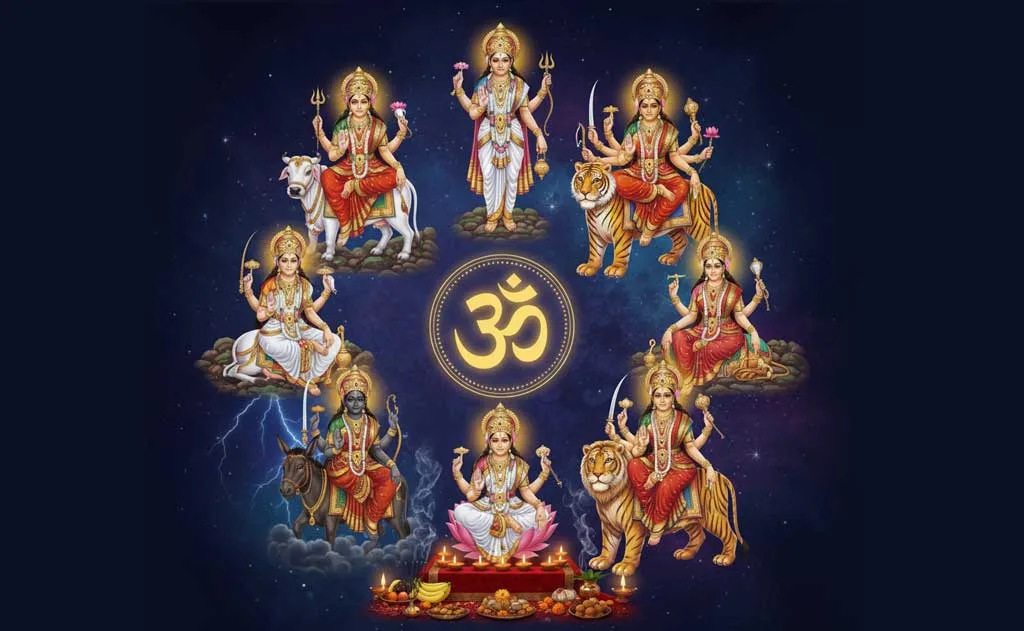
Short answer: Navratri 2026 honours the Navadurga in order: Shailaputri (11 Oct), Brahmacharini (12), Chandraghanta (13), Kushmanda (14), Skandamata (15), Katyayani (16), Kalaratri (17), Mahagauri (18) and Siddhidatri (19). Each is traditionally linked with a quality, such as steadiness, discipline or fearlessness, that devotees reflect on that day.
| Day | Date (India) | Devi | Quality traditionally associated | Popular colour |
|---|---|---|---|---|
| 1 | Sunday 11 October | Shailaputri | Steadiness, a grounded new beginning | Orange |
| 2 | Monday 12 October | Brahmacharini | Discipline, tapas, devotion | White |
| 3 | Tuesday 13 October | Chandraghanta | Courage and calm together | Red |
| 4 | Wednesday 14 October | Kushmanda | Creative energy, warmth | Royal blue |
| 5 | Thursday 15 October | Skandamata | Motherly love and protection | Yellow |
| 6 | Friday 16 October | Katyayani | Strength in the face of wrong | Green |
| 7 | Saturday 17 October | Kalaratri | Fearlessness, removal of darkness | Grey |
| 8 | Sunday 18 October | Mahagauri | Purity, peace, forgiveness | Purple, pink or peacock green (lists differ) |
| 9 | Monday 19 October | Siddhidatri | Fulfilment, inner wisdom | Purple, pink or peacock green (lists differ) |
Dates (fact): per Drik Panchang for India. Note that 18 October still has Saptami at sunrise in India, and Durga Ashtami and Maha Navami both fall on Monday 19 October. Qualities (tradition): drawn from how each form is commonly described. Colours (popular practice): the weekday colour custom is a popular tradition, not scripturally mandated, and lists for days 8 and 9 vary. See the full Navratri 2026 colours list.
Navratri daily routine for women: 15, 30 or 60 minutes
Short answer: A complete Navratri routine can take just 15 minutes: bathe, light a diya, chant the day's naam mantra 11 or 21 times, recite the stuti and offer a flower. With 30 minutes add sankalpa, 108 japa and aarti. With an hour, add Devi Mahatmya reading and quiet meditation. All three are sincere.
Pick the length that suits the day, not the one that looks most impressive. You can switch between them: 15 minutes on a busy Tuesday, 60 minutes on Sunday.
The 15-minute routine (busy mornings)
| TIME | PRACTICE | PURPOSE |
|---|---|---|
| 0–3 min | Wash or bathe, clean the puja corner, sit quietly | Arrive in body and mind |
| 3–5 min | Light the diya and incense, offer one flower | Welcome the Devi into the day |
| 5–11 min | Chant the day's naam mantra 11 or 21 times | Focus on the form of the day |
| 11–13 min | Recite the day's stuti, "Ya Devi sarvabhuteshu..." | Praise and gratitude |
| 13–15 min | Offer water or fruit, bow, take prasad | Close with humility |
The 30-minute routine (most days)
| TIME | PRACTICE | PURPOSE |
|---|---|---|
| 0–5 min | Bath, clean clothes (the day's colour if you like), clean the altar | Freshness and order |
| 5–8 min | Diya, incense, a simple sankalpa in your own words | State your intention for the nine days |
| 8–10 min | Dhyana shloka of the day, picturing the Devi's form | Steady the mind before japa |
| 10–22 min | Naam mantra, 108 times with a mala | Japa, concentration, devotion |
| 22–26 min | Flowers, kumkum, naivedya (the bhog of the day or fruit) | Offering with love |
| 26–30 min | Aarti, stuti, a moment of silence | Thanksgiving and stillness |
The 60-minute routine (weekends, Ashtami, Navami)
| TIME | PRACTICE | PURPOSE |
|---|---|---|
| 0–10 min | Bath, clean and decorate the altar, fresh flowers | Prepare the space with care |
| 10–15 min | Diya, incense, sankalpa, a prayer to Ganesha in your family's way | Begin auspiciously |
| 15–30 min | Dhyana shloka, naam mantra 108 times, the day's stuti | Devotion to the form of the day |
| 30–45 min | Read a chapter or section of the Devi Mahatmya | Svadhyaya, learning the Devi's story |
| 45–52 min | Naivedya, aarti, pradakshina in place | Offering and celebration |
| 52–60 min | Quiet meditation or journalling on the day's quality | Reflection and integration |
For a fuller day plan with evening prayer and variants for students, mothers and apartments, see our Navratri daily routine for women 2026.
A simple morning puja and evening diya
Short answer: In the morning, bathe, light a ghee or oil diya before an image of Durga, offer flowers, kumkum and a little food, chant the day's mantra and do a short aarti. In the evening, light the diya again at dusk, chant once more and sit quietly. Lighting the lamp twice is a common household custom.
Morning puja, step by step
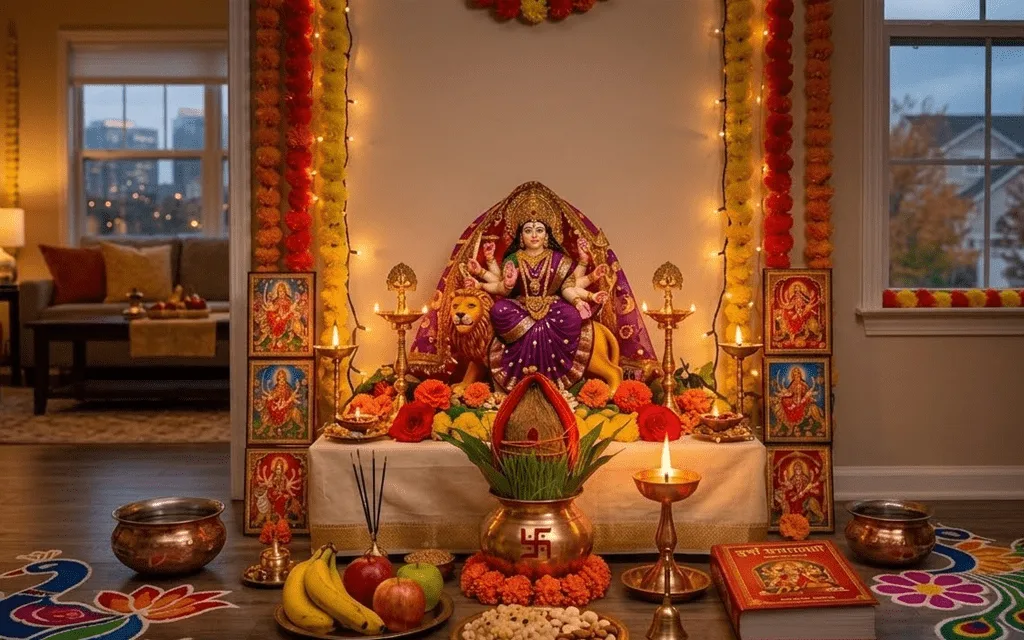
- Prepare: bathe and wear clean clothes. Wipe the puja space and place a picture or murti of Maa Durga or the Devi of the day on a clean cloth.
- Light: a diya with ghee or sesame oil, and incense if you use it. If your family keeps an akhand jyoti (a lamp burning all nine days), tend it carefully.
- Sankalpa: hold a flower and say, in any language, that you offer this day's worship to the Mother.
- Offer: flowers, kumkum and haldi, akshata (unbroken rice), and the bhog of the day or simple fruit and water.
- Chant: the dhyana shloka, the naam mantra and the stuti of the day, from the day posts linked in the table above.
- Aarti and close: sing or play the Durga aarti your family knows, bow, and ask forgiveness for any mistakes.
Evening diya and prayer
At sunset or when you get home, wash your hands and face, light the diya again and chant the naam mantra 11 or 21 times. Many women like to end with the Sarva Mangala verse below, then sit for two or three minutes thinking over the day: where was I patient, where was I brave, what can I let go of? This short practice is often the part people remember most.
Lamp safety: place the diya on a metal plate away from curtains and paper, keep children and pets clear, and never leave a flame unattended. In apartments, an LED diya is a perfectly acceptable alternative. See our apartment-friendly Navratri 2026 puja vidhi.
Navratri mantras for women: chanting and meditation
Short answer: The simplest Navratri mantra is the naam mantra of each day's Devi, such as "Om Devi Shailaputryai Namah" on Day 1. Many women also chant "Om Dum Durgayai Namah" or "Ya Devi sarvabhuteshu shakti-rupena samsthita" daily. Chant slowly, 11, 21 or 108 times; devotion matters more than perfect pronunciation.
These are traditional texts as commonly recited; meanings are our plain-English renderings. We have kept to well-known canonical verses only.
The naam mantra of each day
| Day | Devi | Naam mantra | Transliteration |
|---|---|---|---|
| 1 | Shailaputri | ॐ देवी शैलपुत्र्यै नमः॥ | Om Devi Shailaputryai Namah |
| 2 | Brahmacharini | ॐ देवी ब्रह्मचारिण्यै नमः॥ | Om Devi Brahmacharinyai Namah |
| 3 | Chandraghanta | ॐ देवी चन्द्रघण्टायै नमः॥ | Om Devi Chandraghantayai Namah |
| 4 | Kushmanda | ॐ देवी कूष्माण्डायै नमः॥ | Om Devi Kushmandayai Namah |
| 5 | Skandamata | ॐ देवी स्कन्दमातायै नमः॥ | Om Devi Skandamatayai Namah |
| 6 | Katyayani | ॐ देवी कात्यायन्यै नमः॥ | Om Devi Katyayanyai Namah |
| 7 | Kalaratri | ॐ देवी कालरात्र्यै नमः॥ | Om Devi Kalaratryai Namah |
| 8 | Mahagauri | ॐ देवी महागौर्यै नमः॥ | Om Devi Mahagauryai Namah |
| 9 | Siddhidatri | ॐ देवी सिद्धिदात्र्यै नमः॥ | Om Devi Siddhidatryai Namah |
Each means "Om, salutations to Goddess ..." followed by the name of the day's form. Each day post also gives the dhyana shloka and stuti for that form.
Ya Devi Sarvabhuteshu Shakti Rupena
या देवी सर्वभूतेषु शक्तिरूपेण संस्थिता। नमस्तस्यै नमस्तस्यै नमस्तस्यै नमो नमः॥
Ya Devi sarvabhuteshu shakti-rupena samsthita, namastasyai namastasyai namastasyai namo namah.
Meaning: "To the Goddess who abides in all beings in the form of power: salutations to her, salutations to her, salutations to her, again and again." It comes from the Aparajita Stuti of the Devi Mahatmya.
How to use it: chant it three or eleven times. Many women find it a quiet reminder that the same Shakti lives in every person they meet that day.
Om Dum Durgayai Namah
ॐ दुं दुर्गायै नमः॥
Om Dum Durgayai Namah
Meaning: "Om, salutations to Durga," with "Dum" as the Durga beeja (seed) syllable.
How to use it: a short mantra for 108 repetitions with a mala, morning or evening, on all nine days.
Sarva Mangala Mangalye
सर्वमङ्गलमाङ्गल्ये शिवे सर्वार्थसाधिके। शरण्ये त्र्यम्बके गौरि नारायणि नमोऽस्तु ते॥
Sarva-mangala-mangalye shive sarvartha-sadhike, sharanye tryambake gauri narayani namostu te.
Meaning: "O Narayani, the auspiciousness in all that is auspicious, O gracious one who brings every worthy aim to fulfilment, O refuge of all, three-eyed Gauri, salutations to you." From the Narayani Stuti of the Devi Mahatmya.
How to use it: recite it at the start or close of the puja, or before taking prasad.
About the Navarna mantra: in the Chandi tradition, the nine-syllable Navarna mantra, "Om Aim Hreem Kleem Chamundayai Vichche", is central. In many families it is received from a guru or family priest before regular japa, so follow your own tradition here.
A five-minute Devi meditation
- Sit comfortably after the japa, spine upright, eyes closed or softly lowered.
- Breathe slowly for a minute. Let the shoulders drop.
- Picture the Devi of the day as described in her dhyana shloka, or simply picture the flame of your diya.
- Bring to mind the quality of the day: steadiness, discipline, courage, warmth, love, strength, fearlessness, peace or wisdom.
- Ask quietly where that quality is needed in your life today. Then rest in silence and bow before you rise.
For the mantras of all nine forms, see Navratri day-wise mantras and their significance.
Reading the Devi Mahatmya (Durga Saptashati) during Navratri
Short answer: The Devi Mahatmya, also called Durga Saptashati or Chandi Path, is a text of about 700 verses in 13 chapters from the Markandeya Purana. Many devotees read it during Navratri, either in full or a few chapters a day. Reading even one chapter with attention, or a good translation, is a meaningful practice.
The text tells three episodes, as traditionally arranged: the Goddess as Mahakali and the slaying of Madhu and Kaitabha; the Goddess as Mahalakshmi and the victory over Mahishasura; and the Goddess as Mahasaraswati and the defeat of Shumbha and Nishumbha. Around these sit hymns of praise, including the Narayani Stuti and the Aparajita Stuti, from which two of the verses above come.
- Popular reading plans: the whole text on one day; or spread over the nine days, often in a sequence your family or teacher recommends; or one episode on each of three days.
- If Sanskrit is hard: read a reliable translation in your own language. Understanding the story is itself a form of devotion.
- With children: tell the Mahishasura story at bedtime, as commonly told, and talk about courage and doing what is right.
For an overview of the text and its chapters, see our Devi Mahatmya complete guide.
Navratri fasting for women: optional, varied and health first
Short answer: Fasting during Navratri is optional. Practices vary by family, region and health: some women eat fruit and milk, some one sattvic meal, some fast only on the first and last days, and many do not fast. Pregnant women, diabetics, the elderly, children and anyone on medication should follow medical advice first.
Fasting is a tradition of self-discipline and offering, not a test. As commonly practised in North India:
- Phalahar: fruit, milk, curd and nuts through the day.
- One meal: a single sattvic meal made with vrat ingredients such as kuttu (buckwheat), singhara (water chestnut) flour, sabudana, samak rice, potatoes and sendha namak (rock salt).
- First and last days only: fasting on Day 1 and on Ashtami or Navami.
- Commonly avoided: onion, garlic, meat, eggs, alcohol and, in many homes, regular grains and table salt.
Regional custom: practices differ widely. In Bengal, Navratri is the season of Durga Puja feasting rather than fasting for many families, and in much of South India the focus is on Golu, special prasadam and Saraswati Puja rather than a grain-free diet. No version is more correct than another.
Health first: drink enough water, do not push through dizziness or weakness, and break the fast if you feel unwell. If you are pregnant or breastfeeding, have diabetes or another condition, take regular medication, are elderly, or are fasting with children in the home, talk to your doctor and choose a gentle form or none at all. Prayer without fasting is complete prayer. For food lists and a sample day, see Navratri fasting rules 2026.
What to wear for Navratri: colours, sarees, office and Garba
Short answer: Many women wear the popular colour of the day: orange, white, red, royal blue, yellow, green and grey for 11 to 17 October 2026, and purple, pink or peacock green for 18 and 19 October, as lists differ. It is a joyful custom, not a rule. A saree, kurti or office outfit with a coloured scarf all work.
- At home and for puja: a clean cotton saree or a simple kurta is comfortable for sitting on the floor and handling a lamp. Many women keep a favourite red or yellow saree for Ashtami and Navami.
- Office-friendly: add the colour through a dupatta, scarf, blouse, shirt or bag rather than a full outfit. A small accessory is still a way of joining in.
- Garba and Dandiya: chaniya choli or a lehenga with comfortable footwear, or none if the floor allows. Keep the dupatta pinned so it does not catch while you dance.
- Jewellery: wear what you are comfortable with. Bangles, a bindi and flowers in the hair are traditional in many regions; they are personal choices, not requirements.
- Devotional preparation: many women see dressing for puja as part of the offering: clean, simple and done with attention. A calm minute in front of the mirror before you light the lamp can be its own small prayer.
Working women: keeping Navratri with a full calendar
Short answer: Working women can observe Navratri fully with a short morning routine before work, the day's colour as a small accent, a mantra repeated silently on the commute and a diya at night. Save longer puja for the weekend of 17 and 18 October and for 19 October, Ashtami and Navami in India.
- Prepare the puja space on Saturday 10 October so Sunday's start is easy.
- Keep a small tray ready with diya, matches, incense and kumkum to save time each morning.
- Set a phone reminder for evening diya time, and keep the naam mantra list on your phone.
- If fasting, carry fruit, nuts and water and tell a colleague if you may need a break. Never fast through meetings or travel at the cost of your health.
- Use the lunch break for five minutes of quiet chanting if you like. Silent japa counts.
Mothers, children and Navratri with daughters
Navratri is a lovely time to share faith with children without making it heavy. Some ideas:
- Let children light the diya with you (with supervision) and choose the flower for the day.
- Tell one Devi's story each evening, as commonly told, and ask what quality they noticed.
- Let daughters and sons both help with the altar, the rangoli and the prasad. The Devi's festival belongs to all children.
- Make the colour of the day a game: a ribbon, a bracelet or a drawing in that colour.
- Do not ask children to fast. Offer them simple vrat snacks if they want to join in, and follow your paediatrician's advice.
Navratri with daughters: many mothers use these nine days to talk with their daughters about the Devi's qualities: the courage of Chandraghanta, the discipline of Brahmacharini, the love of Skandamata. Some read a chapter of the Devi Mahatmya together; some dance Garba together. These shared memories, more than any single ritual, are what many families hand down. For more ideas, see explaining Navratri and Dussehra to children.
Kanya Pujan: honouring young girls respectfully
In many North Indian families, Kanya Pujan (also called Kanjak) is performed on Ashtami or Navami. Young girls, often nine, are welcomed as forms of the Devi; their feet are washed, a red thread or tilak is offered, and they are served a meal, commonly halwa, puri and chana, with a small gift. Some families include a young boy as Langur or Bhairav. This is a regional custom; many families do not observe it.
- Invite girls with their parents' knowledge and consent, and let parents stay if they wish.
- Keep it gentle and fun. No child should feel pressured, embarrassed or tired.
- Respect food allergies and dietary needs, and ask parents before serving.
- Give simple, useful gifts such as stationery, books or a small toy.
- Treat it as reverence for every girl child, a value that extends to how girls are treated all year.
Date: in India, Ashtami and Navami are both on Monday 19 October 2026. For timing and steps, see Kanya Pujan 2026 date and vidhi.
Women-led family puja
In many homes the woman of the house leads the Navratri puja, and in any family a woman may do so. If you are leading it for the first time:
- Agree with the family on a simple plan and a time everyone can attend, even 15 minutes.
- Give each person a part: one lights the lamp, one offers flowers, one reads the stuti, a child rings the bell.
- Use the naam mantra of the day so everyone can join in.
- Close with the aarti and share prasad together.
If your family has a priest or a set lineage of practice, follow that for formal rituals such as Ghatasthapana; the daily home puja can still be led by anyone in the household.
Women entrepreneurs and the symbolism of Shakti
Many women who run businesses, shops or practices find meaning in Navratri as a season of reflection. Shakti is traditionally understood as the energy that creates, sustains and protects; devotees often reflect on what they are building and why. This is reflection, not a formula for success: no ritual, mantra or fast promises profits, clients or any worldly result.
- Light a lamp at your workplace or desk on Day 1, if it is safe and appropriate, as a quiet intention to work with honesty.
- On Ayudha Puja, Monday 19 October 2026 in South India, many people clean and honour the tools of their work, from laptops to sewing machines.
- By tradition, many families see Vijayadashami, Tuesday 20 October, as an auspicious day to begin new learning or work; it is a meaningful start, not a guarantee.
- Use the nine qualities as journal prompts: where do I need steadiness, discipline, courage, warmth, care, strength, fearlessness, peace and wisdom in my work? See also Dussehra 2026 for women: Shakti puja and new beginnings.
Community celebrations: Garba, Golu, Durga Puja and more
Navratri is also a festival of togetherness. Depending on where you live, you might join a Garba or Dandiya night, a Golu visit and haldi-kumkum gathering, a Bathukamma circle, or a Durga Puja pandal. In Kolkata in 2026, Drik Panchang lists Maha Saptami on Sunday 18 October, Maha Ashtami and Kumari Puja on Monday 19 October, Maha Navami on Tuesday 20 October and Bijoya Dashami on Wednesday 21 October; see Durga Puja 2026 dates, Mahalaya to Sindoor Khela.
For event schedules, check your local temple or community association directly; we do not list events we cannot verify. If you live alone or are new to a city, these gatherings are also a gentle way to find community.
Navratri for women living abroad
Short answer: Abroad, Navratri 2026 also begins on Sunday 11 October, but Drik Panchang lists Durga Ashtami on 18 October and Maha Navami on 19 October in the USA, Canada and the UK. Use local dates and local muhurats from Drik for your city, keep a short weekday routine, and join temple or community events nearby.
- Never use India's clock times abroad; look up your own city on Drik Panchang or ask your temple priest.
- Plan video calls with family in India around the time difference so you can share aarti together.
- Check smoke alarms and building rules before lighting a diya; an LED diya is fine.
- Dussehra is Tuesday 20 October in India. Check your local temple for its own programme abroad.
Country guides: USA, Canada, UK and Australia. For a dedicated guide, read Navratri 2026 for Indian women abroad.
After Navratri: Dussehra and carrying the nine days forward
Navratri flows into Vijayadashami on Tuesday 20 October 2026 in India, a day many families mark with Aparajita puja, Shami puja and new beginnings, as described in the Dussehra / Vijayadashami 2026 guide. The real gift of nine days of practice, many women say, is the habit: a lamp, a mantra and a minute of reflection that can continue long after the festival.
Frequently asked questions
What should women do during Navratri 2026?
There is no fixed list. Many women light a diya morning and evening, chant the day's Devi mantra, read a little of the Devi Mahatmya, wear the popular colour of the day and share prasad with family. Choose what fits your health, work and family tradition; sincerity matters more than the number of rituals.
Is fasting compulsory for women during Navratri?
No. Fasting is a personal, optional observance and practices vary by family, region and health. Some keep a fruit-and-milk fast, some eat one sattvic meal, some fast only on the first and last days, and many do not fast at all. If you are pregnant, diabetic, on medication, elderly or unwell, follow your doctor's advice.
Can working women observe Navratri properly?
Yes. A 15-minute morning routine (lamp, naam mantra, stuti, a flower) and a short evening diya are a complete, sincere observance. Many working women save the longer puja and Devi Mahatmya reading for the weekend of 17 and 18 October 2026, and for Ashtami and Navami on Monday 19 October in India.
Can women do Navratri puja during periods?
Customs differ by family, community and tradition, and there is no single answer that applies to everyone. Some families ask women to step back from touching the altar for those days, others place no restriction, and many women continue with silent prayer or mantra in the mind. Follow your own family's practice and your own conscience.
What are the Navratri 2026 colours for women?
By the popular weekday pattern: orange (11 Oct), white (12), red (13), royal blue (14), yellow (15), green (16) and grey (17). For 18 and 19 October lists differ between purple, pink and peacock green. The colours are a modern popular custom, not a scriptural rule, so wearing them is optional.
Which mantra should women chant during Navratri?
The simplest is the naam mantra of the Devi of the day, such as "Om Devi Shailaputryai Namah" on Day 1, chanted 11, 21 or 108 times. Many also recite "Ya Devi sarvabhuteshu shakti-rupena samsthita" or "Om Dum Durgayai Namah" every day. Any woman may chant these with devotion.
When is Kanya Pujan in Navratri 2026?
In India, Durga Ashtami and Maha Navami both fall on Monday 19 October 2026 per Drik Panchang, so most families hold Kanya Pujan that day. In the USA, Canada and the UK, Drik lists Durga Ashtami on 18 October and Maha Navami on 19 October. Follow your family custom for the day.
Editor's note
Editor's note (6 October 2026): This guide has been restored at its original address. India dates are from Drik Panchang; Dussehra on 20 October is also on the Government of India holiday calendar. Muhurat times vary by city, so please check your local panchang. Mantras are canonical texts as commonly recited, with our plain-English meanings. Colours, bhog and fasting describe popular practice and vary by family and region. Nothing here is a requirement, and no ritual promises any worldly result; please follow your family tradition and your doctor's advice.
Related guides
You might also like
Navratri Fasting Rules 2026: Vrat Food List, What to Eat and What to Avoid (11 to 19 October)
Navratri Daily Routine for Women 2026: Morning Puja, Evening Prayer and a 9-Day Plan
Navratri 2026 for Indian Women Abroad: A Practical Guide for the USA, Canada, UK and Australia