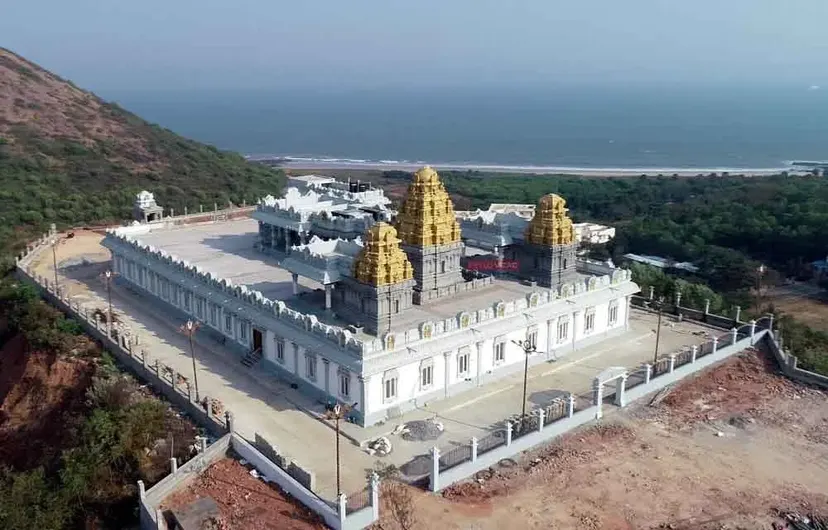
அருள்மிகு வடபழநி ஆண்டவர் திருக்கோயில்
Murugan (Vadapalani Andavar) temple · Chennai (Vadapalani, Kodambakkam area), Chennai, Tamil Nadu, India
The Vadapalani Andavar Temple is a Murugan temple in Vadapalani, in the Kodambakkam area of Chennai, Tamil Nadu. The standing main deity is modelled on Murugan of Palani and is worshipped here as Vadapalani Andavar. The temple comes under the Tamil Nadu Hindu Religious and Charitable Endowments (HR&CE) Department.
According to its own history, the temple dates from the late 19th century. It grew from a thatched hut with a painting of Murugan into one of Chennai's busiest temples. Its own website says around 7,000 couples marry here every year.
Faith & Tradition
The temple website and Dinamalar both say Murugan is shown here wearing padukas (footwear). The temple also has a separate shrine for Angaraka (Mars), the planet linked with Murugan, and a golden chariot.
The shrine became famous for arulvakku, sayings spoken in trance that devotees believed were divinely inspired. Its founder and his successors gave these sayings, and people came to them for help with illness, jobs and marriages, according to the temple's history. The temple website also says film-industry patronage helped make it popular.
Besides the main shrine, the courtyards hold shrines to Varasiddhi Vinayaka, Chokkanathar, Meenakshi Amman, Kali, Bhairava, and Shanmuga with Valli and Devasena. The niches of the inner prakaram hold Dakshinamurti, Chandikeswara and Mahalakshmi.
Heritage
The temple's official history traces it to Annaswami (Annasamy) Naicker. It says this devotee of modest means built a thatched hut and kept a painting of Palani Andavar there for his own worship. In tradition, he fell ill, went to Tiruttani on a sadhu's advice and offered part of his tongue at the balipeetam, then walked to Palani. Before he died he asked his friend Rathinasamy Thambiran to carry on the worship. Offerings from the public paid for a small shrine, and by 1931 a third devotee, Pakkiyalinga Thambiran, had taken over.
The temple website says the temple was renovated in the 1920s, when a Rajagopuram was built. It also says the south Rajagopuram, 72 feet tall, was put up in 1972 along with the temple's first kumbhabhishekam, and that a second kumbhabhishekam in 1984 was followed by a golden chariot. The Murugan Bhakti website names the scholar Kripananda Variyar among those who helped turn the hut into a full temple.
The entrance is crowned by a gopuram decorated with stucco figures from the Skanda Purana, with the temple tank in front. The Murugan Bhakti website gives the eastern tower's height as 40.8 m and says it carries the 108 dance poses of Bharatanatyam. The temple has a large hall used for weddings and religious talks. Its sacred tree (sthala vriksham) is the athi (fig), and its sacred water (theertham) is the temple tank.
Plan Your Visit
The temple is run by the Tamil Nadu HR&CE Department, and weddings, sevas and darshan follow the temple office's current schedule. The temple website notes that weddings are not held on some major festival days. Confirm current arrangements with the temple office or the HR&CE Department before visiting.
Timings and arrangements change with seasons and festivals. Confirm current details with Tamil Nadu HR&CE Department before travelling. Last reviewed 5 October 2026.
Sacred Calendar
This 11-day festival is the temple's main annual festival. A carved wooden chariot is taken in procession on the seventh day.
A ten-day festival with laksharchana on the first six days. Soorasamharam is re-enacted on the sixth evening, and Murugan's wedding (Thirukalyanam) is held on the seventh day.
Ten days of laksharchana end on Panguni Uthiram, followed by a three-day float festival on the temple tank.
Murugan receives special abhishekam and is taken in procession on Kiruthigai days, and Thaipoosam and Aadi Kiruthigai are celebrated with special fervour.
Nine days of special decoration for the goddess, ending with the parivettai procession on Vijayadasami.
Location
The temple website puts the shrine about 100 m from Arcot Road in Vadapalani and about 3 km from the Koyambedu bus stand. Dinamalar lists Chennai Central and Egmore as the main railway stations and Chennai as the airport.
Location: Chennai (Vadapalani, Kodambakkam area), Chennai, Tamil Nadu, India
Nearest airport: Chennai
Nearest railway station: Chennai Central / Chennai Egmore
More in Hindu temples in Tamil Nadu · Murugan (Vadapalani Andavar) temples
Questions
Murugan, worshipped as Vadapalani Andavar. The standing main deity is modelled on Murugan of Palani.
The temple and Dinamalar both note that Murugan here wears padukas (footwear), a feature they mark as special to this temple.
The temple's history says it grew from a thatched hut set up by Annaswami Naicker in the late 19th century. It was renovated in the 1920s, and the south Rajagopuram was built in 1972.
Yes. The temple's website says around 7,000 couples marry there each year, and the temple has a hall for weddings. Weddings are not held on some festival days.
Arulvakku means sayings spoken in trance and believed to be divinely inspired. The founder and his successors gave them, and devotees sought them for help with illness, jobs and marriage, according to the temple's history.
The Tamil Nadu Hindu Religious and Charitable Endowments (HR&CE) Department.
In Vadapalani, Chennai, about 100 m from Arcot Road and about 3 km from the Koyambedu bus stand, according to the temple.
Further reading: Vadapalani Andavar Temple on Wikipedia (CC BY-SA 4.0).
Spotted an error? Write to info@hindutone.com — see our editorial policy.