Shiva Temples to Visit During Karthika Masam in Cambodia: Complete Guide for Hindu Pilgrims (2026)
Karthika Masam 2026 (10 November to 8 December) is a fine time for a quiet Shiva pilgrimage to Cambodia's Khmer temples. Dates, temples, etiquette and planning tips.
Karthika Masam 2026 (10 November to 8 December) is a fine time for a quiet Shiva pilgrimage to Cambodia's Khmer temples. Dates, temples, etiquette and planning tips.
Quick answer
Karthika Masam 2026 runs from Tuesday 10 November to Tuesday 8 December (Telugu/Kannada amanta calendar). Karthika Pournami is Tuesday 24 November, and the four Karthika Somavaram Mondays are 16, 23 and 30 November and 7 December. Drik Panchang lists the same Kartika Purnima date for Cambodia. Because 2026 has an extra lunar month (adhika masa), the month falls about three weeks later than last year. North Indian (purnimanta) Kartik ends on the same full moon, 24 November.
Cambodia has no large Hindu community today, but it holds some of the most remarkable Shiva temples ever built. For a pilgrim who is happy with quiet, personal devotion rather than organised festivals, a visit during Karthika Masam combines dawn meditation, lamp-lighting at home or in your room, and darshan of ancient lingas in the Khmer heartland.
Understanding Cambodia's Hindu heritage
From the 9th to the 15th centuries the Khmer Empire, centred at Angkor, was one of the great Hindu civilisations of Asia. Shaivism was the dominant state religion for much of that time. Kings were consecrated through the devaraja ritual, which linked royal authority to Shiva, and Sanskrit was the language of temple inscriptions. Temple-mountains were built to represent Mount Meru, and a linga stood at the heart of most royal temples.
From the late 12th century the empire gradually turned to Buddhism, and today Cambodia is overwhelmingly Theravada Buddhist. The ancient temples are preserved as archaeological sites, and several are used for Buddhist worship. Hindu stories, however, remain woven into Khmer culture: the Reamker (the Khmer Ramayana), apsara dance and the Churning of the Ocean of Milk all appear in art and performance.
What to expect as a Hindu pilgrim
- No large public Karthika Masam celebrations: this is a personal pilgrimage, not a festival trip.
- Quiet prayer, chanting under your breath and meditation are welcome; formal pujas need permission.
- Open flames are restricted at protected sites. Light your Karthika deepam at your hotel (with care) or use an LED diya at the temples.
- Dress modestly, covering shoulders and knees, out of respect for both Hindu and Buddhist worshippers.
The great Shiva temples around Siem Reap
Most of the important sites lie in and around the Angkor Archaeological Park, a short drive north of Siem Reap. A multi-day Angkor Pass covers the main park; Kbal Spean, Phnom Kulen and Beng Mealea charge separately. Check current fees and opening hours with the official Angkor Enterprise ticket office before you travel.
1. Banteay Srei: the jewel of Shaiva art
Consecrated in 967 CE and dedicated to Shiva as Tribhuvanamaheshvara, Banteay Srei is small, rose-pink sandstone and covered in the finest carving in Khmer art. Look for Ravana shaking Mount Kailash, Shiva burning Kama, and scenes from the Ramayana and Mahabharata. It lies about 25 km north-east of Siem Reap. Go at opening time for soft light and few visitors, and spend a few minutes in silence before the sanctum (which is roped off).
2. Phnom Bakheng: the first Shiva temple-mountain of Angkor
Built by King Yasovarman I around the turn of the 10th century, Phnom Bakheng crowned his new capital and enshrined a linga at its summit. It is a short, steep climb up the hill near Angkor Wat. Sunset is extremely crowded and visitor numbers at the top are limited, so many pilgrims prefer an early morning visit for quiet japa with views over the forest.
3. Angkor Wat
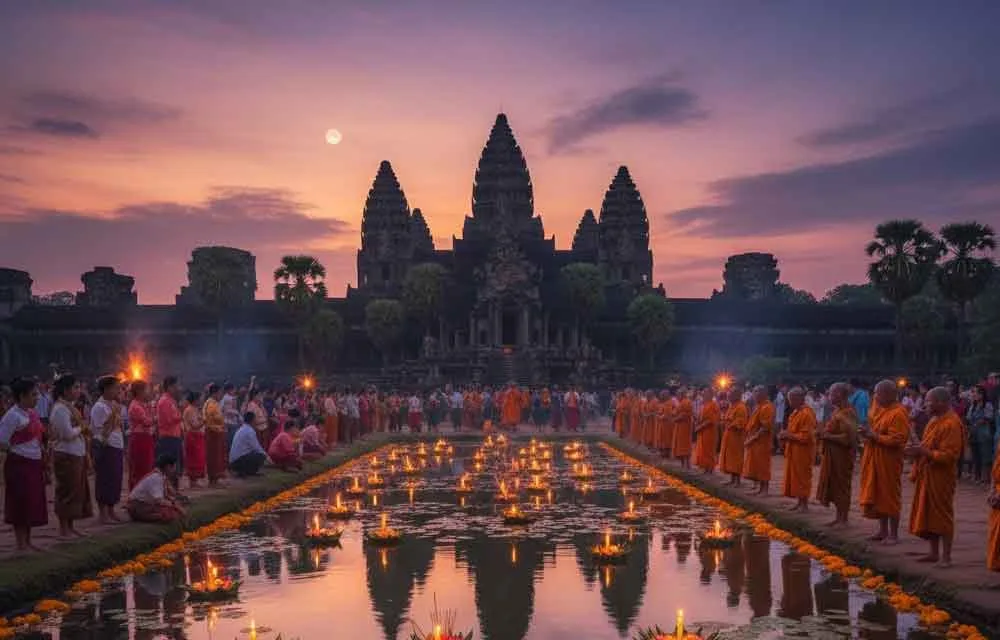
Angkor Wat was built in the first half of the 12th century by Suryavarman II and dedicated to Vishnu, so it is not a Shiva temple, but no pilgrim should miss it. Its galleries hold vast bas-reliefs of the Churning of the Ocean of Milk, the battle of Kurukshetra and the Ramayana, a reminder that Shiva and Vishnu were worshipped side by side. Sunrise over the reflecting pools is a beautiful moment for morning prayers during Karthika Masam. Arrive well before dawn, carry water and wear shoes suitable for steep steps.
4. Angkor Thom: Bayon and Baphuon
The walled city of Angkor Thom was built by Jayavarman VII, a Buddhist king, and its Bayon temple is famous for its serene stone faces. Close by stands the Baphuon, an 11th-century temple-mountain dedicated to Shiva. Together they show the gradual transition from Shaivism to Buddhism. The Terrace of the Elephants and the Terrace of the Leper King are a short walk away.
5. Preah Khan and Ta Prohm
Preah Khan (1191) and Ta Prohm (1186) were also built by Jayavarman VII as Buddhist foundations, but both include Hindu imagery and, at Preah Khan, shrines associated with Shiva and Vishnu. Ta Prohm's giant trees growing through the stones make it one of the most atmospheric places at Angkor. Preah Khan is usually calmer and has quiet courtyards for meditation.
6. Kbal Spean and Phnom Kulen: the river of a thousand lingas
For Shiva devotees this may be the most moving site in Cambodia. At Kbal Spean, in the Kulen hills about an hour and a half from Siem Reap, a forest trail of roughly 1.5 km leads to a riverbed carved with hundreds of lingas, yonis and images of Vishnu reclining on the serpent. Water flows over the lingas before continuing towards the Angkor plain, an ever-running abhishekam. Nearby Phnom Kulen is the sacred mountain where Jayavarman II proclaimed the Khmer kingdom in 802 CE; it also has riverbed carvings, waterfalls and a large reclining Buddha that is a pilgrimage site for Cambodians. Water flow is usually good in November and December.
7. Beng Mealea
About 40 km east of the main park, Beng Mealea is a huge 12th-century temple in the style of Angkor Wat, left largely unrestored and wrapped in jungle. Wooden walkways lead over fallen galleries. It suits fit, adventurous pilgrims who want solitude; wear sturdy shoes and carry water.
Beyond Siem Reap: the oldest Shaiva sites
Sambor Prei Kuk (Kampong Thom Province)
Sambor Prei Kuk was Ishanapura, capital of the Chenla kingdom in the early 7th century, centuries before Angkor. Its many brick sanctuaries, scattered through the forest, are among the oldest Hindu temples in Cambodia, and many were dedicated to Shiva. It was inscribed as a UNESCO World Heritage Site in 2017. It is roughly halfway between Siem Reap and Phnom Penh and can be visited as a day trip or with an overnight stay in Kampong Thom town. Stay on marked paths.
Phnom Da and Angkor Borei (Takeo Province)
South of Phnom Penh, the hilltop sanctuary of Phnom Da and the ancient town of Angkor Borei date back to the Funan and early pre-Angkor periods. Access is harder and facilities are minimal, so this is only for pilgrims with extra time and a local guide. The National Museum in Phnom Penh holds many of the finest early Hindu sculptures, including pieces from this region, and is well worth a visit.
Observing Karthika Masam while in Cambodia
| 2026 date | Observance | Idea for Cambodia |
|---|---|---|
| Tue 10 Nov | Karthika Masam begins | Take your sankalpa at sunrise; light your first deepam |
| Mon 16, 23, 30 Nov; Mon 7 Dec | Karthika Somavaram | Fast or eat one meal; visit Banteay Srei, Phnom Bakheng or Kbal Spean |
| Fri 20 Nov / Sat 21 Nov | Devuthani Ekadashi / Tulsi Vivah | Vishnu prayers at Angkor Wat; Tulsi puja at home if you travel with a plant or image |
| Tue 24 Nov | Karthika Pournami | Light 365 wicks (in your room, safely) and pray for the family |
| Tue 8 Dec | Karthika Amavasya | Month ends; offer tarpanam and charity |
Drik Panchang lists Devutthana Ekadashi on 21 November and Tulasi Vivah on 22 November for Cambodia (one day later than India), so follow the local listing if you are observing in-country. Confirm tithi times for Phnom Penh on Drik Panchang before fasting.
- Rise before dawn, bathe and chant Om Namah Shivaya or the Shiva Panchakshari stotram.
- Carry a compact puja kit: small image or linga, kumkum, akshata, incense and an LED diya.
- Offer flowers respectfully at shrines where locals do so; never leave oil, wax or ash on ancient stone.
- Ask your guide to explain the Hindu iconography: identifying Shiva, Vishnu and the epics in the reliefs deepens the darshan.
- Eat sattvic food. Khmer dishes often contain fish sauce, so learn to ask for vegetarian food, or eat at the Indian restaurants in Siem Reap and Phnom Penh.
Practical planning
Suggested itinerary (5 to 7 days)
- Day 1: Arrive in Siem Reap and rest.
- Day 2: Angkor Wat at sunrise, then Angkor Thom (Bayon and Baphuon) and Ta Prohm.
- Day 3: Banteay Srei early, with nearby smaller temples.
- Day 4: Kbal Spean and Phnom Kulen.
- Day 5: Beng Mealea and Preah Khan.
- Day 6: Phnom Bakheng at dawn and a quiet day of japa.
- Optional: two extra days for Sambor Prei Kuk and Phnom Penh.
Visas, money and transport
Cambodia offers e-visas and visas on arrival for many nationalities; check the official requirements and fees for your passport before booking. The US dollar is widely used alongside the riel, and cash is useful for tuk-tuks and small purchases. Tuk-tuks with a driver for the day, private cars and organised tours are the usual ways to move between temples; agree the price in advance. We have removed specific prices from this guide because fees and fares change; confirm them locally.
Health, safety and packing
- Bring sun protection, a refillable water bottle and insect repellent (dengue is present).
- Drink bottled or filtered water only.
- Pack light clothes that cover shoulders and knees, plus a shawl for temple visits.
- Carry a torch for pre-dawn and after-dark walks on uneven stone.
- Speak to a travel clinic about recommended vaccinations well before you go.
Frequently asked questions
When is Karthika Masam 2026?
In the Telugu and Kannada (amanta) calendar Karthika Masam 2026 runs from Tuesday 10 November to Tuesday 8 December. Karthika Pournami is Tuesday 24 November, and the Karthika Somavaram Mondays are 16, 23 and 30 November and 7 December. Because 2026 has an extra lunar month, the month falls about three weeks later than last year.
Are pujas performed at Angkor Wat and other Khmer temples?
Generally no. The ancient temples are protected archaeological sites, and many are now used for Buddhist worship. Hindu visitors are welcome to pray quietly, meditate and chant softly, but formal pujas, open flames or large offerings should only happen with permission from site staff.
Which Cambodian temples are dedicated to Shiva?
Banteay Srei (consecrated in 967 CE to Shiva), Phnom Bakheng (Yasovarman I's Shiva temple-mountain), the Baphuon inside Angkor Thom, the riverbed lingas of Kbal Spean in the Kulen hills, and the 7th-century brick shrines of Sambor Prei Kuk are the most important Shaiva sites.
Is there a Hindu temple in Phnom Penh for Karthika Masam?
Cambodia's Hindu community is very small and mostly made up of Indian expatriate families. Ask Indian community groups or the Indian Embassy in Phnom Penh about any 2026 gatherings; otherwise plan for private worship in your hotel room.
What is the weather like in Cambodia in November and December?
It is the start of the cool, dry season, with warm days and little rain, which makes it one of the most comfortable times to visit the temples. Sunset in Phnom Penh is around 5:30 PM in early November.
Editor's note (4 October 2026)
This guide has been updated for 2026. Festival dates come from Drik Panchang. We have removed last year's dates and prices, and the historical details describe the temples in general terms. Opening hours, ticket prices and visa rules change, so confirm them with official sources before you travel. There are no organised Karthika Masam events listed here because we could not verify any for 2026.
Related guides
You might also like
Karthika Purnima 2026: Significance, Rituals, and the Triple Festival Across Hindu, Sikh, and Jain Traditions
Shiva Vrats of June 2026: Kalashtami (June 8) & Masik Shivaratri (June 13)
Gayatri Jayanti 2026: Date, Gayatri Mantra, Puja Vidhi & Significance