Annapurna Stotram (Nityanandakari): Lyrics, Meaning and Benefits
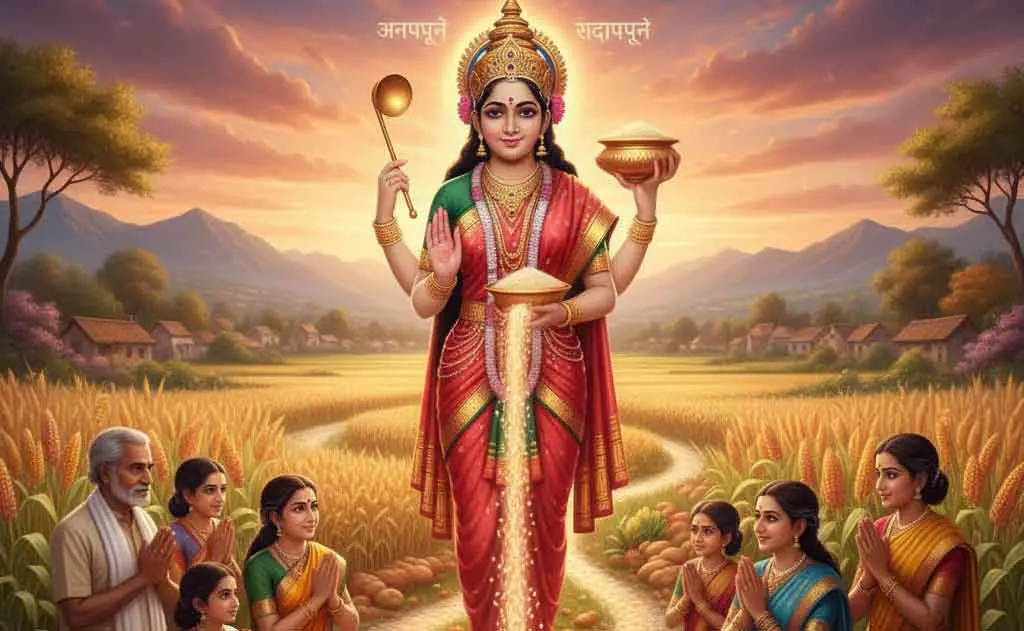
Annapurna Stotram, also called Annapurnashtakam, is Adi Shankaracharya's hymn to Annapurna Devi, the Mother who feeds the world from Kashi. Here is the full text with a simple English meaning of every verse, the famous refrain 'bhiksham dehi', how families chant it before cooking and meals, and the story of Annapurna as commonly told.
Annapurna Stotram, also called Annapurnashtakam, is Adi Shankaracharya's hymn to Annapurna Devi, the Mother who feeds the world from Kashi. Here is the full text with a simple English meaning of every verse, the famous refrain 'bhiksham dehi', how families chant it before cooking and meals, and the story of Annapurna as commonly told.
Quick answer: Annapurna Stotram, also called Annapurnashtakam, is a Sanskrit hymn to Goddess Annapurna that begins "Nityanandakari varabhayakari". It is traditionally attributed to Adi Shankaracharya. Ten verses end with the refrain "bhiksham dehi kripavalambanakari matannapurneshvari", "O Mother Annapurneshvari, support of compassion, give me alms", followed by two short closing verses. Families chant it in the morning, before cooking or before meals, on Fridays and on Annapurna Jayanti.
This guide has been restored at its original hindutone.com address.
Annapurna Stotram: full text with meaning
The text below follows the edition on sanskritdocuments.org. Each verse is given in Devanagari, then in IAST transliteration, then in simple English.
Verse 1
नित्यानन्दकरी वराभयकरी सौन्दर्यरत्नाकरी
निर्धूताखिलघोरपावनकरी प्रत्यक्षमाहेश्वरी ।
प्रालेयाचलवंशपावनकरी काशीपुराधीश्वरी
भिक्षां देहि कृपावलम्बनकरी माताऽन्नपूर्णेश्वरी ॥ १॥
nityānandakarī varābhayakarī saundaryaratnākarī
nirdhūtākhilaghorapāvanakarī pratyakṣamāheśvarī |
prāleyācalavaṃśapāvanakarī kāśīpurādhīśvarī
bhikṣāṃ dehi kṛpāvalambanakarī mātā'nnapūrṇeśvarī || 1||
Meaning: You give eternal bliss, you grant boons and freedom from fear, and you are an ocean of the jewels of beauty. You wash away every dreadful sin and make us pure; you are the great Goddess Maheshvari made visible. You bring glory to the family of the snowy Himalaya. O Queen of Kashi, Mother Annapurneshvari, you who are the support of all compassion, give me alms.
Verse 2
नानारत्नविचित्रभूषणकरी हेमाम्बराडम्बरी
मुक्ताहारविलम्बमान विलसत् वक्षोजकुम्भान्तरी ।
काश्मीरागरुवासिता रुचिकरी काशीपुराधीश्वरी
भिक्षां देहि कृपावलम्बनकरी माताऽन्नपूर्णेश्वरी ॥ २॥
nānāratnavicitrabhūṣaṇakarī hemāmbarāḍambarī
muktāhāravilambamāna vilasat vakṣojakumbhāntarī |
kāśmīrāgaruvāsitā rucikarī kāśīpurādhīśvarī
bhikṣāṃ dehi kṛpāvalambanakarī mātā'nnapūrṇeśvarī || 2||
Meaning: You are adorned with ornaments of many kinds of jewels and shine in golden garments, a string of pearls gleaming upon your breast. You are fragrant with saffron and aloe wood, radiant and lovely to behold. O Queen of Kashi, Mother Annapurneshvari, you who are the support of all compassion, give me alms.
Verse 3
योगानन्दकरी रिपुक्षयकरी धर्मार्थनिष्ठाकरी
चन्द्रार्कानलभासमानलहरी त्रैलोक्यरक्षाकरी ।
सर्वैश्वर्यसमस्तवाञ्छितकरी काशीपुराधीश्वरी
भिक्षां देहि कृपावलम्बनकरी माताऽन्नपूर्णेश्वरी ॥ ३॥
yogānandakarī ripukṣayakarī dharmārthaniṣṭhākarī
candrārkānalabhāsamānalaharī trailokyarakṣākarī |
sarvaiśvaryasamastavāñchitakarī kāśīpurādhīśvarī
bhikṣāṃ dehi kṛpāvalambanakarī mātā'nnapūrṇeśvarī || 3||
Meaning: You give the bliss of yoga and destroy all enemies, and you make us steadfast in dharma and in honest prosperity. Your radiance flows in waves like the light of the moon, the sun and fire, and you protect the three worlds. You grant every kind of good fortune and every wish of the heart. O Queen of Kashi, Mother Annapurneshvari, you who are the support of all compassion, give me alms.
Verse 4
कैलासाचलकन्दरालयकरी गौरी उमा शङ्करी
कौमारी निगमार्थगोचरकरी ओङ्कारबीजाक्षरी ।
मोक्षद्वारकपाटपाटनकरी काशीपुराधीश्वरी
भिक्षां देहि कृपावलम्बनकरी माताऽन्नपूर्णेश्वरी ॥ ४॥
kailāsācalakandarālayakarī gaurī umā śaṅkarī
kaumārī nigamārthagocarakarī oṅkārabījākṣarī |
mokṣadvārakapāṭapāṭanakarī kāśīpurādhīśvarī
bhikṣāṃ dehi kṛpāvalambanakarī mātā'nnapūrṇeśvarī || 4||
Meaning: You dwell in the caves of Mount Kailasa; you are Gauri, Uma and Shankari, the ever-youthful Kaumari. You make the meaning of the Vedas known, and your seed syllable is Om. You throw open the doors of the gate of liberation. O Queen of Kashi, Mother Annapurneshvari, you who are the support of all compassion, give me alms.
Verse 5
दृश्यादृश्य विभूतिवाहनकरी ब्रह्माण्डभाण्डोदरी
लीलानाटकसूत्रभेदनकरी विज्ञानदीपाङ्कुरी ।
श्रीविश्वेशमनः प्रसादनकरी काशीपुराधीश्वरी
भिक्षां देहि कृपावलम्बनकरी माताऽन्नपूर्णेश्वरी ॥ ५॥
dṛśyādṛśya vibhūtivāhanakarī brahmāṇḍabhāṇḍodarī
līlānāṭakasūtrabhedanakarī vijñānadīpāṅkurī |
śrīviśveśamanaḥ prasādanakarī kāśīpurādhīśvarī
bhikṣāṃ dehi kṛpāvalambanakarī mātā'nnapūrṇeśvarī || 5||
Meaning: You bear all glories, seen and unseen, and hold the whole universe within you. You cut the threads of this play-drama of the world, and you are the flame that springs from the lamp of wisdom. You delight the heart of Vishvesha, Lord of Kashi. O Queen of Kashi, Mother Annapurneshvari, you who are the support of all compassion, give me alms.
Verse 6
उर्वी सर्वजनेश्वरी भगवती माताऽन्नपूर्णेश्वरी
वेणीनीलसमानकुन्तलधरी नित्यान्नदानेश्वरी ।
सर्वानन्दकरी सदाशुभकरी काशीपुराधीश्वरी
भिक्षां देहि कृपावलम्बनकरी माताऽन्नपूर्णेश्वरी ॥ ६॥
urvī sarvajaneśvarī bhagavatī mātā'nnapūrṇeśvarī
veṇīnīlasamānakuntaladharī nityānnadāneśvarī |
sarvānandakarī sadāśubhakarī kāśīpurādhīśvarī
bhikṣāṃ dehi kṛpāvalambanakarī mātā'nnapūrṇeśvarī || 6||
Meaning: You are the earth itself, the sovereign of all beings, the blessed Mother Annapurneshvari. Your dark hair falls in a braid, and you are forever the Queen of the gift of food. You give every joy and are always auspicious. O Queen of Kashi, Mother Annapurneshvari, you who are the support of all compassion, give me alms.
Verse 7
आदिक्षान्तसमस्तवर्णनकरी शम्भोस्त्रिभावाकरी
काश्मीरा त्रिजलेश्वरी त्रिलहरी नित्याङ्कुरा शर्वरी ।
कामाकाङ्क्षकरी जनोदयकरी काशीपुराधीश्वरी
भिक्षां देहि कृपावलम्बनकरी माताऽन्नपूर्णेश्वरी ॥ ७॥
ādikṣāntasamastavarṇanakarī śambhostribhāvākarī
kāśmīrā trijaleśvarī trilaharī nityāṅkurā śarvarī |
kāmākāṅkṣakarī janodayakarī kāśīpurādhīśvarī
bhikṣāṃ dehi kṛpāvalambanakarī mātā'nnapūrṇeśvarī || 7||
Meaning: You give form to every letter of the alphabet, from the first to the last, and you embody the three aspects of Shambhu (Shiva). You are the saffron-hued one, the Queen of the three sacred waters, the three-fold wave of power, the ever-new sprout of life and the consort of Sharva. You fulfil desires and longings and raise people up. O Queen of Kashi, Mother Annapurneshvari, you who are the support of all compassion, give me alms.
Verse 8
देवी सर्वविचित्ररत्नरचिता दाक्षायणी सुन्दरी
वामे स्वादुपयोधरा प्रियकरी सौभाग्य माहेश्वरी ।
भक्ताभीष्टकरी सदाशुभकरी काशीपुराधीश्वरी
भिक्षां देहि कृपावलम्बनकरी माताऽन्नपूर्णेश्वरी ॥ ८॥
devī sarvavicitraratnaracitā dākṣāyaṇī sundarī
vāme svādupayodharā priyakarī saubhāgya māheśvarī |
bhaktābhīṣṭakarī sadāśubhakarī kāśīpurādhīśvarī
bhikṣāṃ dehi kṛpāvalambanakarī mātā'nnapūrṇeśvarī || 8||
Meaning: O Goddess, adorned with every wondrous jewel, Dakshayani, the beautiful one, standing at Shiva's left, sweet and nourishing like a mother, loving and gracious, the Maheshvari of good fortune. You fulfil the wishes of your devotees and are always auspicious. O Queen of Kashi, Mother Annapurneshvari, you who are the support of all compassion, give me alms.
Verse 9
चन्द्रार्कानलकोटिकोटिसदृशा चन्द्रांशुबिम्बाधरी
चन्द्रार्काग्निसमानकुण्डलधरी चन्द्रार्कवर्णेश्वरी ।
मालापुस्तकपाशसाङ्कुशधरी काशीपुराधीश्वरी
भिक्षां देहि कृपावलम्बनकरी माताऽन्नपूर्णेश्वरी ॥ ९॥
candrārkānalakoṭikoṭisadṛśā candrāṃśubimbādharī
candrārkāgnisamānakuṇḍaladharī candrārkavarṇeśvarī |
mālāpustakapāśasāṅkuśadharī kāśīpurādhīśvarī
bhikṣāṃ dehi kṛpāvalambanakarī mātā'nnapūrṇeśvarī || 9||
Meaning: You shine like millions upon millions of moons, suns and fires; your lips glow like the moonlit bimba fruit. Your earrings blaze like the moon, the sun and fire, and your splendour has the colours of the moon and the sun. You hold the rosary, the book, the noose and the goad. O Queen of Kashi, Mother Annapurneshvari, you who are the support of all compassion, give me alms.
Verse 10
क्षत्रत्राणकरी महाऽभयकरी माता कृपासागरी
साक्षान्मोक्षकरी सदा शिवकरी विश्वेश्वरी श्रीधरी ।
दक्षाक्रन्दकरी निरामयकरी काशीपुराधीश्वरी
भिक्षां देहि कृपावलम्बनकरी माताऽन्नपूर्णेश्वरी ॥ १०॥
kṣatratrāṇakarī mahā'bhayakarī mātā kṛpāsāgarī
sākṣānmokṣakarī sadā śivakarī viśveśvarī śrīdharī |
dakṣākrandakarī nirāmayakarī kāśīpurādhīśvarī
bhikṣāṃ dehi kṛpāvalambanakarī mātā'nnapūrṇeśvarī || 10||
Meaning: You protect those who protect others and give great fearlessness; you are the Mother, an ocean of compassion. You grant liberation directly, always do good, and are the Queen of the universe who bears all prosperity. You made Daksha cry out in sorrow, and you free us from all illness. O Queen of Kashi, Mother Annapurneshvari, you who are the support of all compassion, give me alms.
Verse 11
अन्नपूर्णे सदापूर्णे शङ्करप्राणवल्लभे ।
ज्ञानवैराग्यसिद्ध्यर्थं भिक्षां देहि च पार्वति ॥ ११॥
annapūrṇe sadāpūrṇe śaṅkaraprāṇavallabhe |
jñānavairāgyasiddhyarthaṃ bhikṣāṃ dehi ca pārvati || 11||
Meaning: O Annapurna, you who are ever full, beloved of Shankara as his very life: so that I may attain knowledge and detachment, give me alms, O Parvati.
Verse 12
माता मे पार्वती देवी पिता देवो महेश्वरः ।
बान्धवाः शिवभक्ताश्च स्वदेशो भुवनत्रयम् ॥ १२॥
mātā me pārvatī devī pitā devo maheśvaraḥ |
bāndhavāḥ śivabhaktāśca svadeśo bhuvanatrayam || 12||
Meaning: My mother is Goddess Parvati, and my father is Lord Maheshvara. My kinsmen are the devotees of Shiva, and my homeland is the three worlds.
Closing line
॥ इति श्रीशङ्करभगवतः कृतौ अन्नपूर्णास्तोत्रं सम्पूर्णम् ॥
|| iti śrīśaṅkarabhagavataḥ kṛtau annapūrṇāstotraṃ sampūrṇam ||
Meaning: Thus ends the Annapurna Stotram, composed by the revered Shankara Bhagavatpada.
Notice what the hymn asks for. Ten times the devotee holds out an empty bowl and says "bhiksham dehi", "give me alms". Only in the eleventh verse do we learn what the alms really are: not just rice and grain, but jnana and vairagya, knowledge and detachment.
How and when to chant Annapurna Stotram
Best times
- Before cooking: many families chant the stotram, or at least the refrain, before lighting the stove, so that the food is prepared as an offering.
- Before meals: verses 11 and 12 are short enough to recite at the table before eating. Children learn them quickly.
- Fridays and Purnima: both are loved for Devi worship.
- Annapurna Jayanti: the Goddess's day falls on Margashirsha Purnima, which in 2026 is Wednesday 23 December in India, the same day as Datta Jayanti 2026. Our Annapurna Jayanti 2026 guide has more.
How many times
Once a day is a beautiful practice. On special days some devotees chant it 3, 11 or 108 times; our article on the sacred number 108 explains why that number is special.
A simple way to chant at home
- Wash your hands and keep the kitchen or puja corner clean; many families keep a small picture of Annapurna near the stove.
- Light a lamp and offer a flower, a little rice, or the first portion of the food you have cooked.
- Make a simple sankalpa (intention) in your own words, for example: "Mother Annapurna, thank you for the food that nourishes our family. May we always share it."
- Recite the twelve verses and the closing line slowly and clearly.
- Offer the food to the Goddess, then share it as prasad.
Pronunciation tips in plain English
- In the IAST lines, a line over a vowel means it is held longer: Annapurna is 'an-na-POOR-naa', with a long 'oo' and a long final 'aa'.
- The verses are long. Take a breath at the vertical line in the middle of each verse, and chant slowly. A clear recording helps.
Significance and traditional benefits
In Hindu thought, food is not just fuel. The Upanishads speak of food itself as a form of the Divine. Annapurna is that truth as a Mother who feeds every creature without asking who is worthy.
Traditionally, devotees believe the hymn blesses the kitchen and the home, nurtures gratitude and a spirit of sharing, and turns the mind toward knowledge and detachment, as the eleventh verse prays. Many also describe it as a prayer that there should never be lack in the home. No hymn comes with a guarantee of material results; it is best chanted as an offering of thanks, alongside honest work and generosity. Feeding someone who is hungry is perhaps the truest worship of Annapurna.
If you are looking for a prayer for a particular need in life, our guide on which god to pray to for job, marriage, health, money and studies offers gentle, traditional suggestions.
The story of Annapurna of Kashi, as commonly told
As the story is commonly told, Shiva once remarked to Parvati that the world is maya, an illusion, and that even food is part of that passing show. She withdrew from the world, and with her went all food. Gods, sages and humans alike suffered from hunger.
Seeing the suffering of all beings, Parvati appeared in Kashi as Annapurna and opened a kitchen to feed everyone. Shiva himself came to her with a begging bowl, and she lovingly filled it with food. This is why Annapurna is often shown with a ladle and a vessel of food, and Shiva before her holding out his bowl.
Kashi, also known as Varanasi, is therefore the special home of Annapurna. The Annapurna Devi temple stands in the old city near the Kashi Vishwanath temple, and pilgrims traditionally visit both. The temple is known for its Annakoot, when a great offering of food is made to the Goddess and shared as prasada. Many also visit the Kalabhairava temple. For current darshan arrangements, check the temples' official websites.
NRI families often keep this spirit alive by reciting 'Annapurne sadapurne' before dinner, and by cooking for a local food bank, a temple annadanam or a neighbour in need. Those who love this hymn often also chant the Kalabhairava Ashtakam for Kashi's guardian.
Frequently asked questions
What is the meaning of Annapurna Stotram lyrics?
Annapurna Stotram praises Goddess Annapurna, the form of Parvati who gives food to the whole world and rules over Kashi. Each of the first ten verses describes her beauty, power and compassion and ends with the refrain 'bhiksham dehi kripavalambanakari matannapurneshvari', meaning 'O Mother Annapurneshvari, support of all compassion, give me alms'. The last two verses ask for the alms of knowledge and detachment and call Parvati and Shiva our parents.
Who wrote Annapurna Stotram?
Annapurna Stotram is traditionally attributed to Adi Shankaracharya. The closing line of the text itself says it was composed by Shankara Bhagavatpada.
What are the benefits of chanting Annapurna Stotram?
Devotees believe the hymn brings the Mother's blessing on the kitchen and the home, nurtures gratitude for food, and helps the mind turn toward knowledge and detachment, which is exactly what the eleventh verse asks for. These are traditional beliefs, not guarantees.
When should I chant Annapurna Stotram: before cooking or before eating?
Both are traditional. Many people chant the full stotram in the morning or before cooking, and recite only verses 11 and 12 ('Annapurne sadapurne' and 'Mata me Parvati Devi') before a meal. Fridays and Purnima days are especially loved.
Can women and children chant Annapurna Stotram?
Yes. It is one of the most widely chanted household hymns, and in many homes it is women and children who lead it. Children can start with the short 'Annapurne sadapurne' verse before meals.
How many times should Annapurna Stotram be chanted?
Once a day is a lovely practice. On special days some devotees chant it 3, 11 or 108 times. A short daily recitation with gratitude matters more than the count.
Editor's note
Editor's note (7 October 2026): This guide has been restored at its original address after the earlier version was lost. The Sanskrit text in Devanagari and IAST follows the edition on sanskritdocuments.org, and minor variants in wording and recitation exist; if your family follows a particular book, follow that book. The English meanings are our own plain translations. The attribution to Adi Shankaracharya is given as traditionally accepted, and the story is given as commonly told. The hymn is presented as an act of devotion, with no promise of particular results.
Related guides
You might also like
Navagraha Stotram (Japakusuma Sankasham): Lyrics, Meaning and Benefits
Bhairav Chalisa: Lyrics in Hindi with Meaning, Bhairav Aarti and How to Recite
Shani Chalisa Lyrics in Hindi with Meaning and Shani Dev Aarti