Bhairav Chalisa: Lyrics in Hindi with Meaning, Bhairav Aarti and How to Recite
Bhairav Chalisa is the Hindi hymn to Shri Bhairav, the fierce yet protective form of Shiva honoured as the Kotwal of Kashi. Here is the full text with a plain-English meaning of every doha and chaupai, the Bhairav aarti, and gentle guidance on reciting it on Ashtami and Kalabhairav Jayanti.
Bhairav Chalisa is the Hindi hymn to Shri Bhairav, the fierce yet protective form of Shiva honoured as the Kotwal of Kashi. Here is the full text with a plain-English meaning of every doha and chaupai, the Bhairav aarti, and gentle guidance on reciting it on Ashtami and Kalabhairav Jayanti.
Quick answer: Bhairav Chalisa is a devotional Hindi hymn of dohas and chaupais in praise of Shri Bhairav, the fierce yet protective form of Shiva who is honoured as the Kotwal, the guardian, of Kashi. As traditionally attributed, it was composed by the poet Sundardas, whose name appears near its end. Devotees recite it on Sundays or Tuesdays, on Kalashtami each month, and above all on Kalabhairav Jayanti, which in 2026 falls on Tuesday 1 December in India and Monday 30 November in the USA. It is usually followed by the Bhairav aarti, "Jai Bhairav Deva".
This guide has been restored at its original hindutone.com address. Below you will find the complete text in Devanagari and transliteration, a plain-English meaning after every unit, the aarti with its meaning, simple guidance on reciting it at home, and the significance of Bhairav worship as devotees understand it.
Who is Bhairav?
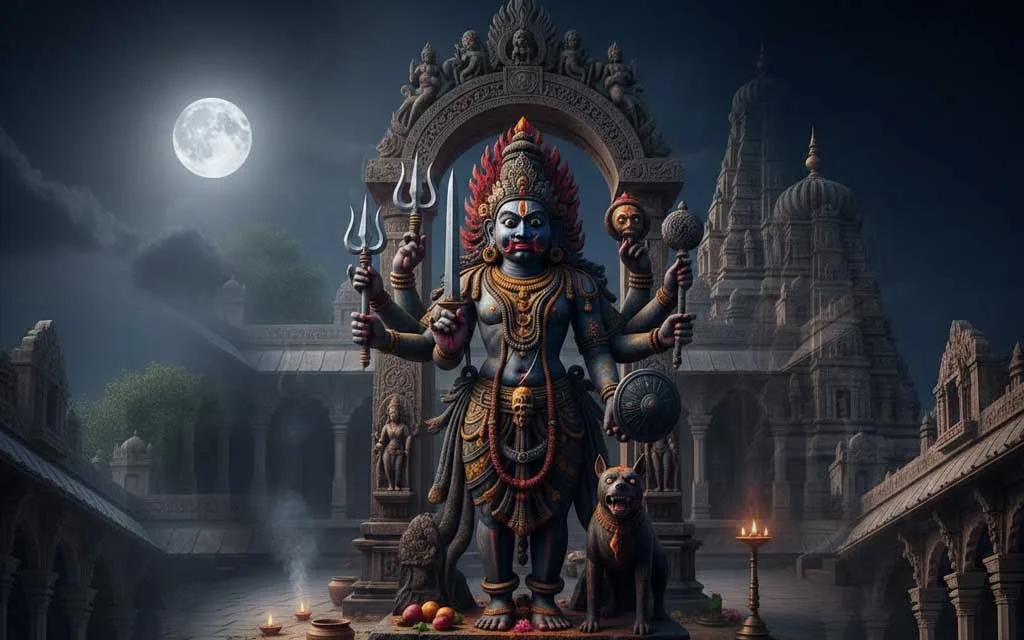
Bhairav, also written Bhairava, is a form of Shiva. His name is linked with bhaya, fear: he is fearsome to look at, yet he removes fear from those who take refuge in him. As commonly told in the Puranas, Shiva manifested as Kaal Bhairav to humble the pride of Brahma, and Bhairav then wandered until he reached Kashi, where he was freed and made the city's guardian. That is why the Chalisa calls him the Kotwal of Kashi again and again.
The Chalisa names several of his forms. Batuk Bhairav is the gentle child form; Kaal Bhairav is the lord of time; Nath Bhairav and Sarva Bhairav are praised alongside them. His mount is a dog, he carries the trident and the damaru, and the sixty-four yoginis dance in his company.
| Form or name in the Chalisa | Simple meaning |
|---|---|
| Kashi Kotwal | The guardian and protector of the holy city of Kashi (Varanasi) |
| Batuk Bhairav | Bhairav in the form of a young boy, gentle and loving to devotees |
| Kaal Bhairav | Bhairav as the lord of time, who gives strength and destroys sin |
| Kali ke lala | The beloved son of Mother Kali |
| Bhaya-harana | The remover of fear |
| Swanarudha | He who rides on a dog |
Bhairav Chalisa: full text with meaning
The text follows the Hindi edition on sanskritdocuments.org. Each unit is given in Devanagari, then in transliteration, then in simple English. The meanings stay close to the Hindi words, but are written so that the devotional sense comes through clearly. A few chaupais near the middle are strings of Bhairav's names, and there we simply list the names.
Opening doha
श्री गणपति गुरु गौरि पद प्रेम सहित धरि माथ ।
चालीसा वन्दन करौं श्री शिव भैरवनाथ ॥
śrī gaṇapati guru gauri pada prema sahita dhari mātha |
cālīsā vandana karauṃ śrī śiva bhairavanātha ||
Meaning: Placing my head with love at the feet of Shri Ganapati, of the Guru and of Gauri, I offer this Chalisa in salutation to Shri Shiva Bhairavanath. Like most chalisas, the hymn begins by honouring Ganesha, the guru and the Divine Mother before turning to its deity.
Chaupais
Each meaning below is a single faithful sentence so that you can follow along while reciting. The first unit is a couplet of invocation describing Bhairav's form; then the chaupais proper begin with "Jai jai Shri Kali ke lala".
श्री भैरव संकट हरण मंगल करण कृपाल ।
श्याम वरण विकराल वपु लोचन लाल विशाल ॥
śrī bhairava saṃkaṭa haraṇa maṃgala karaṇa kṛpāla |
śyāma varaṇa vikarāla vapu locana lāla viśāla ||
Meaning: Shri Bhairav takes away troubles, brings auspiciousness and is full of compassion; his complexion is dark, his body formidable, and his eyes large and red.
जय जय श्री काली के लाला । जयति जयति काशी-कुतवाला ॥
jaya jaya śrī kālī ke lālā | jayati jayati kāśī-kutavālā ||
Meaning: Victory, victory to the beloved son of Shri Kali; victory, victory to the Kotwal, the guardian, of Kashi.
जयति बटुक-भैरव भय हारी । जयति काल-भैरव बलकारी ॥
jayati baṭuka-bhairava bhaya hārī | jayati kāla-bhairava balakārī ||
Meaning: Victory to Batuk Bhairav, who takes away fear; victory to Kaal Bhairav, who gives strength.
जयति नाथ-भैरव विख्याता । जयति सर्व-भैरव सुखदाता ॥
jayati nātha-bhairava vikhyātā | jayati sarva-bhairava sukhadātā ||
Meaning: Victory to the renowned Nath Bhairav; victory to Sarva Bhairav, the giver of happiness.
भैरव रूप कियो शिव धारण । भव के भार उतारण कारण ॥
bhairava rūpa kiyo śiva dhāraṇa | bhava ke bhāra utāraṇa kāraṇa ||
Meaning: Shiva took the form of Bhairav to lift the burden of the world.
भैरव रव सुनि ह्वै भय दूरी । सब विधि होय कामना पूरी ॥
bhairava rava suni hvai bhaya dūrī | saba vidhi hoya kāmanā pūrī ||
Meaning: Hearing Bhairav's roar, fear runs far away, and every wish is fulfilled in every way.
शेष महेश आदि गुण गायो । काशी-कोतवाल कहलायो ॥
śeṣa maheśa ādi guṇa gāyo | kāśī-kotavāla kahalāyo ||
Meaning: Shesha, Mahesh and others sang his virtues, and he came to be called the Kotwal of Kashi.
जटा जूट शिर चंद्र विराजत । बाला मुकुट बिजायठ साजत ॥
jaṭā jūṭa śira caṃdra virājata | bālā mukuṭa bijāyaṭha sājata ||
Meaning: His hair is gathered in matted locks with the moon shining on his head, and he is adorned with earrings, a crown and armlets.
कटि करधनी घूँघरू बाजत । दर्शन करत सकल भय भाजत ॥
kaṭi karadhanī ghū~gharū bājata | darśana karata sakala bhaya bhājata ||
Meaning: Around his waist a girdle of little bells jingles, and seeing him every fear flees.
जीवन दान दास को दीन्ह्यो । कीन्ह्यो कृपा नाथ तब चीन्ह्यो ॥
jīvana dāna dāsa ko dīnhyo | kīnhyo kṛpā nātha taba cīnhyo ||
Meaning: He gave the gift of life to his servant; when he showed me his grace, I recognised my Lord.
वसि रसना बनि सारद-काली । दीन्ह्यो वर राख्यो मम लाली ॥
vasi rasanā bani sārada-kālī | dīnhyo vara rākhyo mama lālī ||
Meaning: Dwelling on my tongue as Sharada and Kali, he granted me a boon and protected my honour.
धन्य धन्य भैरव भय भंजन । जय मनरंजन खल दल भंजन ॥
dhanya dhanya bhairava bhaya bhaṃjana | jaya manaraṃjana khala dala bhaṃjana ||
Meaning: Blessed, blessed is Bhairav, the breaker of fear; victory to him who delights the mind and crushes the hosts of the wicked.
कर त्रिशूल डमरू शुचि कोड़ा । कृपा कटाक्श सुयश नहिं थोडा ॥
kara triśūla ḍamarū śuci kor̤ā | kṛpā kaṭākśa suyaśa nahiṃ thoḍā ||
Meaning: In his hands he holds the trident, the damaru drum and a sacred whip, and his glance of grace and his fame are great.
जो भैरव निर्भय गुण गावत । अष्टसिद्धि नव निधि फल पावत ॥
jo bhairava nirbhaya guṇa gāvata | aṣṭasiddhi nava nidhi phala pāvata ||
Meaning: Whoever fearlessly sings Bhairav's virtues receives the eight siddhis and the nine treasures as fruit.
रूप विशाल कठिन दुख मोचन । क्रोध कराल लाल दुहुँ लोचन ॥
rūpa viśāla kaṭhina dukha mocana | krodha karāla lāla duhu~ locana ||
Meaning: His vast form frees from hard sorrows, and in fierce anger both his eyes glow red.
अगणित भूत प्रेत संग डोलत । बं बं बं शिव बं बं बोलत ॥
agaṇita bhūta preta saṃga ḍolata | baṃ baṃ baṃ śiva baṃ baṃ bolata ||
Meaning: Countless bhutas and pretas wander with him as he calls out, "Bam bam bam Shiva, bam bam".
रुद्रकाय काली के लाला । महा कालहू के हो काला ॥
rudrakāya kālī ke lālā | mahā kālahū ke ho kālā ||
Meaning: O beloved son of Kali, whose body is Rudra himself, you are death even to Mahakaal.
बटुक नाथ हो काल गँभीरा । श्वेत रक्त अरु श्याम शरीरा ॥
baṭuka nātha ho kāla ga~bhīrā | śveta rakta aru śyāma śarīrā ||
Meaning: As Batuk Nath you are as deep as time itself, and your bodies are white, red and dark.
करत नीनहूँ रूप प्रकाशा । भरत सुभक्तन कहँ शुभ आशा ॥
karata nīnahū~ rūpa prakāśā | bharata subhaktana kaha~ śubha āśā ||
Meaning: You shine forth in all three forms, filling your good devotees with auspicious hope.
रत्न जड़ित कंचन सिंहासन । व्याघ्र चर्म शुचि नर्म सुआनन ॥
ratna jar̤ita kaṃcana siṃhāsana | vyāghra carma śuci narma suānana ||
Meaning: You sit on a golden throne set with jewels, on a pure, soft tiger skin, with a gracious face.
तुमहि जाइ काशिहिं जन ध्यावहिं । विश्वनाथ कहँ दर्शन पावहिं ॥
tumahi jāi kāśihiṃ jana dhyāvahiṃ | viśvanātha kaha~ darśana pāvahiṃ ||
Meaning: People go to Kashi to meditate on you, and there they receive the darshan of Vishwanath.
जय प्रभु संहारक सुनन्द जय । जय उन्नत हर उमा नन्द जय ॥
jaya prabhu saṃhāraka sunanda jaya | jaya unnata hara umā nanda jaya ||
Meaning: Victory, O Lord, the destroyer; victory, Sunanda; victory to the exalted one, the joy of Hara and Uma.
भीम त्रिलोचन स्वान साथ जय । वैजनाथ श्री जगतनाथ जय ॥
bhīma trilocana svāna sātha jaya | vaijanātha śrī jagatanātha jaya ||
Meaning: Victory to the mighty three-eyed one who keeps a dog beside him; victory to Vaijanath and to Shri Jagatnath.
महा भीम भीषण शरीर जय । रुद्र त्र्यम्बक धीर वीर जय ॥
mahā bhīma bhīṣaṇa śarīra jaya | rudra tryambaka dhīra vīra jaya ||
Meaning: Victory to the immensely mighty one with a fearsome body; victory to Rudra, Tryambaka, the steady hero.
अश्वनाथ जय प्रेतनाथ जय । स्वानारुढ़ सयचंद्र नाथ जय ॥
aśvanātha jaya pretanātha jaya | svānārur̤ha sayacaṃdra nātha jaya ||
Meaning: Victory to Ashvanath, victory to Pretanath; victory to the lord who rides the dog, the lord who bears the moon.
निमिष दिगंबर चक्रनाथ जय । गहत अनाथन नाथ हाथ जय ॥
nimiṣa digaṃbara cakranātha jaya | gahata anāthana nātha hātha jaya ||
Meaning: Victory to the sky-clad Chakranath, swift as the blink of an eye; victory to the lord who takes the hand of the helpless.
त्रेशलेश भूतेश चंद्र जय । क्रोध वत्स अमरेश नन्द जय ॥
treśaleśa bhūteśa caṃdra jaya | krodha vatsa amareśa nanda jaya ||
Meaning: This chaupai is a string of names: victory to Treshalesh, to Bhutesh, the lord of beings, and to Chandra; victory to Krodha, Vatsa and Amareshnanda.
श्री वामन नकुलेश चण्ड जय । कृत्याऊ कीरति प्रचण्ड जय ॥
śrī vāmana nakuleśa caṇḍa jaya | kṛtyāū kīrati pracaṇḍa jaya ||
Meaning: Victory to Shri Vamana, Nakulesh and Chanda; victory to the one of fierce renown.
रुद्र बटुक क्रोधेश कालधर । चक्र तुण्ड दश पाणिव्याल धर ॥
rudra baṭuka krodheśa kāladhara | cakra tuṇḍa daśa pāṇivyāla dhara ||
Meaning: You are Rudra, Batuk, Krodhesh and the bearer of time, holding the discus, with ten hands that carry serpents.
करि मद पान शम्भु गुणगावत । चौंसठ योगिन संग नचावत ॥
kari mada pāna śambhu guṇagāvata | cauṃsaṭha yogina saṃga nacāvata ||
Meaning: Having drunk deep, you sing the glories of Shambhu and make the sixty-four yoginis dance with you.
करत कृपा जन पर बहु ढंगा । काशी कोतवाल अड़बंगा ॥
karata kṛpā jana para bahu ḍhaṃgā | kāśī kotavāla ar̤abaṃgā ||
Meaning: In many ways you show kindness to your people, O free-spirited Kotwal of Kashi.
देयँ काल भैरव जब सोटा । नसै पाप मोटा से मोटा ॥
deya~ kāla bhairava jaba soṭā | nasai pāpa moṭā se moṭā ||
Meaning: When Kaal Bhairav strikes with his staff, even the heaviest sin is destroyed.
जनकर निर्मल होय शरीरा । मिटै सकल संकट भव पीरा ॥
janakara nirmala hoya śarīrā | miṭai sakala saṃkaṭa bhava pīrā ||
Meaning: The devotee's body becomes pure, and every trouble and the pain of worldly life fade away.
श्री भैरव भूतोंके राजा । बाधा हरत करत शुभ काजा ॥
śrī bhairava bhūtoṃke rājā | bādhā harata karata śubha kājā ||
Meaning: Shri Bhairav is the king of the spirits; he removes obstacles and brings good work to completion.
ऐलादी के दुःख निवारयो । सदा कृपाकरि काज सम्हारयो ॥
ailādī ke duḥkha nivārayo | sadā kṛpākari kāja samhārayo ||
Meaning: He removed the sorrows of Ailadi and others, and by his grace he always set their affairs right.
सुन्दर दास सहित अनुरागा । श्री दुर्वासा निकट प्रयागा ॥
sundara dāsa sahita anurāgā | śrī durvāsā nikaṭa prayāgā ||
Meaning: Sundardas, full of loving devotion, composed this near the place of Shri Durvasa at Prayag.
श्री भैरव जी की जय लेख्यो । सकल कामना पूरण देख्यो ॥
śrī bhairava jī kī jaya lekhyo | sakala kāmanā pūraṇa dekhyo ||
Meaning: He wrote out the victory of Shri Bhairav and saw every wish fulfilled.
Closing doha
जय जय जय भैरव बटुक स्वामी संकट टार ।
कृपा दास पर कीजिए शंकर के अवतार ॥
jaya jaya jaya bhairava baṭuka svāmī saṃkaṭa ṭāra |
kṛpā dāsa para kījie śaṃkara ke avatāra ||
Meaning: Victory, victory, victory to Bhairav, Lord Batuk, who wards off troubles; O incarnation of Shankar, shower your grace on this servant. The closing doha returns to the simplest prayer of all: a request for grace.
Bhairav Aarti: Jai Bhairav Deva, with meaning
After the Chalisa, the aarti is sung while a lamp is waved before Bhairav's image. In this aarti, the closing stanza names its poet, Dharanidhar, and calls the Lord Batuknath, the child form of Bhairav.
जय भैरव देवा प्रभु जय भैरव देवा ।
जय काली और गौरा देवी कृत सेवा ॥ जय॥
jaya bhairava devā prabhu jaya bhairava devā |
jaya kālī aura gaurā devī kṛta sevā || jaya||
Meaning: Victory to you, Lord Bhairav Deva, victory to Bhairav Deva, you who are served by Kali and by Gauri Devi. The words 'Jai' at the end of each stanza are the refrain, sung by everyone as the lamp is waved.
तुम्ही पाप उद्धारक दुःख सिन्धु तारक ।
भक्तों के सुख कारक भीषण वपु धारक ॥ जय॥
tumhī pāpa uddhāraka duḥkha sindhu tāraka |
bhaktoṃ ke sukha kāraka bhīṣaṇa vapu dhāraka || jaya||
Meaning: You lift us out of sin and carry us across the ocean of sorrow; you bring happiness to your devotees and bear a fearsome form.
वाहन श्वान विराजत कर त्रिशूल धारी ।
महिमा अमित तुम्हारी जय जय भयहारी ॥ जय॥
vāhana śvāna virājata kara triśūla dhārī |
mahimā amita tumhārī jaya jaya bhayahārī || jaya||
Meaning: Your mount, the dog, is with you and you hold the trident in your hand. Your glory is boundless; victory, victory to you, the remover of fear.
तुम बिन सेवा देवा सफल नहीं होवे ।
चौमुख दीपक दर्शन सबका दुःख खोवे ॥ जय॥
tuma bina sevā devā saphala nahīṃ hove |
caumukha dīpaka darśana sabakā duḥkha khove || jaya||
Meaning: Without you, O Deva, no worship bears fruit. The sight of the four-wicked lamp takes away everyone's sorrow.
तेल चटकि दधि मिश्रित भाषावलि तेरी ।
कृपा करिये भैरव करिये नहीं देरी ॥ जय॥
tela caṭaki dadhi miśrita bhāṣāvali terī |
kṛpā kariye bhairava kariye nahīṃ derī || jaya||
Meaning: Oil and curd are offered to you as your praises are sung; O Bhairav, show your grace and do not delay. The first half of this line is read in slightly different ways in different editions, but it clearly speaks of the simple offerings made to Bhairav.
पाव घूंघरु बाजत अरु डमरु डमकावत ।
बटुकनाथ बन बालकजन मन हरषावत ॥ जय॥
pāva ghūṃgharu bājata aru ḍamaru ḍamakāvata |
baṭukanātha bana bālakajana mana haraṣāvata || jaya||
Meaning: Anklet bells jingle on your feet and your damaru resounds. Taking the form of Batuknath, a child, you delight the hearts of the people.
बटुकनाथ की आरती जो कोई नर गावे ।
कहे धरणीधर नर मनवांछित फल पावे ॥ जय॥
baṭukanātha kī āratī jo koī nara gāve |
kahe dharaṇīdhara nara manavāṃchita phala pāve || jaya||
Meaning: Whoever sings this aarti of Batuknath, says the poet Dharanidhar, receives the fruit desired in their heart. This is the traditional closing blessing of the aarti, an expression of faith rather than a promise.
How and when to recite Bhairav Chalisa
Best days and times
- Kalabhairav Jayanti: the appearance day of Kaal Bhairav is the most important day of the year for this Chalisa. In 2026 it falls on Tuesday 1 December in India and Monday 30 November in the USA. Our Kalabhairava Jayanti 2026 guide covers its significance, vrat and mantra.
- Kalashtami: the Ashtami (eighth lunar day) of the waning moon each month is sacred to Bhairav, and many devotees recite the Chalisa on that day.
- Sundays and Tuesdays: many families set aside one of these days each week for Bhairav worship.
- Evening: Bhairav is often worshipped at dusk or after dark, when the lamp is lit. Morning recitation after a bath is equally fine.
How many times
Once on each chosen day is a complete practice. On Kalashtami or Kalabhairav Jayanti some devotees read it 3, 11 or 108 times. If you count on a mala, our article on the sacred number 108 explains why that number is special.
A simple setup at home
- Wash your hands and face and sit before a picture of Bhairav or a Shiva lingam. A clean, quiet corner is all you need.
- Light a lamp. Many devotees use a mustard-oil or sesame-oil lamp for Bhairav, and the aarti itself praises the four-wicked lamp.
- Offer a flower, a little incense, and a simple sweet or some curd, as the aarti mentions.
- Make a simple sankalpa in your own words, for example: "Bhairav Baba, I recite this Chalisa with devotion. Please take away fear from our hearts and protect our family."
- Recite the opening doha, the chaupais and the closing doha slowly and clearly, then sing the aarti while waving the lamp.
- Many devotees feed a dog afterwards, since the dog is Bhairav's mount. Share the sweet as prasad.
Significance and traditional benefits
Bhairav can look frightening: dark, with red eyes, surrounded by spirits, carrying weapons. The Chalisa does not hide this. But again and again it calls him kind, the remover of fear, the one who holds the hand of the helpless. Devotees understand his fierceness as directed at what harms us, never at the devotee.
Traditionally, devotees believe that reciting Bhairav Chalisa with devotion:
- removes fear and anxiety and gives courage, as chaupais 7, 10 and 13 say;
- invites Bhairav's protection over the home, the family and journeys;
- helps clear obstacles from good work, in the words of chaupai 35;
- purifies the mind and loosens the hold of past wrongdoing, as chaupais 33 and 34 describe.
The Chalisa speaks in the traditional language of devotion: wishes fulfilled, siddhis and treasures gained. These are expressions of faith in Bhairav's grace, not guarantees of particular results. The hymn is best recited as an offering of love and surrender.
Many devotees also chant the Sanskrit Kalabhairava Ashtakam of Adi Shankaracharya, which praises the same Lord of Kashi. On a pilgrimage to Varanasi, it is a long-held custom to seek Kaal Bhairav's blessing along with the darshan of Kashi Vishwanath, just as chaupai 22 says.
Tips for NRI families
- Mark Kalabhairav Jayanti by your local date. In 2026 the USA observes it on Monday 30 November, a day earlier than India. In other countries, check a reliable panchang for your city.
- Start with the aarti. Children quickly learn the refrain "Jai Bhairav Deva". Add the Chalisa a few chaupais at a time.
- Introduce Batuk Bhairav first. Young children relate easily to the gentle boy form, and the aarti itself says he delights people's hearts as a child.
- Remember the dog. Feeding a street dog or caring for a pet with kindness is a simple, gentle way to honour Bhairav's mount wherever you live.
Frequently asked questions
Where can I find Bhairav Chalisa lyrics in Hindi with meaning?
The complete Bhairav Chalisa is given on this page in Hindi (Devanagari), followed by English transliteration and a simple English meaning after every doha and chaupai. The Bhairav aarti, "Jai Bhairav Deva", follows it with its meaning.
Who wrote Bhairav Chalisa?
The poet names himself inside the hymn: one chaupai mentions Sundardas, who composed it with loving devotion near the place of the sage Durvasa at Prayag. As traditionally attributed, Bhairav Chalisa is therefore the work of Sundardas. The aarti that follows names a different poet, Dharanidhar.
What are the benefits of reading Bhairav Chalisa?
Devotees believe that reciting Bhairav Chalisa with devotion removes fear, gives courage and inner strength, and invites Bhairav's protection over the home and family. The hymn itself speaks of troubles fading and obstacles being removed. These are traditional statements of faith, not guarantees of particular results.
On which day should I read Bhairav Chalisa?
Many devotees recite it on Sundays or Tuesdays, and especially on Kalashtami, the Ashtami of the waning moon each month. The most important day of the year is Kalabhairav Jayanti, which in 2026 falls on Tuesday 1 December in India and Monday 30 November in the USA.
How many times should Bhairav Chalisa be read?
Once a day, or once on each day you set aside for Bhairav, is a complete practice. On Kalashtami or Kalabhairav Jayanti some devotees read it 3, 11 or 108 times. Steady, sincere recitation matters more than the count.
Is Bhairav Chalisa the same as Kalabhairava Ashtakam?
No. Bhairav Chalisa is a Hindi devotional hymn of dohas and chaupais. Kalabhairava Ashtakam is an eight-verse Sanskrit hymn traditionally attributed to Adi Shankaracharya. Both praise Kaal Bhairav, the guardian of Kashi, and many devotees recite them together.
Editor's note
Editor's note (7 October 2026): This guide has been restored at its original address after the earlier version was lost. The Hindi text in Devanagari and transliteration follows the edition on sanskritdocuments.org. Minor variants in wording and recitation exist between printed editions and family traditions; if your family or temple follows a particular book, follow that book. The English meanings are our own plain translations, and a few obscure names are given as they appear. The authorship of the Chalisa (Sundardas) and of the aarti (Dharanidhar) is given as traditionally attributed, and the legends as commonly told. The Kalabhairav Jayanti dates are Monday 30 November 2026 for the USA and Tuesday 1 December 2026 for India. The hymn is presented as an act of devotion, with no promise of particular results.
Related guides
- Kalabhairava Ashtakam: lyrics, meaning and benefits
- Kalabhairava Jayanti 2026: significance, vrat and mantra
- Shiv Chalisa lyrics in Hindi with meaning
- Shiva Panchakshara Stotram with meaning
- Shani Chalisa lyrics in Hindi with meaning
- Kashi Vishwanath Temple, Varanasi
- 12 Jyotirlingas of Lord Shiva: complete guide
You might also like
Ram Chalisa: Lyrics in Hindi with Meaning, Ram Stuti Aarti and How to Recite
Shani Chalisa Lyrics in Hindi with Meaning and Shani Dev Aarti
Lakshmi Chalisa Lyrics in Hindi with Meaning, and Om Jai Lakshmi Mata Aarti