
Kuttu Puri for Navratri Vrat: Buckwheat Puris with Potato Binder and Vrat Aloo Sabzi
A standard home recipe for kuttu ka atta puri for the Navratri fast, using boiled potato to bind the gluten-free buckwheat flour, with a quick vrat aloo sabzi, rolling tips, substitutions and storage.
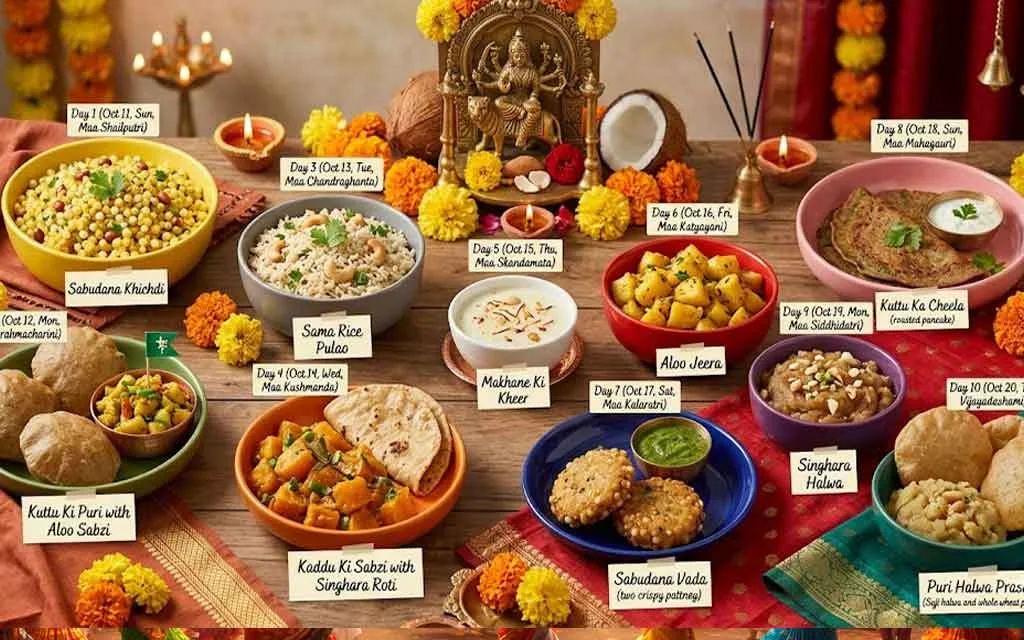
A standard home recipe for kuttu ka atta puri for the Navratri fast, using boiled potato to bind the gluten-free buckwheat flour, with a quick vrat aloo sabzi, rolling tips, substitutions and storage.
Quick answer: Kuttu puri is made by kneading 1 cup of kuttu ka atta (buckwheat flour) with one mashed boiled potato and sendha namak (rock salt) into a soft dough, rolling small puris between two sheets of baking paper, and deep-frying them in hot ghee or oil. Because buckwheat has no gluten, the potato is what holds the dough together. Serve with a no-onion, no-garlic vrat aloo sabzi. It is a classic meal for the Navratri 2026 fast, 11 to 19 October 2026 in India.
Below are standard home recipes for both, with approximate quantities and timings, rolling tips, substitutions and storage. For the full nine-day menu, see our Sharad Navratri 2026 day-wise vrat recipes.
Why kuttu is used in the fast
Kuttu (buckwheat) is the seed of a flowering plant rather than a true cereal, so many families treat it as phalahar or vrat food alongside singhara, rajgira and samak. The flour is dark and earthy, and it is the most common base for vrat puris and pakoras in North India. Some families eat only fruit and milk on certain days, while others allow one cooked meal. See our Navratri fasting rules 2026 for the common practice.
The recipes
Kuttu Puri (Buckwheat Puri for Vrat)
Deep-fried puris of kuttu (buckwheat) flour bound with mashed boiled potato and seasoned with rock salt. A classic Navratri fasting bread in North Indian homes.
Prep: about 15 minutes. Cook: about 15 minutes. Makes: About 10 to 12 small puris (serves 2 to 3) (approximate).
Ingredients
- 1 cup (about 120 g) kuttu ka atta (buckwheat flour), plus a little for dusting
- 1 medium potato (about 120 g), boiled, peeled and finely mashed
- 1/2 teaspoon sendha namak (rock salt), or to taste
- 1/4 teaspoon cumin seeds or black pepper, crushed (optional)
- 1 teaspoon ghee
- 1 to 3 tablespoons water, only if needed
- Ghee or groundnut oil for deep-frying
Method
- Mash the boiled potato while still warm until completely smooth, with no lumps.
- In a bowl, mix the kuttu atta, rock salt and cumin or pepper. Add the mashed potato and the teaspoon of ghee.
- Knead with your hands. The potato's moisture binds the flour; add water only a teaspoon at a time if the dough is crumbly. It should be soft but not sticky.
- Rest the dough, covered, for 5 minutes only. Kuttu dough gets sticky if left too long.
- Heat ghee or oil for deep-frying over medium-high heat.
- Divide the dough into 10 to 12 small balls. Place a ball between two sheets of baking paper or a cut-open plastic bag and roll or press it into a puri about 3 mm thick, slightly thicker than a wheat puri.
- Peel off the top sheet, flip the puri onto your palm and peel off the second sheet.
- Slide the puri gently into the hot fat. Press it lightly with a slotted spoon so it puffs, then turn and fry for 30 to 40 seconds more until light brown on both sides.
- Drain on paper towels and serve hot with vrat aloo sabzi.
Tips: Make the dough just before frying. If the dough cracks at the edges while rolling, knead in a teaspoon of mashed potato or water. If it sticks to the sheets, dust with a little more kuttu atta.
Vrat Aloo Sabzi (No Onion, No Garlic)
A quick potato curry with cumin, green chilli, ginger, tomato and rock salt, made without onion, garlic or turmeric for fasting days.
Prep: about 10 minutes. Cook: about 15 minutes. Makes: Serves 2 to 3 (approximate).
Ingredients
- 3 medium potatoes (about 400 g), boiled, peeled and roughly broken by hand
- 1 tablespoon ghee
- 1 teaspoon cumin seeds
- 1 green chilli, chopped
- 1 teaspoon grated ginger
- 1 medium tomato, chopped (optional; leave out if your family avoids it)
- 1/2 teaspoon red chilli powder (optional)
- 3/4 teaspoon sendha namak (rock salt), or to taste
- 1 1/2 cups (360 ml) hot water
- 2 tablespoons chopped coriander leaves
Method
- Heat the ghee in a pan, add the cumin seeds and let them sizzle.
- Add the green chilli and ginger and stir for 30 seconds.
- Add the tomato and cook for 3 to 4 minutes until soft.
- Add the potatoes, red chilli powder and rock salt and stir for a minute.
- Pour in the hot water and simmer for 6 to 8 minutes. Mash a few pieces of potato against the pan to thicken the gravy.
- Finish with the coriander leaves and serve hot with the puris.
Tips: Many vrat kitchens leave out turmeric, mustard seeds and hing; this version follows that practice. If your family allows tomatoes, they give the gravy body; otherwise add a spoon of curd at the end, off the heat.
Rolling between sheets: step-by-step tips
- Use baking paper, a freezer bag cut open on three sides, or a clean food-safe plastic sheet. Grease it with a drop of ghee if the dough sticks.
- Press the ball flat with your palm first, then roll gently from the centre outwards. Rotate the sheets, not the dough.
- Keep puris small, about 10 cm across. Large kuttu puris tear when you lift them.
- If you have a puri press or tortilla press, line it with the same sheets and press gently.
Substitutions
| Ingredient | Substitute | Note |
|---|---|---|
| Potato binder | Boiled arbi, raw banana or a spoon of curd | Arbi gives a very soft dough |
| Kuttu atta | Singhara or rajgira atta | Rajgira is lighter; singhara needs more binder |
| Ghee for frying | Groundnut oil | Common in vrat cooking |
| Tomato in sabzi | Curd or lemon juice | Add curd off the heat so it does not split |
For a flatbread version on the tawa with less oil, try our rajgira paratha recipe, which also covers singhara atta.
A simple kuttu puri thali
A typical vrat thali might have kuttu puri, vrat aloo sabzi, plain or cucumber curd seasoned with rock salt, and a small sweet such as makhana kheer. Many families make kuttu puri on the weekend days of the festival, such as Day 1 on Sunday 11 October (Maa Shailaputri), or on the Saptami, Day 7 (Maa Kalaratri, Saturday 17 October).
Tips for cooking abroad
- Kuttu atta is sold as 'buckwheat flour' in Indian stores and in many supermarkets. Supermarket buckwheat flour also works, though colour and flavour vary by brand.
- Check that any supermarket flour is pure buckwheat. Some blends contain wheat, which would not suit a vrat.
- Floury potatoes such as russets give the smoothest dough.
Storage
- Puris: best eaten fresh and hot. They turn chewy as they cool; leftovers can be warmed on a tawa.
- Dough: do not store; it gets sticky and dark. Make it just before frying.
- Aloo sabzi: 1 to 2 days in the fridge. Add a splash of water when reheating.
- Kuttu atta: airtight, in a cool place or the fridge, and used within the season.
Frequently asked questions
Why is kuttu dough so hard to roll?
Buckwheat flour has no gluten, so the dough does not stretch like wheat dough. Boiled potato holds it together. Roll between two sheets of baking paper or plastic, keep the puris a little thicker, and do not rest the dough for long.
Can I make kuttu puri without potato?
Yes. Some families bind the dough with mashed boiled arbi (colocasia), raw banana or a spoon of curd instead, or just knead with warm water. Without a binder, the puris crack more easily, so roll them thicker and smaller.
Why did my kuttu puris not puff?
Usually the oil was not hot enough, the puri was rolled unevenly, or the dough was too dry. Heat the oil until a pinch of dough rises at once, roll evenly and press the puri gently as it fries. Kuttu puris puff less than wheat puris, and that is normal.
Is kuttu atta allowed in the Navratri fast?
Buckwheat is a seed, not a cereal grain, so it is one of the most widely used vrat flours in North India. Customs still differ: some families avoid tomato, cumin or chilli in vrat food. Follow your family's rules.
How should I buy and store kuttu atta?
Buy a fresh, sealed pack from a reliable store, check the date, and use it within the season. Smell the flour before use; if it smells stale or bitter, do not use it. Store it airtight in a cool place or in the fridge.
When is Navratri in 2026?
Sharad Navratri runs from Sunday 11 October to Monday 19 October 2026 in India (Drik Panchang), with Durga Ashtami and Maha Navami both on Monday 19 October and Dussehra on Tuesday 20 October.
Editor's note (8 October 2026)
We wrote this recipe page in October 2026 for Sharad Navratri. Dates follow Drik Panchang for India: Navratri from Sunday 11 to Monday 19 October 2026, Durga Ashtami and Maha Navami on Monday 19 October, and Dussehra on Tuesday 20 October. These are standard home recipes; quantities, timings and yields are approximate, and vrat ingredients differ between families and regions.
Related guides
You might also like
Samak Rice Khichdi for Navratri Vrat: Vrat ke Chawal Khichdi, Pulao and Kheer
Sabudana Khichdi for Navratri Vrat: Soaking Ratio, Non-Sticky Method and Variations
Makhana Kheer for Navratri Vrat and Bhog: Creamy Fox Nut Kheer with Sugar or Jaggery