
Sabudana Khichdi for Navratri Vrat: Soaking Ratio, Non-Sticky Method and Variations
A standard home recipe for fluffy, separate-pearl sabudana khichdi for the Navratri fast, with the soaking ratio, the finger-press test, why khichdi turns sticky, substitutions, variations and storage.
A standard home recipe for fluffy, separate-pearl sabudana khichdi for the Navratri fast, with the soaking ratio, the finger-press test, why khichdi turns sticky, substitutions, variations and storage.
Quick answer: For non-sticky sabudana khichdi, rinse 1 cup of sabudana until the water runs clearer, soak it in just enough water to come level with the pearls (about 3/4 cup) for 4 to 6 hours, and check that a pearl squashes fully between your fingers. Toss the drained pearls with crushed roasted peanuts and sendha namak (rock salt), then cook briefly in ghee with cumin, green chilli and potato over low heat, folding gently, and finish with lemon. It is one of the most popular meals for the Navratri 2026 fast, which runs from Sunday 11 to Monday 19 October 2026 in India.
Below is a standard home recipe with quantities, approximate timings, the reasons khichdi turns sticky, substitutions and variations. For a full menu across the nine days, see our Sharad Navratri 2026 day-wise vrat recipes.
Why sabudana khichdi is a vrat favourite
Sabudana (tapioca pearls) is made from the cassava root, not from a cereal grain, so many families treat it as fasting food along with potatoes, peanuts, rock salt and ghee. It is filling, quick to cook once soaked, and easy to vary. What counts as vrat food differs: some homes avoid cumin or green chilli, some do not use sugar, and some eat only one cooked meal a day. Check the common practice in our Navratri fasting rules 2026 guide and follow your family's custom.
Soaking ratio and the press test
Soaking is where most sabudana khichdi succeeds or fails. The pearls should absorb water right through to the centre but stay dry on the outside.
| Pearl size | Water for 1 cup | Soak time (approx.) |
|---|---|---|
| Small | About 1/2 to 2/3 cup, level with pearls | 2 to 4 hours |
| Medium (most common) | About 3/4 cup, level with pearls | 4 to 6 hours |
| Large | Level with pearls, top up a spoon if dry | 6 to 8 hours or overnight |
Brands differ, so treat the table as a starting point. After soaking, press a pearl: if it mashes completely, it is ready. If there is a hard white centre, sprinkle a spoon of water and wait. If the pearls are wet and clumped, spread them on a plate for 15 minutes to dry before cooking.
The recipe
Sabudana Khichdi (Navratri Vrat Style)
Soaked tapioca pearls tossed with roasted peanuts, potato, cumin, green chilli and rock salt, finished with lemon. A common fasting meal during Navratri in many Maharashtrian, Gujarati and North Indian homes.
Prep: about 10 minutes, plus 4 to 6 hours soaking. Cook: about 15 minutes. Makes: Serves 2 to 3 (approximate).
Ingredients
- 1 cup (about 160 g) medium sabudana (tapioca pearls)
- About 3/4 cup (180 ml) water for soaking, adjusted for pearl size
- 1/2 cup (about 70 g) raw peanuts
- 1 medium potato, boiled, peeled and cut into small cubes
- 2 tablespoons ghee (or a vrat-approved oil such as groundnut oil)
- 1 teaspoon cumin seeds
- 2 green chillies, finely chopped
- 3/4 teaspoon sendha namak (rock salt), or to taste
- 1 teaspoon sugar (optional)
- 1 tablespoon lemon juice
- 2 tablespoons chopped coriander leaves (optional)
Method
- Rinse the sabudana in a bowl of water 2 or 3 times, rubbing gently, until the water is less cloudy. Drain well.
- Add just enough fresh water to come level with the pearls (about 3/4 cup for medium pearls). Cover and soak for 4 to 6 hours, or overnight.
- Test a pearl: press it between your thumb and finger. It should squash completely with no hard white centre. If it is still hard, sprinkle a spoon of water, cover and wait another 30 to 60 minutes.
- Dry-roast the peanuts in a pan over medium heat for 5 to 6 minutes until they smell toasty. Cool, rub off the skins if you like, and crush coarsely.
- Spread the soaked sabudana in a wide bowl and loosen it with your fingers. Add the crushed peanuts, rock salt and sugar and toss lightly so each pearl is coated.
- Heat the ghee in a wide, heavy pan over medium heat. Add the cumin seeds and let them sizzle, then add the green chillies and stir for a few seconds.
- Add the potato cubes and saute for 2 to 3 minutes until lightly golden at the edges.
- Add the sabudana mixture and fold it in gently. Turn the heat to low, cover and cook for 2 minutes.
- Uncover and fold gently from the bottom. Cook for 3 to 5 minutes more, folding every minute, until most pearls turn translucent. Do not stir hard or cook too long.
- Turn off the heat, squeeze in the lemon juice, add the coriander leaves and fold once. Serve hot.
How to avoid sticky sabudana khichdi
- Rinse well. Washing off surface starch is the first defence against clumping.
- Do not over-soak in water. Keep the water level with the pearls, not above them.
- Coat with peanuts before cooking. Crushed peanuts act like a dry coating that keeps pearls apart.
- Use a wide pan and low heat. A heavy, wide pan spreads the pearls so they steam evenly instead of sticking together.
- Fold, do not stir. Lift from the bottom with a flat spatula once a minute.
- Stop early. Take it off the heat when most pearls are translucent; a few white specks are fine, as they finish in the residual heat.
Substitutions
| Ingredient | Substitute | Note |
|---|---|---|
| Ghee | Groundnut oil | Many families use only ghee or groundnut oil during vrat |
| Lemon juice | A spoon of tamarind water or skip | Lemon brightens the dish |
| Peanuts | Roasted makhana pieces or cashews | For peanut allergies; texture is different |
| Potato | Sweet potato | Boil until just tender |
| Green chilli | A pinch of black pepper | If your family avoids chilli in vrat |
Variations
- Maharashtrian style: add a few curry leaves with the cumin and a little more sugar; serve with a bowl of plain curd.
- Without potato: add more peanuts and a handful of roasted makhana for bulk.
- Sabudana vada: the same soaked pearls, mixed with mashed potato and shaped into crisp patties. See our sabudana vada vrat recipe.
- With coconut: fold in 2 tablespoons of fresh grated coconut at the end.
Fitting it into the nine days
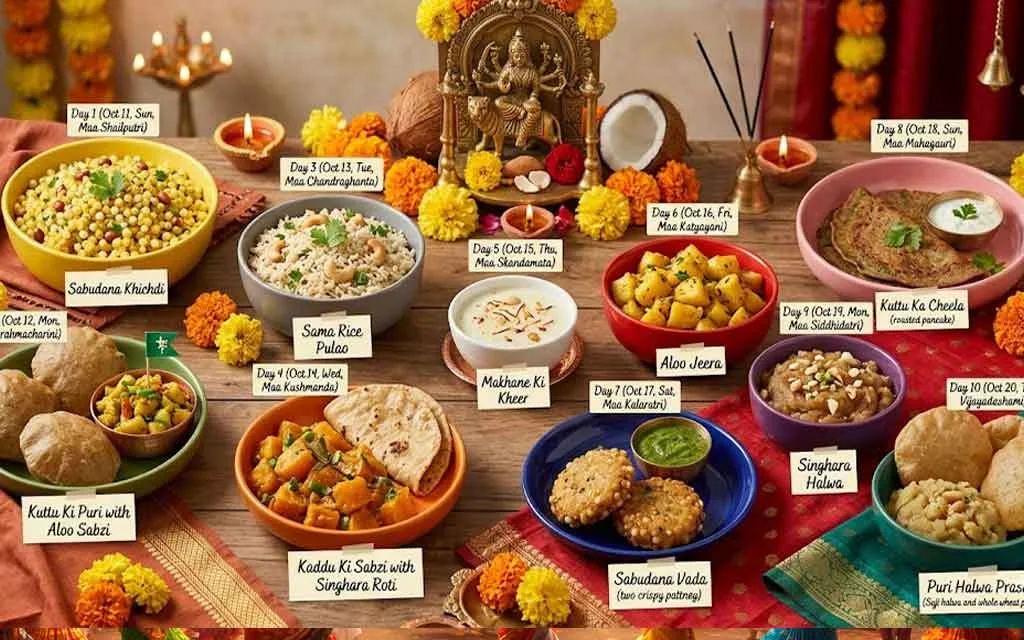
Sabudana khichdi works as a morning or afternoon meal on any day of the fast. Many families eat it on Day 1, when Maa Shailaputri is worshipped on Sunday 11 October 2026, and again on busy weekdays because the pearls can be soaked overnight. Rotate it with kuttu puri, samak rice khichdi and rajgira paratha so the menu does not get repetitive.
Tips for cooking abroad
- Sabudana is sold in Indian grocery stores in the USA, UK, Canada and Australia, often as 'sago' or 'tapioca pearls'. Choose the Indian sabudana pack rather than the very small tapioca used for bubble tea or pudding.
- Sendha namak may be labelled 'rock salt' or 'Himalayan pink salt' abroad. Families differ on whether pink salt counts as sendha namak; if unsure, buy the pack labelled sendha namak from an Indian store.
- In cold, dry kitchens the soak may take longer. Soak the night before and test in the morning.
Storage
- Cooked khichdi: best eaten fresh. Leftovers keep a day in the fridge; sprinkle a little water and warm gently in a covered pan.
- Soaked sabudana: keeps a few hours at room temperature or overnight in the fridge, covered.
- Roasted crushed peanuts: up to two weeks in an airtight jar, handy for the whole Navratri.
Frequently asked questions
How much water do I need to soak sabudana for khichdi?
Use just enough water to come level with the rinsed pearls, about 3/4 cup for 1 cup of medium sabudana. Large pearls may need a little more and a longer soak; small pearls need less. Too much water is the most common reason for sticky khichdi.
How do I know the sabudana is soaked properly?
Press one pearl between your thumb and finger. It should mash completely with no hard white dot in the centre. The soaked pearls should feel separate and slightly dry, not wet or pasty.
Why did my sabudana khichdi turn sticky and lumpy?
Usually because the starch was not rinsed off, the pearls soaked in too much water, or the khichdi was stirred hard or cooked too long. Rinse well, soak level with the water, coat the pearls with peanuts before cooking, fold gently over low heat and take it off as soon as most pearls turn translucent.
Is sabudana khichdi allowed in the Navratri fast?
In many families yes: sabudana, peanuts, potato, cumin, green chilli, ghee and rock salt are widely treated as vrat food. Customs differ between families and regions, so some leave out cumin, chilli or sugar. Follow your own family's rules; our fasting rules guide lists the common practice.
Can I make sabudana khichdi in advance?
It is best fresh, because the pearls firm up and turn chewy as they cool. You can soak the sabudana and roast the peanuts the night before, then cook it in about 15 minutes in the morning.
When is Navratri in 2026?
Sharad Navratri runs from Sunday 11 October to Monday 19 October 2026 in India (Drik Panchang), with Durga Ashtami and Maha Navami both on Monday 19 October and Dussehra on Tuesday 20 October.
Editor's note (8 October 2026)
We wrote this recipe page in October 2026 for Sharad Navratri. Dates follow Drik Panchang for India: Navratri from Sunday 11 to Monday 19 October 2026, Durga Ashtami and Maha Navami on Monday 19 October, and Dussehra on Tuesday 20 October. This is a standard home recipe; quantities, timings and yields are approximate, and what is allowed during a vrat differs between families and regions.
Related guides
You might also like
Samak Rice Khichdi for Navratri Vrat: Vrat ke Chawal Khichdi, Pulao and Kheer
Sabudana Vada for Vrat: Crisp Fried or Air-Fryer Vadas with Vrat Green Chutney
Makhana Kheer for Navratri Vrat and Bhog: Creamy Fox Nut Kheer with Sugar or Jaggery