
Why Is Ganesha Worshipped First? The Stories, Scriptures and Meaning
Every Hindu ritual begins with Ganesha. Here is why: the Puranic boon of agra-puja, the famous contest with Kartikeya, the Vedic Ganapati hymn, his role as Vighnaharta, and what the practice means for families today.
Every Hindu ritual begins with Ganesha. Here is why: the Puranic boon of agra-puja, the famous contest with Kartikeya, the Vedic Ganapati hymn, his role as Vighnaharta, and what the practice means for families today.
Quick answer: Ganesha is worshipped first because, according to the Shiva Purana, Lord Shiva granted him the boon of agra-puja, the right to be honoured before all other gods, when he restored Ganesha to life with an elephant's head. Ganesha is also Vighnaharta, the remover of obstacles, and Ganapati, the lord of Shiva's hosts, so invoking him first is a prayer that the ritual or venture ahead goes smoothly. A popular second story, in which he circles his parents to win a contest with his brother Kartikeya, teaches the same lesson.
Whether it is a griha pravesham in Texas, a wedding in Hyderabad or a child's first day at school in London, Hindu families begin with a prayer to Ganesha. This guide explains the reasons, from scripture and from living tradition, so you can explain them to the next generation.
The Shiva Purana: the boon of agra-puja
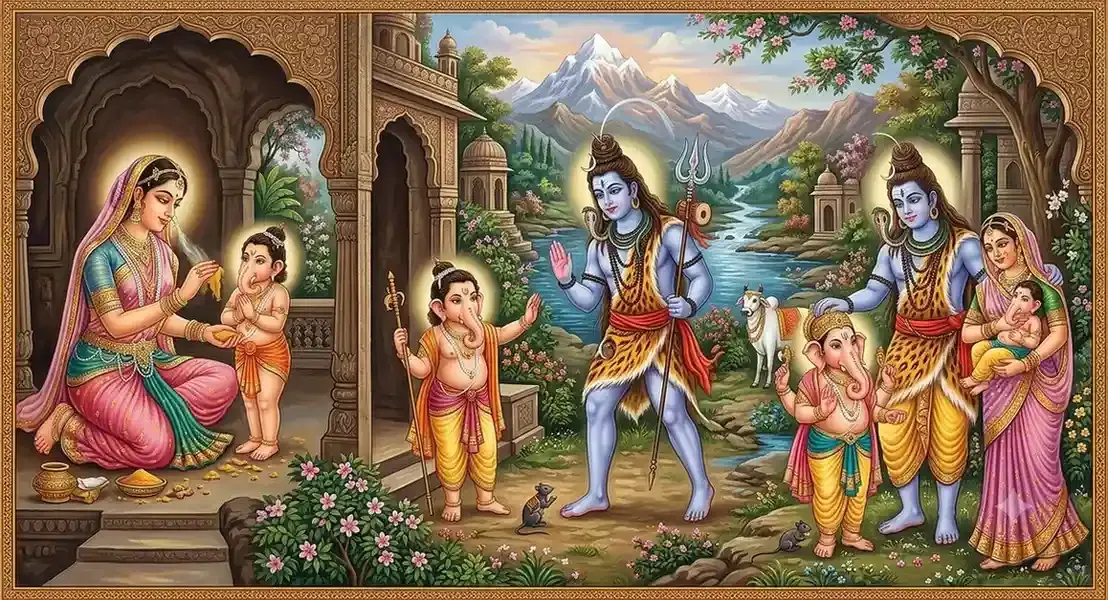
The best-known account is in the Rudra Samhita of the Shiva Purana. Parvati shapes a boy from the paste she used while bathing, gives him life and sets him to guard her door. When Shiva returns, the boy, who has never seen him, refuses him entry. A fight follows between the boy and Shiva's ganas, and finally Shiva cuts off the boy's head.
Parvati's grief and anger shake the universe. To pacify her, Shiva sends his attendants out with instructions to bring back the head of the first living being they meet, and they return with the head of an elephant. Shiva places it on the boy's body and brings him back to life.
Shiva and the assembled gods then honour the child. Shiva declares him the leader of his ganas, hence the names Ganapati and Ganesha, and decrees that he shall be worshipped before any other deity. Rituals performed without first honouring him, the story says, will not bear fruit. This is the scriptural root of agra-puja.
The contest with Kartikeya: circling the parents
A second story is told in many forms across India. Shiva and Parvati set a challenge for their sons, Ganesha and Kartikeya (also called Skanda, Murugan or Subrahmanya): whoever goes around the whole world first will win. In one widely told version the prize is a divine fruit; in the Shiva Purana version it is the right to marry first.
Kartikeya sets off at once on his peacock. Ganesha, whose vehicle is a small mouse, calmly walks around his parents and bows to them. When asked to explain, he says that his parents are the whole universe to him, and that the scriptures teach that circling one's parents equals circling the world. Shiva and Parvati are delighted and declare him the winner.
In Tamil Nadu this story is linked with Murugan's departure to Palani. Wherever it is told, it carries a clear message: wisdom and devotion outrun mere speed and strength. A god who understands that is the right one to approach first.
Vighnaharta: the remover of obstacles
Ganesha's most important title in daily worship is Vighneshvara or Vighnaharta, the lord and remover of obstacles. Traditional teaching holds that he both removes obstacles from the path of the sincere and places them before those whose aims are wrong, so that they reconsider.
Seen this way, beginning with Ganesha is simply common sense: before any undertaking, you pray to the deity responsible for clearing the way. That is why the opening prayer most commonly chanted in South Indian homes ends with the words 'sarva vighnopashantaye', 'for the removal of all obstacles':
Shuklambaradharam Vishnum shashivarnam chaturbhujam, prasanna vadanam dhyayet sarva vighnopashantaye.
Meaning: 'One should meditate on the one clad in white, all-pervading, bright as the moon, four-armed and of serene face, for the removal of all obstacles.'
In North India and Maharashtra the equally popular prayer is:
Vakratunda mahakaya suryakoti samaprabha, nirvighnam kuru me deva sarva karyeshu sarvada.
Meaning: 'O Lord with the curved trunk and mighty body, radiant as a million suns, please make all my works free of obstacles, always.'
Vedic and philosophical roots
- The Ganapati hymn: Priests open many rituals with the Rig Veda verse 'Gananam tva ganapatim havamahe' (2.23.1). In its Vedic setting it is addressed to Brahmanaspati, the lord of sacred speech, but tradition now chants it in honour of Ganesha.
- Ganapati Atharvashirsha: This later Upanishad-style text praises Ganapati as the supreme reality itself and gives his seed syllable 'gam'. For devotees in the Ganapatya tradition, worshipping him first is worshipping the source of everything.
- Panchayatana puja: In the Smarta tradition associated with Adi Shankaracharya, five deities are worshipped together: Shiva, Vishnu, Devi, Surya and Ganesha. Ganesha's place in this group reinforces his universal role.
- Lord of beginnings: Ganesha is associated with buddhi (intellect) and siddhi (accomplishment), which in some traditions are personified as his consorts. A good beginning, made with a clear mind, leads to success.
How agra-puja shows up in practice
| Occasion | How Ganesha is honoured first |
|---|---|
| Any home puja | A short Ganapati prayer or a turmeric Ganesha (Haridra Ganapati) is worshipped before the main deity. |
| Weddings | Ceremonies open with Ganesh puja; many families send the first wedding invitation to Ganesha. |
| Griha pravesham (housewarming) | Ganapati puja and often Ganapati homam begin the day. |
| New business or new job | Account books, shop counters and laptops are blessed with a Ganesha puja or 'Shri Ganeshaya Namah'. |
| Temple festivals | Major utsavams often begin with a Ganesha ritual before the flag-hoisting or main event. |
| Writing and study | Children write 'Om' or 'Shri Ganeshaya Namah' before starting to write, as in Vidyarambham. |
A popular cautionary tale
Ganesha-centred traditions tell a story in which even Shiva, setting out to destroy the three demon cities (Tripura), meets an obstacle because he has not first honoured Ganesha, and succeeds only after doing so. The story is told to show how firmly the rule of agra-puja is held: it applies even to the gods. Different texts and regional retellings give it in different forms.
What it means for families today
For many NRI families, Ganesha is the first deity children learn about, through Ganesh Chaturthi celebrations at the temple or at home. The idea behind agra-puja is easy to share:
- Begin every task with a calm mind and a moment of prayer.
- Respect your parents and elders; the circling story makes them the centre of the world.
- Humility matters: the mighty gods themselves bow to the small, elephant-headed boy.
- Obstacles are part of every journey; facing them with wisdom is what Ganesha represents.
A simple daily habit, such as saying the Vakratunda shloka before school or work, is a practical way to keep this tradition alive outside India.
Frequently asked questions
Is Ganesha worshipped first even in a puja to Shiva, Vishnu or Devi?
Yes. In most traditions a short Ganapati prayer or Ganesha puja opens every ritual, whichever deity is the main focus. Even a Satyanarayana puja or a Lakshmi puja begins with Ganesha.
What prayer is said to Ganesha at the start of a puja?
The most common is 'Shuklambaradharam Vishnum shashivarnam chaturbhujam, prasanna vadanam dhyayet sarva vighnopashantaye', especially in South India. In North India many begin with 'Vakratunda mahakaya suryakoti samaprabha, nirvighnam kuru me deva sarva karyeshu sarvada'.
Does the Rig Veda mention Ganesha?
The famous verse 'Gananam tva ganapatim havamahe' (Rig Veda 2.23.1) is chanted at the start of rituals today in honour of Ganesha. In its original Vedic context it addresses Brahmanaspati, the lord of prayer. The fully developed figure of elephant-headed Ganesha appears later, in the Puranas.
Why do people write 'Shri Ganeshaya Namah' at the top of documents?
It extends the same idea of agra-puja to everyday life. Writing his name before an account book, a letter or an exam paper is a way of invoking the remover of obstacles before beginning any task.
Is there one single reason Ganesha comes first?
No. Scriptures give more than one account, and teachers also explain it symbolically. The Shiva Purana boon, the circling-the-parents story and his role as lord of obstacles all point to the same conclusion, and families usually learn whichever version their tradition tells.
Editor's note
Editor's note (5 October 2026): This article has been restored at its original address after the earlier version was lost. The accounts above follow the Shiva Purana and widely told devotional tradition; details such as the prize in the Kartikeya contest vary between texts and regions, and we have noted those variations rather than choosing one as the only correct version.
Related guides
You might also like
Ganesha Stories: 10 Puranic Legends Every Family Should Know
Parthiva Ganapati: The Significance of Worshipping a Clay Ganesha, and How to Make One at Home
Who Started Public Ganesh Chaturthi? Lokmanya Tilak and the Story of 1893