Ram Raksha Stotram: Full Lyrics with Meaning, Benefits and How to Recite
Ram Raksha Stotram, traditionally attributed to the sage Budha Kaushika, is a protective kavacha of Lord Rama recited in many homes every evening. Here is the full text with viniyoga and dhyana in Devanagari and IAST, a short English meaning of all 38 verses, how and when to recite it, and its traditional significance.
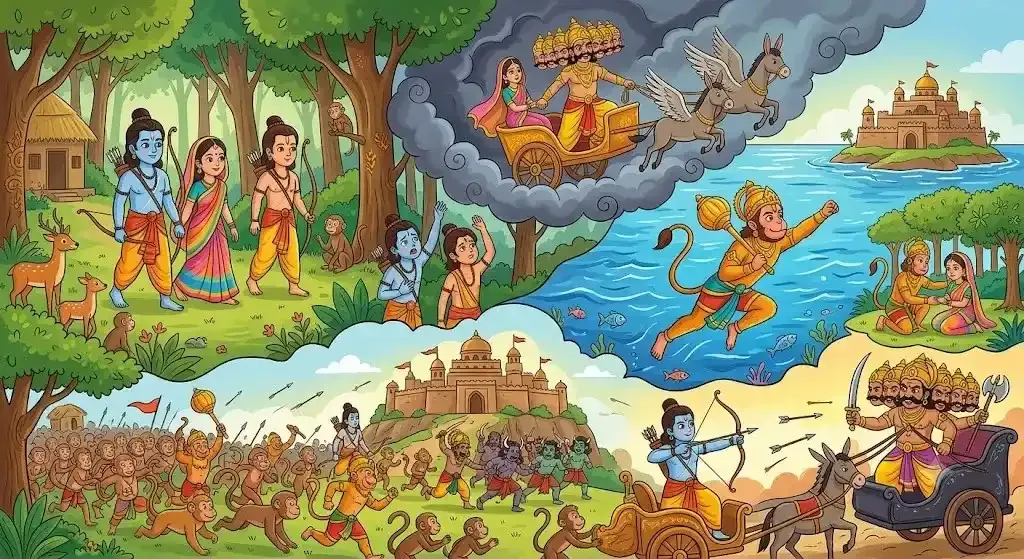
Ram Raksha Stotram, traditionally attributed to the sage Budha Kaushika, is a protective kavacha of Lord Rama recited in many homes every evening. Here is the full text with viniyoga and dhyana in Devanagari and IAST, a short English meaning of all 38 verses, how and when to recite it, and its traditional significance.
Quick answer: Ram Raksha Stotram is a Sanskrit hymn of protection addressed to Lord Rama, traditionally attributed to the sage Budha Kaushika, who, as the stotra itself says, received it from Lord Shiva in a dream. It opens with a viniyoga and a dhyana, then in 38 verses asks Rama to guard every part of the body and praises Rama, Lakshmana, Sita and Hanuman. Many families recite it every evening after lighting the lamp; it can also be chanted in the morning or on Thursdays, Saturdays and Rama festivals.
Several verses run on as one sentence (2 to 4, 17 to 19, 22 to 24), so the meanings read straight through.
Ram Raksha Stotram: full text with meaning
The text follows sanskritdocuments.org. Meanings are our own concise devotional renderings.
Viniyoga and dhyana (preface)
॥ ॐ श्रीगणेशाय नमः ॥
अस्य श्रीरामरक्षास्तोत्रमन्त्रस्य । बुधकौशिक ऋषिः ।
श्रीसीतारामचन्द्रो देवता । अनुष्टुप् छन्दः ।
सीता शक्तिः । श्रीमद् हनुमान कीलकम् ।
श्रीरामचन्द्रप्रीत्यर्थे रामरक्षास्तोत्रजपे विनियोगः ॥
अथ ध्यानम् ।
ध्यायेदाजानुबाहुं धृतशरधनुषं बद्धपद्मासनस्थं
पीतं वासो वसानं नवकमलदलस्पर्धिनेत्रं प्रसन्नम् ।
वामाङ्कारूढ सीतामुखकमलमिलल्लोचनं नीरदाभं
नानालङ्कारदीप्तं दधतमुरुजटामण्डनं रामचन्द्रम् ॥
इति ध्यानम् ॥
|| oṃ śrīgaṇeśāya namaḥ ||
asya śrīrāmarakṣāstotramantrasya | budhakauśika ṛṣiḥ |
śrīsītārāmacandro devatā | anuṣṭup chandaḥ |
sītā śaktiḥ | śrīmad hanumāna kīlakam |
śrīrāmacandraprītyarthe rāmarakṣāstotrajape viniyogaḥ ||
atha dhyānam |
dhyāyedājānubāhuṃ dhṛtaśaradhanuṣaṃ baddhapadmāsanasthaṃ
pītaṃ vāso vasānaṃ navakamaladalaspardhinetraṃ prasannam |
vāmāṅkārūḍha sītāmukhakamalamilallocanaṃ nīradābhaṃ
nānālaṅkāradīptaṃ dadhatamurujaṭāmaṇḍanaṃ rāmacandram ||
iti dhyānam ||
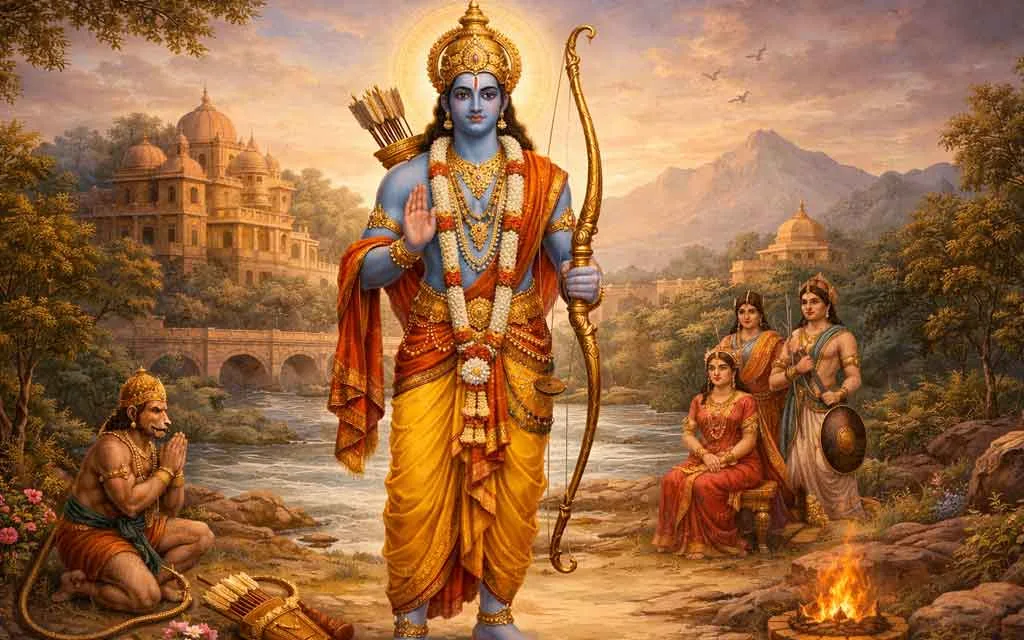
Salutations to Sri Ganesha. The viniyoga states the details of this stotra-mantra: its seer is Budha Kaushika, its deity Sri Sita-Ramachandra, its metre anushtup, its power Sita and its key (kilaka) Hanuman, and it is recited to please Sri Ramachandra. The dhyana then asks us to picture Ramachandra seated in lotus posture, his arms reaching to his knees, holding bow and arrows, wearing yellow silk, his eyes rivalling fresh lotus petals, serene and dark as a rain-cloud. Sita sits on his left lap, their eyes meeting; he shines with ornaments and a crown of matted locks.
Verse 1
चरितं रघुनाथस्य शतकोटि प्रविस्तरम् ।
एकैकमक्षरं पुंसां महापातकनाशनम् ॥ १॥
caritaṃ raghunāthasya śatakoṭi pravistaram |
ekaikamakṣaraṃ puṃsāṃ mahāpātakanāśanam || 1||
The story of the Lord of the Raghus spreads over a hundred crore verses, and every single syllable of it destroys even great sins.
Verse 2
ध्यात्वा नीलोत्पलश्यामं रामं राजीवलोचनम् ।
जानकीलक्ष्मणोपेतं जटामुकुटमण्डितम् ॥ २॥
dhyātvā nīlotpalaśyāmaṃ rāmaṃ rājīvalocanam |
jānakīlakṣmaṇopetaṃ jaṭāmukuṭamaṇḍitam || 2||
Meditating on Rama, dark as a blue lotus and lotus-eyed, accompanied by Janaki and Lakshmana and crowned with matted locks,
Verse 3
सासितूणधनुर्बाणपाणिं नक्तञ्चरान्तकम् ।
स्वलीलया जगत्त्रातुमाविर्भूतमजं विभुम् ॥ ३॥
sāsitūṇadhanurbāṇapāṇiṃ naktañcarāntakam |
svalīlayā jagattrātumāvirbhūtamajaṃ vibhum || 3||
holding sword, quiver, bow and arrows, the destroyer of the night-roaming demons, the unborn, all-pervading Lord who appeared by his own play to protect the world,
Verse 4
रामरक्षां पठेत्प्राज्ञः पापघ्नीं सर्वकामदाम् ।
शिरो मे राघवः पातु भालं दशरथात्मजः ॥ ४॥
rāmarakṣāṃ paṭhetprājñaḥ pāpaghnīṃ sarvakāmadām |
śiro me rāghavaḥ pātu bhālaṃ daśarathātmajaḥ || 4||
the wise should recite this Rama Raksha, which removes sin and fulfils every good wish. May Raghava protect my head, and the son of Dasharatha my forehead.
Verse 5
कौसल्येयो दृशौ पातु विश्वामित्रप्रियः श्रुती ।
घ्राणं पातु मखत्राता मुखं सौमित्रिवत्सलः ॥ ५॥
kausalyeyo dṛśau pātu viśvāmitrapriyaḥ śrutī |
ghrāṇaṃ pātu makhatrātā mukhaṃ saumitrivatsalaḥ || 5||
May Kausalya's son protect my eyes and Vishvamitra's beloved my ears. May the protector of the sacrifice guard my nose, and the one affectionate to Lakshmana my mouth.
Verse 6
जिह्वां विद्यानिधिः पातु कण्ठं भरतवन्दितः ।
स्कन्धौ दिव्यायुधः पातु भुजौ भग्नेशकार्मुकः ॥ ६॥
jihvāṃ vidyānidhiḥ pātu kaṇṭhaṃ bharatavanditaḥ |
skandhau divyāyudhaḥ pātu bhujau bhagneśakārmukaḥ || 6||
May the treasury of knowledge protect my tongue and the one revered by Bharata my throat. May the bearer of divine weapons guard my shoulders, and the breaker of Shiva's bow my arms.
Verse 7
करौ सीतापतिः पातु हृदयं जामदग्न्यजित् ।
मध्यं पातु खरध्वंसी नाभिं जाम्बवदाश्रयः ॥ ७॥
karau sītāpatiḥ pātu hṛdayaṃ jāmadagnyajit |
madhyaṃ pātu kharadhvaṃsī nābhiṃ jāmbavadāśrayaḥ || 7||
May Sita's husband protect my hands and the victor over Parashurama my heart. May the slayer of Khara guard my middle, and the refuge of Jambavan my navel.
Verse 8
सुग्रीवेशः कटी पातु सक्थिनी हनुमत्प्रभुः ।
ऊरू रघूत्तमः पातु रक्षःकुलविनाशकृत् ॥ ८॥
sugrīveśaḥ kaṭī pātu sakthinī hanumatprabhuḥ |
ūrū raghūttamaḥ pātu rakṣaḥkulavināśakṛt || 8||
May the lord of Sugriva protect my hips and the master of Hanuman my thighs. May the best of the Raghus, destroyer of the rakshasa clan, guard my upper legs.
Verse 9
जानुनी सेतुकृत्पातु जङ्घे दशमुखान्तकः ।
पादौ बिभीषणश्रीदः पातु रामोऽखिलं वपुः ॥ ९॥
jānunī setukṛtpātu jaṅghe daśamukhāntakaḥ |
pādau bibhīṣaṇaśrīdaḥ pātu rāmo'khilaṃ vapuḥ || 9||
May the builder of the bridge protect my knees and the slayer of the ten-headed Ravana my shins. May the one who gave royal fortune to Vibhishana guard my feet, and may Rama protect my whole body.
Verse 10
एतां रामबलोपेतां रक्षां यः सुकृती पठेत् ।
स चिरायुः सुखी पुत्री विजयी विनयी भवेत् ॥ १०॥
etāṃ rāmabalopetāṃ rakṣāṃ yaḥ sukṛtī paṭhet |
sa cirāyuḥ sukhī putrī vijayī vinayī bhavet || 10||
The virtuous person who recites this protection, filled with Rama's strength, will be long-lived, happy, blessed with children, victorious and humble.
Verse 11
पातालभूतलव्योमचारिणश्छद्मचारिणः ।
न द्रष्टुमपि शक्तास्ते रक्षितं रामनामभिः ॥ ११॥
pātālabhūtalavyomacāriṇaśchadmacāriṇaḥ |
na draṣṭumapi śaktāste rakṣitaṃ rāmanāmabhiḥ || 11||
Beings that roam the underworld, the earth or the sky, and those that move in disguise, cannot even look upon one who is guarded by the names of Rama.
Verse 12
रामेति रामभद्रेति रामचन्द्रेति वा स्मरन् ।
नरो न लिप्यते पापैः भुक्तिं मुक्तिं च विन्दति ॥ १२॥
rāmeti rāmabhadreti rāmacandreti vā smaran |
naro na lipyate pāpaiḥ bhuktiṃ muktiṃ ca vindati || 12||
One who remembers 'Rama', 'Ramabhadra' or 'Ramachandra' is not stained by sin, and gains both worldly fulfilment and liberation.
Verse 13
जगज्जैत्रैकमन्त्रेण रामनाम्नाभिरक्षितम् ।
यः कण्ठे धारयेत्तस्य करस्थाः सर्वसिद्धयः ॥ १३॥
jagajjaitraikamantreṇa rāmanāmnābhirakṣitam |
yaḥ kaṇṭhe dhārayettasya karasthāḥ sarvasiddhayaḥ || 13||
Whoever keeps on the throat this protection by Rama's name, the one mantra that conquers the world, holds every accomplishment in the palm of the hand.
Verse 14
वज्रपञ्जरनामेदं यो रामकवचं स्मरेत् ।
अव्याहताज्ञः सर्वत्र लभते जयमङ्गलम् ॥ १४॥
vajrapañjaranāmedaṃ yo rāmakavacaṃ smaret |
avyāhatājñaḥ sarvatra labhate jayamaṅgalam || 14||
Whoever remembers this Rama kavacha, called the Vajrapanjara or diamond cage, finds his word unobstructed everywhere and gains victory and auspiciousness.
Verse 15
आदिष्टवान् यथा स्वप्ने रामरक्षामिमां हरः ।
तथा लिखितवान् प्रातः प्रबुद्धो बुधकौशिकः ॥ १५॥
ādiṣṭavān yathā svapne rāmarakṣāmimāṃ haraḥ |
tathā likhitavān prātaḥ prabuddho budhakauśikaḥ || 15||
Just as Hara (Shiva) revealed this Rama Raksha in a dream, so Budha Kaushika wrote it down in the morning when he awoke.
Verse 16
आरामः कल्पवृक्षाणां विरामः सकलापदाम् ।
अभिरामस्त्रिलोकानां रामः श्रीमान् स नः प्रभुः ॥ १६॥
ārāmaḥ kalpavṛkṣāṇāṃ virāmaḥ sakalāpadām |
abhirāmastrilokānāṃ rāmaḥ śrīmān sa naḥ prabhuḥ || 16||
He is a garden of wish-fulfilling trees, the end of all calamities, the delight of the three worlds: that glorious Rama is our Lord.
Verse 17
तरुणौ रूपसम्पन्नौ सुकुमारौ महाबलौ ।
पुण्डरीकविशालाक्षौ चीरकृष्णाजिनाम्बरौ ॥ १७॥
taruṇau rūpasampannau sukumārau mahābalau |
puṇḍarīkaviśālākṣau cīrakṛṣṇājināmbarau || 17||
Young and handsome, delicate yet mighty, with wide lotus eyes, clad in bark and black deerskin,
Verse 18
फलमूलाशिनौ दान्तौ तापसौ ब्रह्मचारिणौ ।
पुत्रौ दशरथस्यैतौ भ्रातरौ रामलक्ष्मणौ ॥ १८॥
phalamūlāśinau dāntau tāpasau brahmacāriṇau |
putrau daśarathasyaitau bhrātarau rāmalakṣmaṇau || 18||
living on fruits and roots, self-controlled ascetics observing brahmacharya, these two sons of Dasharatha, the brothers Rama and Lakshmana,
Verse 19
शरण्यौ सर्वसत्त्वानां श्रेष्ठौ सर्वधनुष्मताम् ।
रक्षः कुलनिहन्तारौ त्रायेतां नो रघूत्तमौ ॥ १९॥
śaraṇyau sarvasattvānāṃ śreṣṭhau sarvadhanuṣmatām |
rakṣaḥ kulanihantārau trāyetāṃ no raghūttamau || 19||
refuge of all beings, foremost of all archers and destroyers of the rakshasa clan: may these two best of the Raghus protect us.
Verse 20
आत्तसज्जधनुषाविषुस्पृशावक्षयाशुगनिषङ्गसङ्गिनौ ।
रक्षणाय मम रामलक्ष्मणावग्रतः पथि सदैव गच्छताम् ॥ २०॥
āttasajjadhanuṣāviṣuspṛśāvakṣayāśuganiṣaṅgasaṅginau |
rakṣaṇāya mama rāmalakṣmaṇāvagrataḥ pathi sadaiva gacchatām || 20||
With bows strung, hands upon arrows and inexhaustible quivers at their side, may Rama and Lakshmana always walk ahead of me on the path to protect me.
Verse 21
सन्नद्धः कवची खड्गी चापबाणधरो युवा ।
गच्छन्मनोरथोऽस्माकं रामः पातु सलक्ष्मणः ॥ २१॥
sannaddhaḥ kavacī khaḍgī cāpabāṇadharo yuvā |
gacchanmanoratho'smākaṃ rāmaḥ pātu salakṣmaṇaḥ || 21||
Armed and armoured, with sword, bow and arrows, youthful, the very fulfilment of our heart's wish: may Rama, with Lakshmana, go with us and protect us.
Verse 22
रामो दाशरथिः शूरो लक्ष्मणानुचरो बली ।
काकुत्स्थः पुरुषः पूर्णः कौसल्येयो रघूत्तमः ॥ २२॥
rāmo dāśarathiḥ śūro lakṣmaṇānucaro balī |
kākutsthaḥ puruṣaḥ pūrṇaḥ kausalyeyo raghūttamaḥ || 22||
Rama, son of Dasharatha, the brave; mighty, with Lakshmana following him; Kakutstha, the complete Person, son of Kausalya, best of the Raghus;
Verse 23
वेदान्तवेद्यो यज्ञेशः पुराणपुरुषोत्तमः ।
जानकीवल्लभः श्रीमान् अप्रमेय पराक्रमः ॥ २३॥
vedāntavedyo yajñeśaḥ purāṇapuruṣottamaḥ |
jānakīvallabhaḥ śrīmān aprameya parākramaḥ || 23||
known through Vedanta, lord of sacrifice, the ancient Supreme Person, beloved of Janaki, glorious, of immeasurable valour:
Verse 24
इत्येतानि जपन्नित्यं मद्भक्तः श्रद्धयान्वितः ।
अश्वमेधाधिकं पुण्यं सम्प्राप्नोति न संशयः ॥ २४॥
ityetāni japannityaṃ madbhaktaḥ śraddhayānvitaḥ |
aśvamedhādhikaṃ puṇyaṃ samprāpnoti na saṃśayaḥ || 24||
the devotee of mine who chants these names daily with faith gains merit greater than an Ashvamedha sacrifice, without doubt. (In the tradition the speaker here is understood to be Shiva.)
Verse 25
रामं दूर्वादलश्यामं पद्माक्षं पीतवाससम् ।
स्तुवन्ति नामभिर्दिव्यैः न ते संसारिणो नराः ॥ २५॥
rāmaṃ dūrvādalaśyāmaṃ padmākṣaṃ pītavāsasam |
stuvanti nāmabhirdivyaiḥ na te saṃsāriṇo narāḥ || 25||
Those who praise with divine names Rama, dark as a blade of durva grass, lotus-eyed and clad in yellow, are no longer bound to the cycle of worldly life.
Verse 26
रामं लक्ष्मणपूर्वजं रघुवरं सीतापतिं सुन्दरम् ।
काकुत्स्थं करुणार्णवं गुणनिधिं विप्रप्रियं धार्मिकम् ।
राजेन्द्रं सत्यसन्धं दशरथतनयं श्यामलं शान्तमूर्तिम् ।
वन्दे लोकाभिरामं रघुकुलतिलकं राघवं रावणारिम् ॥ २६॥
rāmaṃ lakṣmaṇapūrvajaṃ raghuvaraṃ sītāpatiṃ sundaram |
kākutsthaṃ karuṇārṇavaṃ guṇanidhiṃ viprapriyaṃ dhārmikam |
rājendraṃ satyasandhaṃ daśarathatanayaṃ śyāmalaṃ śāntamūrtim |
vande lokābhirāmaṃ raghukulatilakaṃ rāghavaṃ rāvaṇārim || 26||
I bow to Rama, elder brother of Lakshmana, best of the Raghus, Sita's beautiful husband, ocean of compassion, treasury of virtues, dear to the learned and righteous; king of kings, true to his word, dark-hued son of Dasharatha, the very form of peace, delight of the world, jewel of the Raghu clan, the enemy of Ravana.
Verse 27
रामाय रामभद्राय रामचन्द्राय वेधसे ।
रघुनाथाय नाथाय सीतायाः पतये नमः ॥ २७॥
rāmāya rāmabhadrāya rāmacandrāya vedhase |
raghunāthāya nāthāya sītāyāḥ pataye namaḥ || 27||
Salutations to Rama, Ramabhadra and Ramachandra, the Creator, the Lord of the Raghus, our Lord, the husband of Sita.
Verse 28
श्रीराम राम रघुनन्दन राम राम
श्रीराम राम भरताग्रज राम राम ।
श्रीराम राम रणकर्कश राम राम
श्रीराम राम शरणं भव राम राम ॥ २८॥
śrīrāma rāma raghunandana rāma rāma
śrīrāma rāma bharatāgraja rāma rāma |
śrīrāma rāma raṇakarkaśa rāma rāma
śrīrāma rāma śaraṇaṃ bhava rāma rāma || 28||
Sri Rama, Rama, joy of the Raghus; Sri Rama, elder brother of Bharata; Sri Rama, fierce in battle: O Rama, be my refuge.
Verse 29
श्रीरामचन्द्रचरणौ मनसा स्मरामि
श्रीरामचन्द्रचरणौ वचसा गृणामि ।
श्रीरामचन्द्रचरणौ शिरसा नमामि
श्रीरामचन्द्रचरणौ शरणं प्रपद्ये ॥ २९॥
śrīrāmacandracaraṇau manasā smarāmi
śrīrāmacandracaraṇau vacasā gṛṇāmi |
śrīrāmacandracaraṇau śirasā namāmi
śrīrāmacandracaraṇau śaraṇaṃ prapadye || 29||
I remember the feet of Sri Ramachandra with my mind, praise them with my speech, bow to them with my head, and take refuge in them.
Verse 30
माता रामो मत्पिता रामचन्द्रः
स्वामी रामो मत्सखा रामचन्द्रः ।
सर्वस्वं मे रामचन्द्रो दयालु-
र्नान्यं जाने नैव जाने न जाने ॥ ३०॥
mātā rāmo matpitā rāmacandraḥ
svāmī rāmo matsakhā rāmacandraḥ |
sarvasvaṃ me rāmacandro dayālu-
rnānyaṃ jāne naiva jāne na jāne || 30||
Rama is my mother, Ramachandra my father; Rama my master, Ramachandra my friend. Compassionate Ramachandra is my all; I know no other, truly none.
Verse 31
दक्षिणे लक्ष्मणो यस्य वामे तु जनकात्मजा ।
पुरतो मारुतिर्यस्य तं वन्दे रघुनन्दनम् ॥ ३१॥
dakṣiṇe lakṣmaṇo yasya vāme tu janakātmajā |
purato mārutiryasya taṃ vande raghunandanam || 31||
I bow to the joy of the Raghus, with Lakshmana at his right, Janaka's daughter at his left, and Hanuman before him.
Verse 32
लोकाभिरामं रणरङ्गधीरं
राजीवनेत्रं रघुवंशनाथम् ।
कारुण्यरूपं करुणाकरं तं
श्रीरामचन्द्रम् शरणं प्रपद्ये ॥ ३२॥
lokābhirāmaṃ raṇaraṅgadhīraṃ
rājīvanetraṃ raghuvaṃśanātham |
kāruṇyarūpaṃ karuṇākaraṃ taṃ
śrīrāmacandram śaraṇaṃ prapadye || 32||
I take refuge in Sri Ramachandra, the delight of the world, steadfast on the battlefield, lotus-eyed lord of the Raghu dynasty, compassion in form and a mine of mercy.
Verse 33
मनोजवं मारुततुल्यवेगं
जितेन्द्रियं बुद्धिमतां वरिष्ठम् ।
वातात्मजं वानरयूथमुख्यं
श्रीरामदूतं शरणं प्रपद्ये ॥ ३३॥
manojavaṃ mārutatulyavegaṃ
jitendriyaṃ buddhimatāṃ variṣṭham |
vātātmajaṃ vānarayūthamukhyaṃ
śrīrāmadūtaṃ śaraṇaṃ prapadye || 33||
I take refuge in Rama's messenger, swift as the mind and fast as the wind, master of the senses, foremost of the wise, son of the Wind God and chief of the vanara host.
Verse 34
कूजन्तं रामरामेति मधुरं मधुराक्षरम् ।
आरुह्य कविताशाखां वन्दे वाल्मीकिकोकिलम् ॥ ३४॥
kūjantaṃ rāmarāmeti madhuraṃ madhurākṣaram |
āruhya kavitāśākhāṃ vande vālmīkikokilam || 34||
I bow to Valmiki, the cuckoo who sits on the branch of poetry and sings sweetly the sweet syllables 'Rama, Rama'.
Verse 35
आपदामपहर्तारं दातारं सर्वसम्पदाम् ।
लोकाभिरामं श्रीरामं भूयो भूयो नमाम्यहम् ॥ ३५॥
āpadāmapahartāraṃ dātāraṃ sarvasampadām |
lokābhirāmaṃ śrīrāmaṃ bhūyo bhūyo namāmyaham || 35||
Again and again I bow to Sri Rama, remover of calamities, giver of all prosperity, delight of the world.
Verse 36
भर्जनं भवबीजानामर्जनं सुखसम्पदाम् ।
तर्जनं यमदूतानां रामरामेति गर्जनम् ॥ ३६॥
bharjanaṃ bhavabījānāmarjanaṃ sukhasampadām |
tarjanaṃ yamadūtānāṃ rāmarāmeti garjanam || 36||
The roar of 'Rama, Rama' roasts the seeds of rebirth, gathers happiness and prosperity, and frightens away the messengers of Yama.
Verse 37
रामो राजमणिः सदा विजयते रामं रमेशं भजे
रामेणाभिहता निशाचरचमू रामाय तस्मै नमः ।
रामान्नास्ति परायणं परतरं रामस्य दासोऽस्म्यहं
रामे चित्तलयः सदा भवतु मे भो राम मामुद्धर ॥ ३७॥
rāmo rājamaṇiḥ sadā vijayate rāmaṃ rameśaṃ bhaje
rāmeṇābhihatā niśācaracamū rāmāya tasmai namaḥ |
rāmānnāsti parāyaṇaṃ parataraṃ rāmasya dāso'smyahaṃ
rāme cittalayaḥ sadā bhavatu me bho rāma māmuddhara || 37||
Rama, jewel among kings, is ever victorious; I worship Rama, Lord of Lakshmi; by Rama the demon army was struck down; salutations to that Rama. There is no refuge higher than Rama; I am Rama's servant; may my mind always rest in Rama; O Rama, lift me up.
Verse 38
रामरामेति रामेति रमे रामे मनोरमे ।
सहस्रनामतत्तुल्यं रामनाम वरानने ॥ ३८॥
rāmarāmeti rāmeti rame rāme manorame |
sahasranāmatattulyaṃ rāmanāma varānane || 38||
(Shiva says to Parvati:) 'Rama, Rama, Rama': O lovely-faced one, I delight in Rama, who delights the mind. The name of Rama equals the thousand names.
Colophon
इति श्रीबुधकौशिकविरचितं श्रीरामरक्षास्तोत्रं सम्पूर्णम् ॥
iti śrībudhakauśikaviracitaṃ śrīrāmarakṣāstotraṃ sampūrṇam ||
Thus ends the Sri Rama Raksha Stotra composed by Sri Budha Kaushika.
How and when to recite Ram Raksha
The evening family recitation
In many homes, especially in Maharashtra and among Marathi families abroad, Ram Raksha is part of the evening routine: the lamp is lit at dusk, children say a short prayer, and the family recites Ram Raksha together. It takes about ten to fifteen minutes at an easy pace. NRI families abroad often keep the same habit, sometimes over a video call with grandparents.
Best time and how many times
- Evening lamp-lighting time is the most common; early morning after a bath is also traditional.
- Once daily is the usual practice.
- Three or eleven recitations are sometimes chosen on Thursdays, Saturdays, Rama Navami or Hanuman Jayanti.
A simple sankalpa
Take a little water in your right palm and say in your own words: 'For the grace of Sri Sita-Ramachandra and the protection of my family, I recite the Ram Raksha Stotram today.' Let the water fall, read the viniyoga and dhyana, and begin.
Pronunciation tips in plain English
- Most verses are in the steady anushtup metre: four short quarters of eight syllables. Pause briefly at each vertical bar.
- Several verses, such as 20, 26, 28 to 30, 32, 33 and 37, are in longer, musical metres; slow down and let them sing.
- A line over a vowel means it is held long, as in the first 'a' of Rama.
- Learn in parts: the body-protection verses (4 to 9) first, then the rest.
Significance and traditional benefits
Ram Raksha belongs to the kavacha, or armour, family of hymns. The stotra calls itself the Vajrapanjara, the 'diamond cage', and its central section places a different name of Rama over each part of the body, from head to feet. Each name recalls a scene from the Ramayana, so reciting it remembers the whole epic while placing oneself in Rama's care.
Traditionally, devotees believe that regular recitation:
- brings a sense of protection, courage and calm, especially at night or in times of worry;
- purifies the mind through the remembrance of Rama's names, as verses 12 and 36 describe;
- draws the blessings of Hanuman, named as the kilaka of the stotra and praised in verse 33;
The stotra's own phala verses speak of long life, happiness, children and victory. These are expressions of devotion handed down by tradition, not guarantees; Ram Raksha is a prayer, and it is not a substitute for medical care, legal help or practical action.
For more prayers to Rama's great devotee, see our 11 Hanuman mantras to chant daily and the guide to Hanuman Jayanti and Hanumad Vratha in Karnataka.
Story and context: a hymn given in a dream
As the stotra itself tells it in verse 15, Lord Shiva appeared to the sage Budha Kaushika in a dream and recited the Rama Raksha to him; when the sage awoke in the morning, he wrote it down. Some traditions identify Budha Kaushika with the sage Vishvamitra, who was born in the Kaushika line and was Rama's teacher; others regard him as a separate sage.
In verse 38 Shiva tells Parvati that chanting 'Rama, Rama, Rama' is equal to the thousand names of Vishnu. Verse 37 uses the name Rama in every grammatical case.
To learn more about Valmiki, praised in verse 34, see our guide to Valmiki Jayanti.
Also read: Ram Chalisa and Sankat Mochan Hanuman Ashtak.
Frequently asked questions
What is the meaning of Ram Raksha Stotram?
Ram Raksha means 'the protection of Rama'. The stotra asks Rama, under a different name for each, to guard every part of the body, and then praises Rama, Lakshmana, Sita and Hanuman. It closes by declaring that the name of Rama is equal to the thousand names of Vishnu.
Who wrote Ram Raksha Stotram?
It is traditionally attributed to the sage Budha Kaushika. Verse 15 itself says that Lord Shiva revealed it to him in a dream and that he wrote it down on waking in the morning.
What are the benefits of chanting Ram Raksha Stotram?
Devotees believe it gives a sense of protection, courage and peace, and the stotra's own phala verses speak of long life, happiness and victory for the devoted reciter. These are traditional beliefs about devotion, not guaranteed results, and it is no substitute for medical or practical help.
When is the best time to recite Ram Raksha?
Many families recite it every evening after lighting the lamp, and some also chant it in the morning. Thursdays, Saturdays, Rama Navami and Hanuman Jayanti are popular occasions, but it may be recited on any day.
Can women and children chant Ram Raksha Stotram?
Yes. It is a devotional stotra recited by people of every age, and in many households children learn it from their mothers and grandmothers as part of evening prayer.
How many times should Ram Raksha be recited?
Once a day is the common practice. Some devotees recite it three or eleven times on special days, or undertake a fixed number of days of recitation as a vow. Regular, attentive recitation matters more than the count.
Editor's note
Editor's note (7 October 2026): This page has been restored at its original address after the earlier version was lost. The Sanskrit text, including the viniyoga and dhyana, follows sanskritdocuments.org in Devanagari and IAST; minor recitation variants exist between printed editions and family traditions. The English meanings are our own concise devotional renderings. Authorship is given as traditionally attributed. Traditional benefits are described as beliefs, not guarantees.
Related guides
You might also like
Annapurna Stotram (Nityanandakari): Lyrics, Meaning and Benefits
Navagraha Stotram (Japakusuma Sankasham): Lyrics, Meaning and Benefits
Ram Chalisa: Lyrics in Hindi with Meaning, Ram Stuti Aarti and How to Recite