
Kanya Pujan Prasad Recipe: Suji Halwa, Puri and Kale Chane for Ashtami and Navami 2026
Standard home recipes for the classic Kanya Pujan bhog of suji halwa, puri and sookhe kale chane, with a quantity table for nine girls plus family, a night-before and morning timing plan, substitutions and storage. Kanya Pujan falls on Monday 19 October 2026 in India.
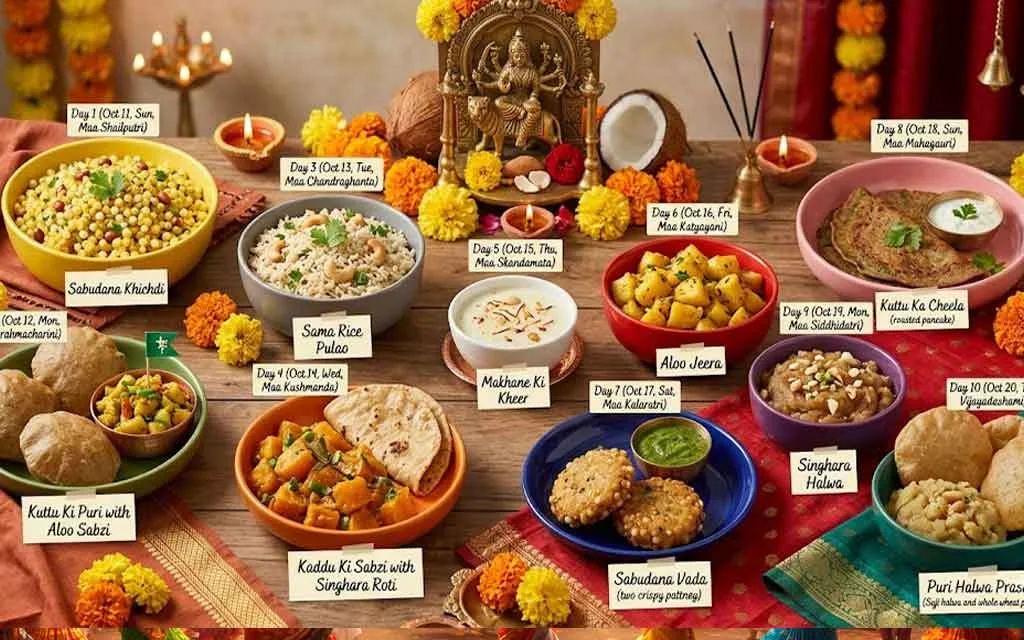
Standard home recipes for the classic Kanya Pujan bhog of suji halwa, puri and sookhe kale chane, with a quantity table for nine girls plus family, a night-before and morning timing plan, substitutions and storage. Kanya Pujan falls on Monday 19 October 2026 in India.
Quick answer: The classic Kanya Pujan prasad in many North Indian homes is suji halwa, puri and sookhe kale chane (dry black chickpeas), offered to the Goddess and then served to young girls invited as forms of the Devi on Ashtami or Navami. In 2026, Durga Ashtami and Maha Navami are both on Monday 19 October in India (Drik Panchang). Soak the chana the night before; on the morning, cook the chana, knead the puri dough, make the halwa and fry the puris last. For nine girls plus family, plan on about 1 1/2 cups suji, 4 cups atta and 2 cups dry kala chana.
Note that this is not vrat food: puri contains wheat and halwa contains suji. It is prasad, cooked fresh and offered after the puja. For the puja steps, see our Kanya Pujan 2026 date, Ashtami and Navami vidhi.
Kanya Pujan 2026: which day?
Families perform Kanya Pujan (also called Kanjak or Kumari Puja) on Durga Ashtami or Maha Navami, according to family custom. In 2026, Drik Panchang lists both on Monday 19 October in India, the ninth day of Navratri, when Maa Siddhidatri is worshipped. In the common day-wise bhog lists, halwa-puri-chana is the offering associated with this day.
For NRI families: Drik lists Durga Ashtami on Sunday 18 October and Maha Navami on Monday 19 October for the USA, Canada and the UK, so an Ashtami Kanya Pujan abroad may fall on the Sunday. Check a panchang for your own city, and see our Navratri 2026 NRI guide.
Quantities for 9 girls plus family
Most families invite nine girls, often aged between about two and ten, and many also invite one young boy as Langur or Bhairav. Each child usually receives a small plate with two puris, a spoon or two of halwa and some chana. The table assumes nine girls, one boy and about six adults; all amounts are approximate.
| Dish | Recipe below makes | For 9 girls + 1 boy + 6 adults |
|---|---|---|
| Suji halwa | 1 cup suji (about 10 portions) | 1 1/2 cups suji, 1 1/2 cups sugar, 4 1/2 cups water, 3/4 to 1 cup ghee |
| Puri | 2 cups atta (18 to 20 puris) | 4 cups atta (about 40 puris) |
| Kale chane | 1 cup dry chana (about 10 portions) | 2 cups dry chana, spices doubled |
Children often eat less than you expect, while adults eat more. If you are also distributing prasad to neighbours or at a community event, scale up from the table rather than guessing.
Timing plan
- Day before: buy fresh ingredients, set aside clean vessels for the bhog, and soak the kala chana overnight. Optionally pressure cook the chana in the evening and refrigerate it.
- Morning, first: after bathing and preparing the puja space, boil the chana if not done, and knead the puri dough so it can rest.
- Next: make the chana masala, then the suji halwa, and keep both covered.
- Last: fry the puris, so they are hot and puffed when served.
- Before serving: offer a plate of halwa, puri and chana to the Devi first, then wash the girls' feet, apply tilak, tie the sacred thread if that is your custom, serve them, and give a small gift. Muhurat and the full vidhi are in our Kanya Pujan guide.
The recipes
Suji Halwa for Kanya Pujan
Semolina roasted in ghee and cooked in cardamom-scented sugar syrup with nuts. The sweet part of the Ashtami and Navami bhog in many North Indian homes.
Prep: about 5 minutes. Cook: about 20 minutes. Makes: Serves about 10 as prasad portions (approximate).
Ingredients
- 1 cup (about 170 g) suji (fine or medium semolina)
- 1/2 to 3/4 cup (about 110 to 165 g) ghee
- 1 cup (200 g) sugar
- 3 cups (720 ml) water
- 1/2 teaspoon cardamom powder
- 2 tablespoons sliced almonds or cashews
- 1 tablespoon raisins (optional)
Method
- Put the water and sugar in a saucepan, bring to a boil, stir until the sugar dissolves, add the cardamom and keep it hot on low heat.
- In a heavy kadhai, heat the ghee over low-medium heat. Add the suji and roast, stirring constantly, for 8 to 10 minutes until it turns light golden and smells nutty. Add the nuts for the last minute.
- Stand back and carefully pour the hot syrup into the suji a little at a time, stirring all the while. It will splutter and steam.
- Keep stirring over low heat for 3 to 5 minutes as the suji absorbs the syrup and the halwa thickens.
- Add the raisins and cook until the halwa leaves the sides of the pan and the ghee begins to show at the edges.
- Turn off the heat and keep it covered. Set aside a portion for the bhog before serving anyone.
Tips: Roast the suji patiently on low heat; under-roasted suji tastes raw and turns pasty. Many Punjabi families use equal parts suji, sugar and ghee for a rich, glossy Ashtami halwa; others use less ghee. Some families cook the halwa in milk instead of water.
Puri for Kanya Pujan
Small, puffed wheat puris fried in ghee or oil, served with halwa and chana as prasad.
Prep: about 25 minutes, including resting. Cook: about 25 minutes. Makes: About 18 to 20 small puris (approximate).
Ingredients
- 2 cups (about 260 g) whole wheat atta
- 1 tablespoon fine suji (optional, for crispness)
- 1/2 teaspoon salt
- 1 tablespoon ghee or oil for the dough
- About 3/4 cup (180 ml) water
- Ghee or oil for deep-frying
Method
- Mix the atta, suji and salt in a bowl and rub in the tablespoon of ghee or oil.
- Add the water a little at a time and knead into a firm, smooth dough, stiffer than chapati dough.
- Cover and rest for 15 to 20 minutes.
- Knead briefly and divide into 18 to 20 small balls. Roll each into a round about 10 cm across, using a few drops of oil instead of dry flour so the frying oil stays clean.
- Heat ghee or oil for deep-frying over medium-high heat until a pinch of dough rises to the top at once.
- Slide in one puri at a time. Press it gently with a slotted spoon until it puffs, then turn and fry for a few seconds more until light golden.
- Drain on a rack or paper towels and keep the puris in a covered basket.
Tips: A stiff dough and hot oil are the keys to puffed, non-oily puris. If they do not puff, the oil is too cool or the puri is rolled unevenly.
Sookhe Kale Chane (Dry Black Chana for Ashtami)
Soaked and boiled black chickpeas tossed dry with ghee, cumin, ginger and spices, without onion or garlic. The savoury part of the Kanya Pujan plate.
Prep: about 10 minutes, plus 8 hours soaking. Cook: about 40 minutes. Makes: Serves about 10 as prasad portions (approximate).
Ingredients
- 1 cup (about 200 g) kala chana (black chickpeas)
- Water for soaking and cooking
- 1 teaspoon salt for cooking, plus to taste
- 2 tablespoons ghee
- 1 teaspoon cumin seeds
- A pinch of hing (asafoetida)
- 1 teaspoon grated ginger
- 1 or 2 green chillies, slit
- 1 1/2 teaspoons coriander powder
- 1/2 teaspoon red chilli powder
- 1 teaspoon amchur (dry mango powder)
- 1/2 teaspoon garam masala
- 2 tablespoons chopped coriander leaves
Method
- Rinse the kala chana and soak in plenty of water for 8 hours or overnight.
- Drain, add fresh water to cover by about 3 cm and 1 teaspoon of salt, and pressure cook for 5 to 6 whistles, or simmer in a covered pot for about an hour, until the chana is soft but holds its shape.
- Drain the chana well, saving the cooking water for another dish.
- Heat the ghee in a kadhai over medium heat. Add the cumin seeds, then the hing, ginger and green chillies, and stir for 30 seconds.
- Lower the heat and add the coriander powder and red chilli powder. Stir for a few seconds without letting them burn.
- Add the drained chana and toss well. Sprinkle a spoon or two of the cooking water if the spices stick.
- Add the amchur, garam masala and salt to taste. Toss over medium heat for 4 to 5 minutes until the chana is dry and coated.
- Finish with coriander leaves.
Tips: Kala chana needs a long soak; old chana may need more cooking time. The chana should be soft enough to press between your fingers but still whole. Some families use rock salt in prasad; ordinary salt is also common, since this is not vrat food.
Substitutions
| Ingredient | Substitute | Note |
|---|---|---|
| Sugar in halwa | Jaggery or mishri | Jaggery gives a darker halwa; dissolve it in the water |
| Ghee | Oil for frying puris | Ghee is preferred for halwa and bhog in many homes |
| Kala chana | Kabuli chana (white chickpeas) | Softer and paler; less traditional |
| Amchur | Lemon juice | Add off the heat |
If your family breaks the fast on this day
Many devotees who keep the full Navratri vrat end their fast after Kanya Pujan by eating this prasad. If you are still fasting on that morning and need vrat meals while cooking, our makhana kheer, sabudana khichdi and kuttu puri recipes are all made without grains. For the fasting rules, see our Navratri fasting rules 2026 guide.
Tips for NRI families
- Fine or medium suji, atta and kala chana are sold in Indian grocery stores in the USA, UK, Canada and Australia. Buy them a few days early, as stores get busy before Ashtami.
- If you cannot invite nine girls, many families invite as many as they can, including daughters of friends and neighbours; some temples abroad hold community Kanya Pujan. Follow what your family or priest advises.
- If Kanya Pujan falls on a weekday, a weekend gathering with prasad is a practical choice for many families, while the puja itself is done on the tithi.
Storage
- Halwa: 2 days in the fridge; warm with a splash of water or milk.
- Puri: best fresh; leftovers keep a day in a closed box and can be warmed in an oven.
- Kale chane: 2 to 3 days in the fridge. Boiled, unseasoned chana freezes well.
Frequently asked questions
When is Kanya Pujan in 2026?
In India, Durga Ashtami and Maha Navami both fall on Monday 19 October 2026 per Drik Panchang, so most families doing Kanya Pujan on either day will do it on 19 October. Drik lists Durga Ashtami on Sunday 18 October and Maha Navami on Monday 19 October for the USA, Canada and the UK, so check a panchang for your city.
Is halwa, puri and chana vrat food?
No. Puri is made from wheat and halwa from suji (semolina), so this meal is not fasting food. It is prasad, cooked after bathing and offered to the Goddess and the girls after the puja. Many families who keep the nine-day fast end it with this prasad, but customs differ.
How much should I make for 9 girls plus family?
For nine girls, one young boy and about six family members, roughly 1 1/2 cups of suji for halwa, 4 cups of atta for puri and 2 cups of dry kala chana are a comfortable amount. See the quantity table on this page.
Why is onion and garlic not used in the chana?
Food offered as bhog in most Hindu homes is sattvik, cooked without onion and garlic. Hing, ginger and whole spices give the chana its flavour instead.
Can I make the prasad the night before?
You can soak and boil the chana and roast the suji the night before. Most families cook the halwa and fry the puris fresh on the morning of the puja, so the bhog is freshly prepared.
Why did my halwa turn lumpy?
Usually the syrup was not hot, or it was poured in too fast without stirring. Keep the syrup boiling hot, add it gradually while stirring constantly, and break any lumps against the side of the pan.
Editor's note (8 October 2026)
We wrote this recipe page in October 2026 for Sharad Navratri. Dates follow Drik Panchang: in India, Navratri runs from Sunday 11 to Monday 19 October 2026, with Durga Ashtami and Maha Navami both on Monday 19 October and Dussehra on Tuesday 20 October; abroad, Drik lists Ashtami on 18 October and Navami on 19 October for the USA, Canada and the UK. These are standard home recipes; quantities, timings and yields are approximate, and Kanya Pujan customs differ between families and regions.
Related guides
You might also like

Fafda-Jalebi Recipe for Dussehra 2026: Crisp Fafda, Jalebi, Sambharo and Kadhi Chutney
Telugu Deepavali Recipes 2026: Ariselu, Kajjikayalu, Gavvalu and Chekkalu
Dussehra Recipes 2026: What India Cooks for Vijayadashami and the Last Days of Navratri, Region by Region