
Eco-Friendly Ganesh Idols in the USA: How to Choose, Make and Immerse a Clay Ganesha
A practical guide for Ganesh Chaturthi in the USA: how to recognise a genuinely eco-friendly clay idol, where to look, how to make your own Ganesha at home, how to do a respectful home visarjan, and how to keep decorations green.
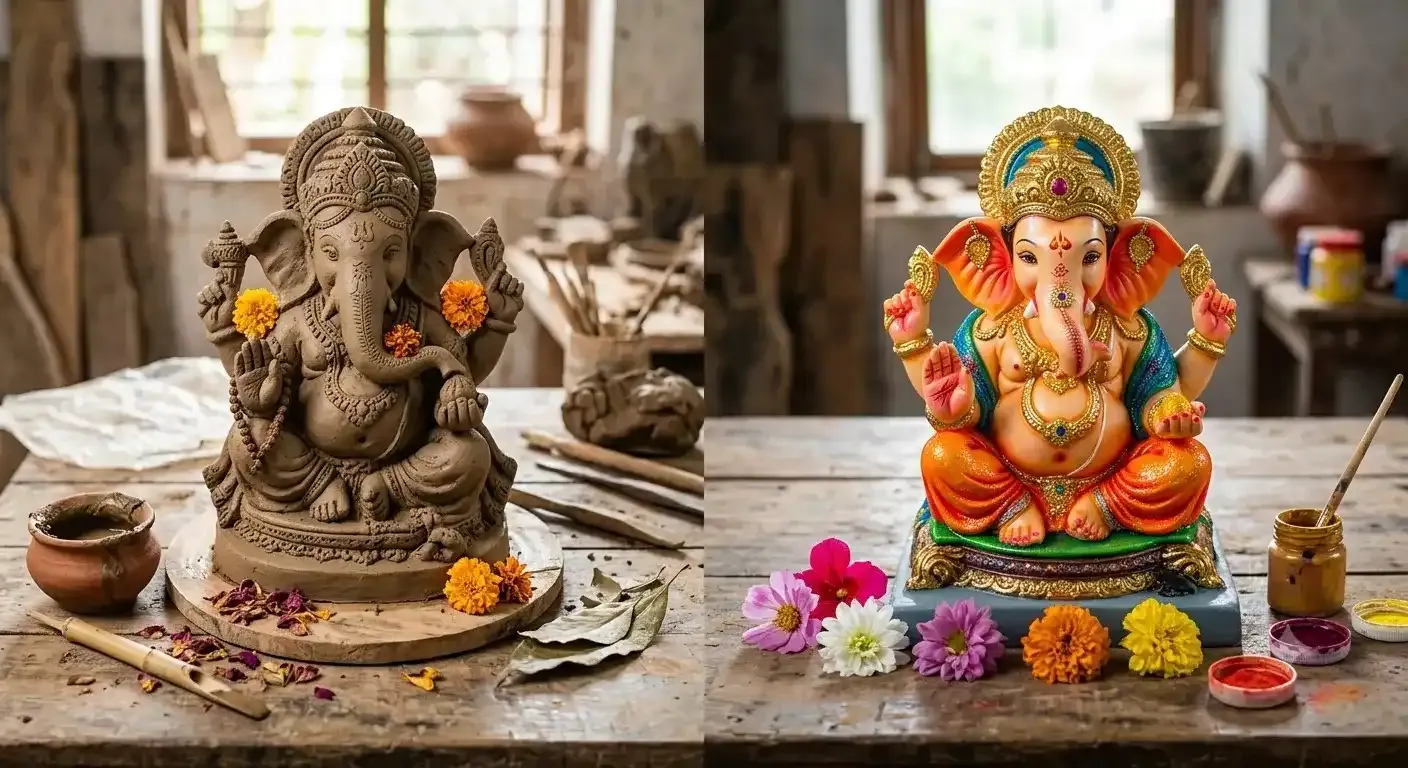
A practical guide for Ganesh Chaturthi in the USA: how to recognise a genuinely eco-friendly clay idol, where to look, how to make your own Ganesha at home, how to do a respectful home visarjan, and how to keep decorations green.
Quick answer: An eco-friendly Ganesh idol is made of unbaked natural clay (shadu mati, river clay or plain earthenware clay) and painted with natural, non-toxic colours or left unpainted. It dissolves in a bucket of water within hours to a couple of days, and the clay can go back into your garden. In the USA, look for clay idols at your local Hindu temple or Indian grocery store, or make one at home. Avoid plaster of Paris, polymer clay, thermocol and glitter, and do home or temple visarjan rather than immersing in lakes or the ocean without checking local rules.
This guide has been restored at its original hindutone.com address. Ganesh Chaturthi 2026 was on Monday 14 September; the next is Saturday 4 September 2027, which gives US families a full weekend to plan a green celebration.
Why clay, and why it matters in the USA
The classical form of Ganesha worshipped on Chaturthi is the Parthiva Ganapati, an idol shaped from earth (prithvi). The idol is invoked with life during the puja and returned to water and earth at visarjan, completing a natural cycle. Plaster of Paris (PoP) idols, which became common in the last century, break this cycle: plaster does not dissolve readily, and bright synthetic paints can contain substances you would not want in water or soil.
For US families, there is also a practical reason. A clay idol can be immersed at home and the water poured into the garden, avoiding the need to find an immersion site at all. A PoP idol leaves you with a lump of plaster and no good way to dispose of it respectfully.
Clay vs other materials
| Material | Dissolves in water? | Verdict |
|---|---|---|
| Unbaked natural clay (shadu, river clay) | Yes, within hours to a day or two | Best choice |
| Plain unfired earthenware or terracotta clay | Yes | Good choice for DIY |
| Paper mache with natural glue | Breaks down slowly | Acceptable if paints are natural |
| Seed or plantable clay idols | Yes; seeds can sprout | Good choice |
| Air-dry craft clay | Varies with additives | Check the label |
| Plaster of Paris | No, not readily | Avoid |
| Polymer clay, resin, fibreglass | No | Avoid for visarjan |
Where US families find clay Ganesh idols
We do not list individual sellers, because stock and quality change every year. These are the places to start:
- Your local Hindu temple: Many temples sell or arrange clay idols before Ganesh Chaturthi, and some hold clay Ganesha-making workshops for children. Check your temple's official website or notice board from July onwards.
- Indian grocery stores: Many stock idols in August. Ask specifically for unbaked clay and natural colours; 'eco-friendly' labels are not always accurate.
- Community and cultural associations: Regional associations often organise bulk orders or workshops.
- Online sellers: Order early, read reviews about breakage in shipping, and ask what the idol is made of before buying.
Size tip: A smaller idol, about 8 to 12 inches, dissolves faster in a bucket and is easier to carry. Large idols need a big tub and several days.
Make your own clay Ganesha at home
Making the idol yourself is the most traditional and most joyful option, and children love it. You need about 2 to 3 pounds of natural unfired clay for a 6 to 8 inch Ganesha.
- Base and body: Roll a thick disc for the seat and a large ball for the belly. Press the belly onto the seat.
- Legs: Roll two thick logs, bend them, and press them around the belly as if seated cross-legged.
- Head: Roll a smaller ball and attach it above the belly. Join pieces by scoring the surfaces and smoothing with a wet finger.
- Trunk and ears: Roll a tapering log for the trunk and curve it to one side. Flatten two discs into fan-shaped ears.
- Arms: Add four thin logs; one hand can hold a small modak ball.
- Details: Add a small tusk (one broken, for Ekadanta), a crown, and a little mouse at the base.
- Drying: Let it dry in the shade for a day or two. Do not bake or fire it, or it will not dissolve.
Leave the idol unpainted for a beautiful earthy look, or decorate it with turmeric, kumkum, sandalwood paste and a little rice flour mixed with water. Avoid acrylic paints, varnish and glitter.
Turmeric Ganesha: the simplest option
For a very small or last-minute celebration, mix turmeric powder with a few drops of water into a stiff paste and shape a small cone or figure. This Haridra Ganapati is traditionally used at the start of many pujas and dissolves instantly at visarjan.
Home visarjan in the USA
- After the uttara puja and visarjan mantra, carry the idol to a clean bucket or tub filled with water.
- Remove flowers, cloth and decorations, and immerse the idol gently with folded hands.
- Leave it to dissolve. Stir gently after a few hours if needed.
- Pour the clay and water into your garden beds or large pots. Many families plant tulasi or a sapling in this soil.
- Compost flowers and leaves, keeping any toxic leaves away from pets.
Do not immerse idols in lakes, rivers or the ocean unless the local authority or a temple has organised a permitted site; rules differ by location. For the mantras and full steps, see our Ganesh visarjan mantra guide.
Green decorations
- Use banana leaves, mango leaves, marigolds and fresh flowers instead of plastic flowers.
- Build a mandapam from cardboard, wood, fabric or reusable frames rather than thermocol (styrofoam).
- Skip glitter and plastic confetti; use rangoli powder or flower petals.
- Use oil or ghee diyas or LED lights, kept away from smoke detectors and curtains.
- Serve prasad in steel, banana leaf or compostable plates at community gatherings.
Bringing the community along
Many US temples and associations now hold clay Ganesha workshops before the festival, and some organise a shared visarjan tank. If yours does not, suggest one: it teaches children the tradition, reduces waste and brings families together. Our guide to Parthiva Ganapati explains the scriptural meaning of the clay idol, which can be a good starting point for a workshop talk.
Frequently asked questions
How can I tell if a Ganesh idol is really made of clay?
Natural clay idols are noticeably heavier than plaster of Paris idols of the same size, feel slightly rough or earthy, and often show fine cracks on the base. Plaster idols are lighter, smoother and very white where the paint is chipped. Ask the seller directly whether it is unbaked natural clay (shadu or river clay) and whether the paints are natural.
Can I use air-dry clay or polymer clay from a craft store?
Avoid polymer clay, which is a plastic and does not dissolve. Many air-dry clays contain binders or other additives and may not break down cleanly. Plain natural earthenware or terracotta clay that has never been fired dissolves in water and is the safest craft-store choice. Read the label before buying.
Is it okay to immerse my Ganesha in a lake or the ocean in the USA?
Do not assume it is allowed. Rules for placing objects in natural waters differ by state and city, and some places prohibit it. Home visarjan in a bucket or a temple-organised visarjan is the safe choice. If you want to use a natural water body, check with your local authority first.
What if I already have a permanent metal or marble Ganesha?
Keep it in your puja room and worship it daily. For the Chaturthi visarjan, many families make a small turmeric (Haridra) Ganesha or a tiny clay Ganesha for the festival and immerse that instead.
Is a clay idol required by tradition, or just a modern green idea?
It is traditional. The Parthiva Ganapati, an idol made of earth, is the classical form for Ganesh Chaturthi worship. Plaster of Paris idols are a modern development. Choosing clay returns to the older practice.
Editor's note
Editor's note (5 October 2026): This guide has been restored at its original address after the earlier version was lost. We have deliberately not named sellers, prices or specific state regulations, because these change; check locally. Dates are from Drik Panchang: Ganesh Chaturthi was Monday 14 September 2026 and will be Saturday 4 September 2027.
Related guides
You might also like
Parthiva Ganapati: The Significance of Worshipping a Clay Ganesha, and How to Make One at Home

Ganesh Chaturthi & Vinayaka Chavithi Wishes for NRIs in the USA
Why Is Ganesha Worshipped First? The Stories, Scriptures and Meaning