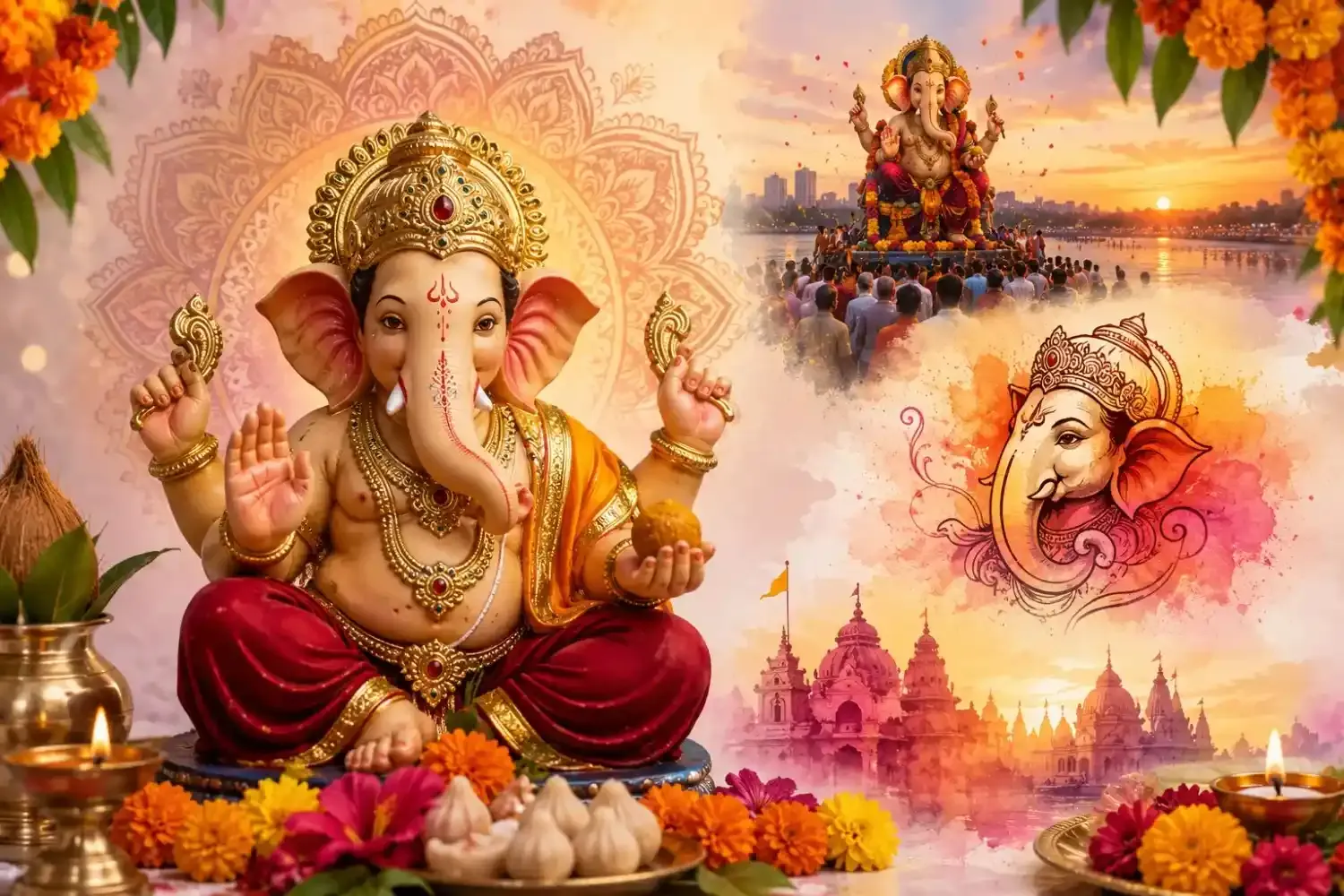
Ganesh Visarjan Mantra: Sanskrit Text, Meaning and Step-by-Step Visarjan Vidhi
Everything you need for Ganesh visarjan: the 'Yantu devaganah sarve' mantra with meaning, the kshama prarthana prayers, a step-by-step uttara puja and visarjan vidhi, and practical guidance for home immersion in the USA, UK and elsewhere.
Everything you need for Ganesh visarjan: the 'Yantu devaganah sarve' mantra with meaning, the kshama prarthana prayers, a step-by-step uttara puja and visarjan vidhi, and practical guidance for home immersion in the USA, UK and elsewhere.
Quick answer: The main Ganesh visarjan mantra is 'Yantu devaganah sarve pujam adaya mamakim, ishtakama prasiddhyartham punaragamanaya cha', meaning 'May all the divine beings depart, accepting my worship, for the fulfilment of my wishes, and to return again.' It is chanted after a short uttara puja (final worship) and followed by prayers asking forgiveness for any mistakes. The idol is then moved slightly from its place and immersed, ideally a clay idol in clean water at home or at a permitted site.
This guide has been restored at its original hindutone.com address. It gives the mantras in Devanagari, transliteration and English, and a step-by-step visarjan vidhi that works for a home in Hyderabad or a flat in New Jersey.
The meaning of visarjan
Visarjan means 'letting go'. During Ganesh Chaturthi, Ganesha is invoked into the clay murti through avahana and prana pratishtha, and honoured as a guest. At visarjan the presence of the deity is respectfully requested to return to its own abode, and the clay form, made from earth, goes back to water and earth.
The festival teaches a gentle lesson about impermanence: forms come and go, but the divine presence remains. That is why the visarjan mantra does not say goodbye. It says 'come back again'.
The visarjan mantra
यान्तु देवगणाः सर्वे पूजामादाय मामकीम्।
इष्टकामप्रसिद्ध्यर्थं पुनरागमनाय च॥
Transliteration: Yantu devaganah sarve pujam adaya mamakim; ishtakama prasiddhyartham punaragamanaya cha.
| Words | Meaning |
|---|---|
| Yantu devaganah sarve | May all the divine beings go (to their abode) |
| Pujam adaya mamakim | Taking with them my worship |
| Ishtakama prasiddhyartham | For the fulfilment of my cherished wishes |
| Punaragamanaya cha | And in order to return again |
This verse is used at the close of many pujas, not only for Ganesha, whenever a deity invoked for the ritual is bid farewell.
Kshama prarthana: asking forgiveness
Before or after the visarjan mantra, it is customary to ask forgiveness for any mistakes in the worship. Two widely used verses:
आवाहनं न जानामि न जानामि विसर्जनम्।
पूजां चैव न जानामि क्षमस्व परमेश्वर॥
Transliteration: Avahanam na janami na janami visarjanam; pujam chaiva na janami kshamasva parameshvara.
Meaning: 'I do not know how to invoke you, nor how to bid you farewell; I do not even know how to worship you. Forgive me, O Supreme Lord.'
मन्त्रहीनं क्रियाहीनं भक्तिहीनं सुरेश्वर।
यत्पूजितं मया देव परिपूर्णं तदस्तु मे॥
Transliteration: Mantrahinam kriyahinam bhaktihinam sureshvara; yat pujitam maya deva paripurnam tad astu me.
Meaning: 'O Lord of the gods, whatever worship I have offered, lacking in mantra, in action or in devotion, may it become complete.'
Step-by-step visarjan vidhi
- Choose the day and time. Follow your family custom (1.5, 3, 5, 7 or 10 days). Visarjan is usually done in the afternoon or evening after the uttara puja.
- Uttara puja. Offer a final simple worship: light the lamp, offer flowers, durva, akshata, kumkum and incense, and offer naivedyam such as modaks, kudumulu or fruit.
- Aarti. Sing Jai Ganesh Deva, Sukhkarta Dukhharta or your family's aarti with the whole household.
- Pushpanjali and prayers. Offer a handful of flowers and pray for the family's well-being, and for Ganesha to return next year.
- Kshama prarthana. Recite the forgiveness verses above.
- Visarjan mantra. Chant 'Yantu devaganah sarve...' and offer akshata on the idol.
- Udvasana (moving the idol). Gently lift or shift the idol slightly from its seat. Many families do this immediately after the mantra, as a sign that the invoked presence has been released.
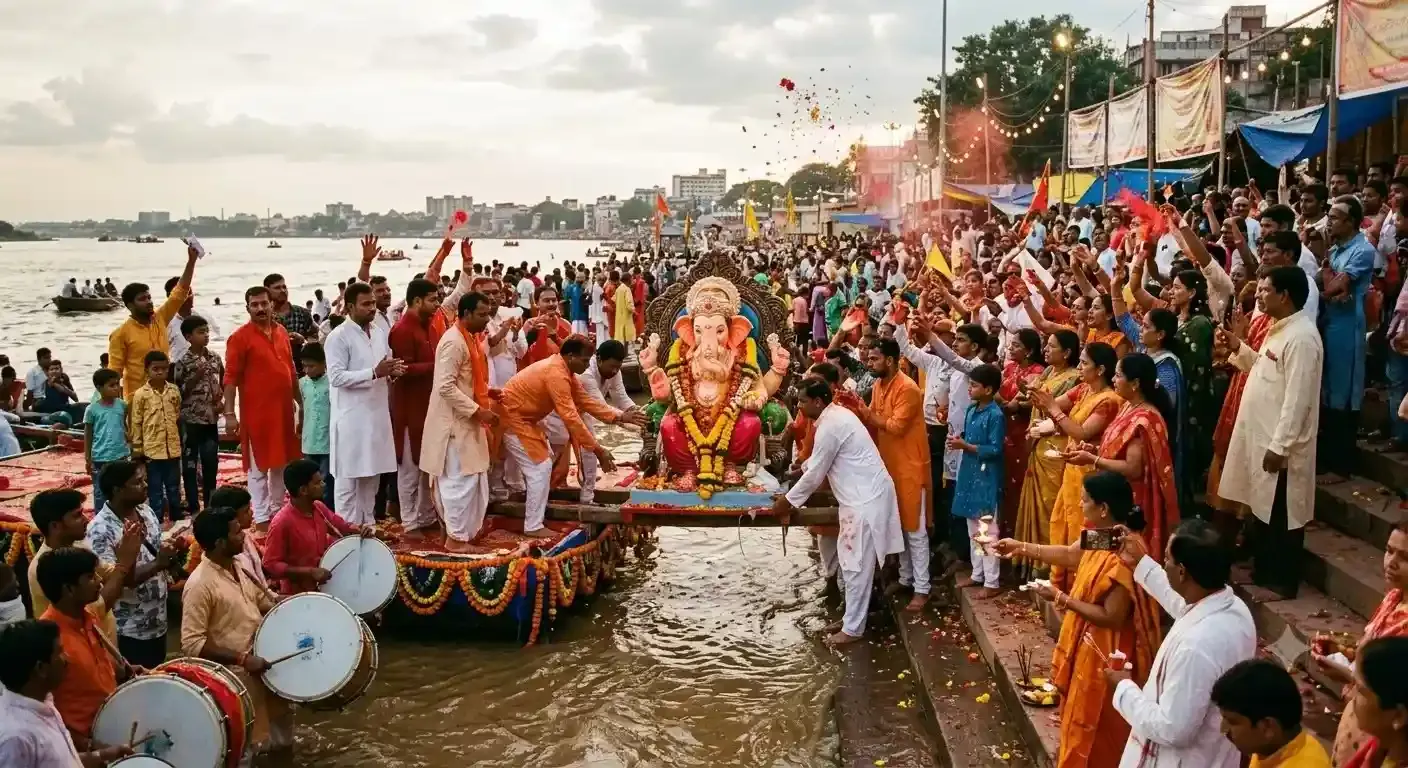
- Procession. Carry the idol to the place of immersion with chants of 'Ganpati Bappa Morya' or 'Jai Bolo Ganesh Maharaj ki Jai'.
- Immersion. Immerse the idol gently with folded hands. Remove flowers, cloth and decorations first if the water body or bucket must be kept clean.
Visarjan abroad: practical and respectful
For families in the USA, UK, Canada, Australia, Singapore or the Gulf, home visarjan is often the most practical and environmentally sound choice:
- Use a natural, unbaked clay idol. It dissolves in water within hours to a day or two; plaster of Paris does not.
- Fill a clean bucket or tub with water. Immerse the idol with the mantras above and leave it to dissolve.
- Pour the dissolved clay and water into your garden or large potted plants. Many families plant tulasi or another seedling in the clay.
- Compost the flowers and leaves. Keep any toxic leaves from the 21 patri away from pets.
- If you have a metal or stone idol that stays permanently in the puja room, perform the visarjan mantra symbolically with a small turmeric (Haridra) Ganesha or a betel nut, and immerse that instead.
- Do not immerse idols in lakes, rivers or the sea unless the local authority or temple has organised a permitted site. Rules differ from place to place, so check locally.
Many diaspora temples organise a community visarjan, often in a tank on temple grounds. Check your temple's official website for details. For more on idol choices, see our guide to eco-friendly Ganesh idols in the USA.
Visarjan days at a glance
| Tradition | When visarjan happens |
|---|---|
| One and a half days (Dedh din) | Common in many Maharashtrian homes; immersion on the day after Chaturthi |
| Third, fifth or seventh day | Common in many family and community celebrations |
| Tenth day (Anant Chaturdashi) | Large public mandals and many families; 25 September in 2026 |
Frequently asked questions
Which mantra is chanted at Ganesh visarjan?
The most widely used is 'Yantu devaganah sarve pujam adaya mamakim, ishtakama prasiddhyartham punaragamanaya cha', asking the deity to accept the worship, grant one's wishes and return again. It is usually followed by the kshama prarthana prayers asking forgiveness for any mistakes.
On which day should I do visarjan?
Families choose according to custom: one and a half, three, five, seven or ten days after Ganesh Chaturthi. The tenth-day visarjan falls on Anant Chaturdashi, which in 2026 was Friday 25 September. Whatever day you choose, keep it consistent with your family tradition.
Can I do visarjan at home in a bucket?
Yes. Immersing a natural clay idol in a clean bucket or tub at home is widely accepted, especially abroad. Once the clay has dissolved, the water and clay can go into your garden or potted plants.
Do I need a priest for visarjan?
No. The uttara puja and visarjan are simple enough for the head of the household to perform. Read the mantras slowly from this page or your vrata book; sincerity matters more than perfect pronunciation.
What does 'Ganpati Bappa Morya, pudhchya varshi lavkar ya' mean?
It is Marathi for 'Ganpati, our father, Morya; come early next year'. 'Morya' is often linked with the saint Morya Gosavi of Chinchwad, a great Ganesha devotee. The chant is popular at visarjan processions everywhere.
Editor's note
Editor's note (5 October 2026): This guide has been restored at its original address after the earlier version was lost. The mantras given are the standard verses printed in most puja books; regional traditions may add further prayers. Anant Chaturdashi 2026 (Friday 25 September) is from Drik Panchang. Ganesh Chaturthi 2027 falls on Saturday 4 September 2027.
Related guides
You might also like
Vinayaka Vrata Vidhanam: Step-by-Step Vinayaka Chavithi Pooja at Home
Top Bollywood Songs for Ganesh Mandapams and Ganpati Processions
Sukhkarta Dukhharta Ganesh Aarti: Lyrics and Meaning, Verse by Verse