Sukhkarta Dukhharta Ganesh Aarti: Lyrics and Meaning, Verse by Verse
The full Marathi Ganesh aarti Sukhkarta Dukhharta in Devanagari, transliteration and English meaning, with background on Samarth Ramdas, the Morgaon connection and tips for singing it at home.
The full Marathi Ganesh aarti Sukhkarta Dukhharta in Devanagari, transliteration and English meaning, with background on Samarth Ramdas, the Morgaon connection and tips for singing it at home.
Quick answer: "Sukhkarta Dukhharta" is the most popular Marathi Ganesh aarti, traditionally attributed to Samarth Ramdas (17th century). Its three verses describe Ganesha as the giver of joy and remover of sorrow, adorned with vermilion, pearls, a jewelled crown and anklets, pot-bellied, wearing yellow silk with a serpent belt, three-eyed and with a curved trunk. The refrain "Jai Dev Jai Dev Jai Mangalmurti, darshanmatre mankamana purti" means "Victory to the auspicious lord; merely seeing you fulfils the heart's wishes."
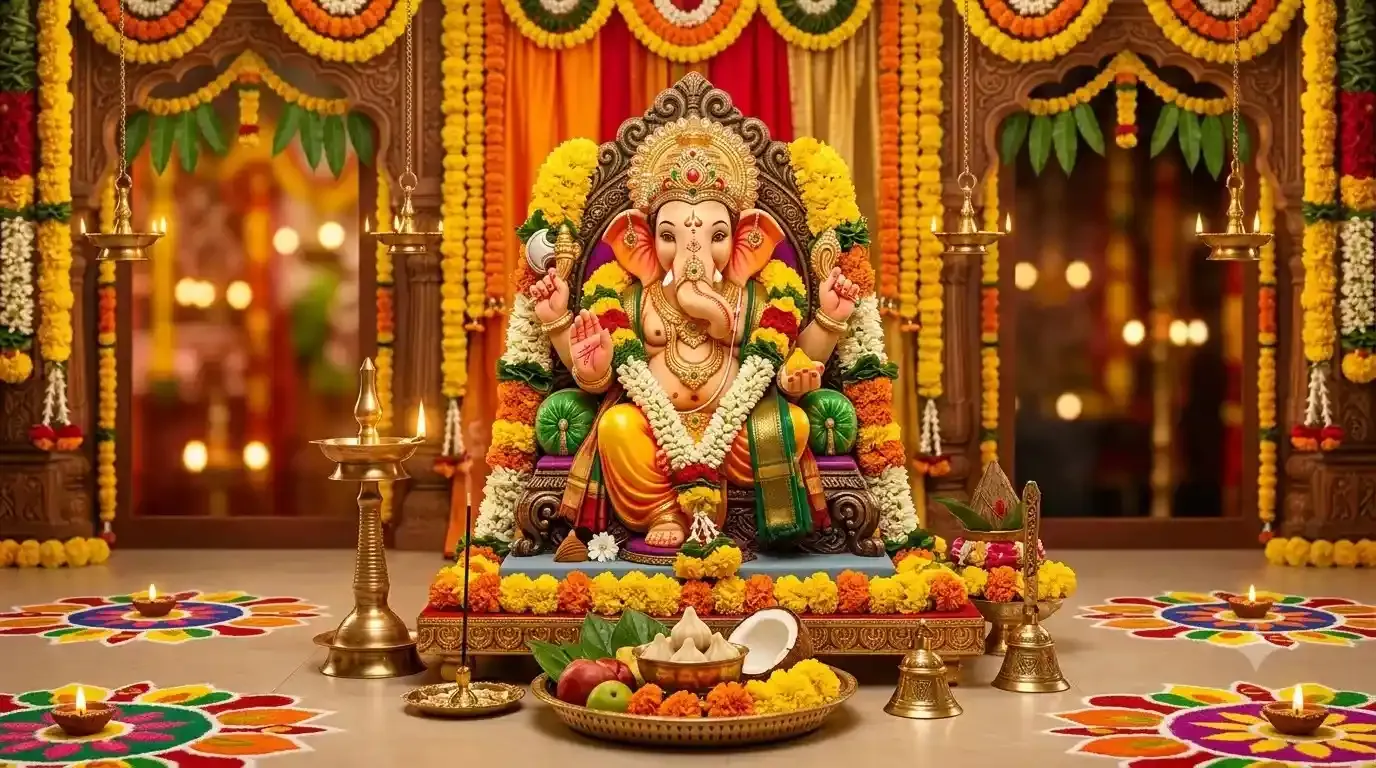
From Pune homes to Ganeshotsav celebrations in London, New Jersey and Dubai, the opening notes of "Sukhkarta Dukhharta" bring everyone to their feet. Clapping, cymbals and a ringing bell accompany every line. Yet many people who sing it every year are not sure what all the words mean, especially those who do not speak Marathi. Here is the complete aarti with a line-by-line explanation.
Background: Samarth Ramdas and the aarti
Samarth Ramdas (traditionally dated 1608 to 1681) was a Marathi saint-poet and devotee of Rama and Hanuman, revered as a spiritual guide in Shivaji's era. He composed the Dasbodh and the Manache Shlok, among many other works. Several popular Marathi aartis are attributed to him. The signature "Das Ramacha" in the final verse of Sukhkarta Dukhharta marks it as his. Popular tradition associates the aarti with the Mayureshwar Ganesha temple at Morgaon, the first of the Ashtavinayak temples, but the exact circumstances of its composition are not historically documented.
Verse 1: lyrics
सुखकर्ता दुःखहर्ता वार्ता विघ्नाची।
नुरवी पुरवी प्रेम कृपा जयाची।
सर्वांगी सुंदर उटी शेंदुराची।
कंठी झळके माळ मुक्ताफळांची॥१॥
Transliteration: Sukhkarta dukhharta varta vighnachi, nurvi purvi prem krupa jayachi. Sarvangi sundar uti shendurachi, kanthi jhalke mal muktaphalanchi.
| Phrase | Meaning |
|---|---|
| Sukhkarta dukhharta | Giver of happiness, remover of sorrow |
| varta vighnachi nurvi | who leaves no trace (not even talk) of obstacles |
| purvi prem krupa jayachi | whose love and grace fulfil (our needs) |
| sarvangi sundar uti shendurachi | whose whole body is beautifully coated with vermilion paste |
| kanthi jhalke mal muktaphalanchi | a necklace of pearls shines at his throat |
Refrain
जय देव जय देव जय मंगलमूर्ती।
दर्शनमात्रे मनकामना पुरती॥ जय देव जय देव॥
Transliteration: Jai Dev Jai Dev Jai Mangalmurti, darshanmatre mankamana purti. Jai Dev Jai Dev.
Meaning: Victory, O God, victory, O embodiment of auspiciousness. By your mere sight, the wishes of the mind are fulfilled.
The word "Mangalmurti" is especially dear in Maharashtra, echoing the chant "Ganpati Bappa Morya, Mangal Murti Morya".
Verse 2: lyrics
रत्नखचित फरा तुज गौरीकुमरा।
चंदनाची उटी कुंकुमकेशरा।
हिरेजडित मुकुट शोभतो बरा।
रुणझुणती नूपुरे चरणी घागरिया॥२॥
Transliteration: Ratnakhachit phara tuj Gaurikumara, chandanachi uti kumkumkeshara. Hirejadit mukut shobhato bara, runjhunati nupure charani ghagariya.
| Phrase | Meaning |
|---|---|
| Ratnakhachit phara tuj Gaurikumara | O son of Gauri (Parvati), a jewel-studded seat (or ornament) is for you |
| chandanachi uti kumkumkeshara | sandalwood paste mixed with kumkum and saffron is applied to you |
| hirejadit mukut shobhato bara | a diamond-studded crown looks splendid on you |
| runjhunati nupure charani ghagariya | anklets with little bells jingle on your feet |
The word "phara" is explained differently by commentators, as a seat, a platter or an ornament. The overall picture is of Ganesha richly adorned in jewels, fragrant pastes and ornaments.
Verse 3: lyrics
लंबोदर पीतांबर फणिवरबंधना।
सरळ सोंड वक्रतुंड त्रिनयना।
दास रामाचा वाट पाहे सदना।
संकटी पावावे निर्वाणी रक्षावे सुरवरवंदना॥३॥
Transliteration: Lambodar pitambar phanivarbandhana, saral sond vakratunda trinayana. Das Ramacha vaat pahe sadana, sankati pavave nirvani rakshave survarvandana.
| Phrase | Meaning |
|---|---|
| Lambodar pitambar phanivarbandhana | Pot-bellied one, clad in yellow silk, with a great serpent as your belt |
| saral sond vakratunda trinayana | with a straight trunk, a curved tusk (or face), and three eyes |
| Das Ramacha vaat pahe sadana | this servant of Rama waits for you at home |
| sankati pavave nirvani rakshave survarvandana | come to me in times of trouble and protect me at the very end, O you who are worshipped by the best of the gods |
The last verse turns from description to prayer. After praising Ganesha's form, the poet speaks personally: I am waiting for you; come when I am in trouble, and protect me at the end of life. This movement from admiration to intimate prayer is what gives the aarti its emotional power.
The spiritual message of the aarti
- Grace removes obstacles completely. The first line says obstacles are not merely reduced but leave no trace.
- Beauty draws the mind to the divine. Two verses describe Ganesha's adornment in detail, a practice of focusing the mind on the deity's form (saguna upasana).
- Darshan itself is a blessing. The refrain says simply seeing him fulfils the heart's wishes, which is why devotees value darshan so deeply.
- Devotion is personal. The poet ends by placing himself, a humble servant, before Ganesha and asking for protection in life and at death.
How to sing it during Ganeshotsav
- It is sung at the end of the pooja, morning and evening, while the lamp is waved.
- Everyone claps on the beat; children often play small cymbals (tal) or ring the bell.
- The refrain is repeated after each verse, often faster and louder as the aarti builds.
- In many homes it is followed by other aartis and closes with "Ghalin Lotangan" and "Mantra Pushpanjali", ending with the chant "Ganpati Bappa Morya".
If you do not read Devanagari, print the transliteration above for guests. Many second-generation NRI children learn the aarti by ear first and only later understand the words. Sharing the meaning, one verse each evening, makes the experience far richer.
Common pronunciation tips
- "Sukhkarta" has a soft "kh" sound; do not split it into "Sukh-kar-ta" with pauses.
- "Nurvi purvi" is commonly sung as one flowing phrase.
- "Jhalke" (shines) begins with a "jh" sound, as in "jhula".
- "Runjhunati" imitates the sound of jingling anklets.
Frequently asked questions
Who wrote Sukhkarta Dukhharta?
It is traditionally attributed to Samarth Ramdas, the 17th-century Marathi saint and guru associated with Chhatrapati Shivaji. His signature "Das Ramacha" (servant of Rama) appears in the third verse. Tradition links its composition to his visit to the Ganesha temple at Morgaon, though this is a matter of tradition rather than documented history.
What does "Sukhkarta Dukhharta" mean?
"Sukhkarta" means the giver of happiness and "Dukhharta" means the remover of sorrow. Together they describe Ganesha as the one who grants joy and takes away suffering.
What does "Jai Dev Jai Dev Jai Mangalmurti" mean?
It means "Victory, O God, victory, O auspicious form". The following line, "Darshanmatre mankamana purti", means that merely seeing him fulfils the wishes of the heart.
Is Sukhkarta Dukhharta sung only in Marathi?
Yes, the text is Marathi, but it is sung by Ganesha devotees of every language, especially in Maharashtra, Goa, Karnataka and among the diaspora. Many non-Marathi families learn it phonetically.
What is sung after Sukhkarta Dukhharta?
In many Marathi homes the aarti sequence continues with aartis to Shiva ("Lavathavati Vikrala") and Devi ("Durge Durghat Bhari"), and ends with "Ghalin Lotangan" and the mantra pushpanjali. Sequences differ by family.
Editor's note (5 October 2026)
This guide restores a lost hindutone.com page and has been rewritten. The text follows the widely sung version; small spelling and wording variations exist in printed aarti books. Some words, such as "phara", have more than one traditional interpretation, and we have noted them. The attribution to Samarth Ramdas and the Morgaon association are traditional. Ganesh Chaturthi 2027 falls on Saturday, 4 September 2027 per the Indian panchang.
Related guides
You might also like
Jai Ganesh Deva Aarti: Lyrics in Hindi and English, Meaning and How to Sing It
Top Bollywood Songs for Ganesh Mandapams and Ganpati Processions
Ganesh Visarjan Mantra: Sanskrit Text, Meaning and Step-by-Step Visarjan Vidhi