Ganesha Sahasranama: The Thousand Names of Ganesha Explained
A clear introduction to the Ganesha Sahasranama, the thousand names of Lord Ganesha: where it comes from, how it is structured, a selection of well-known names with their meanings, how to recite it or perform a sahasranama archana at home, and how NRI families can begin.
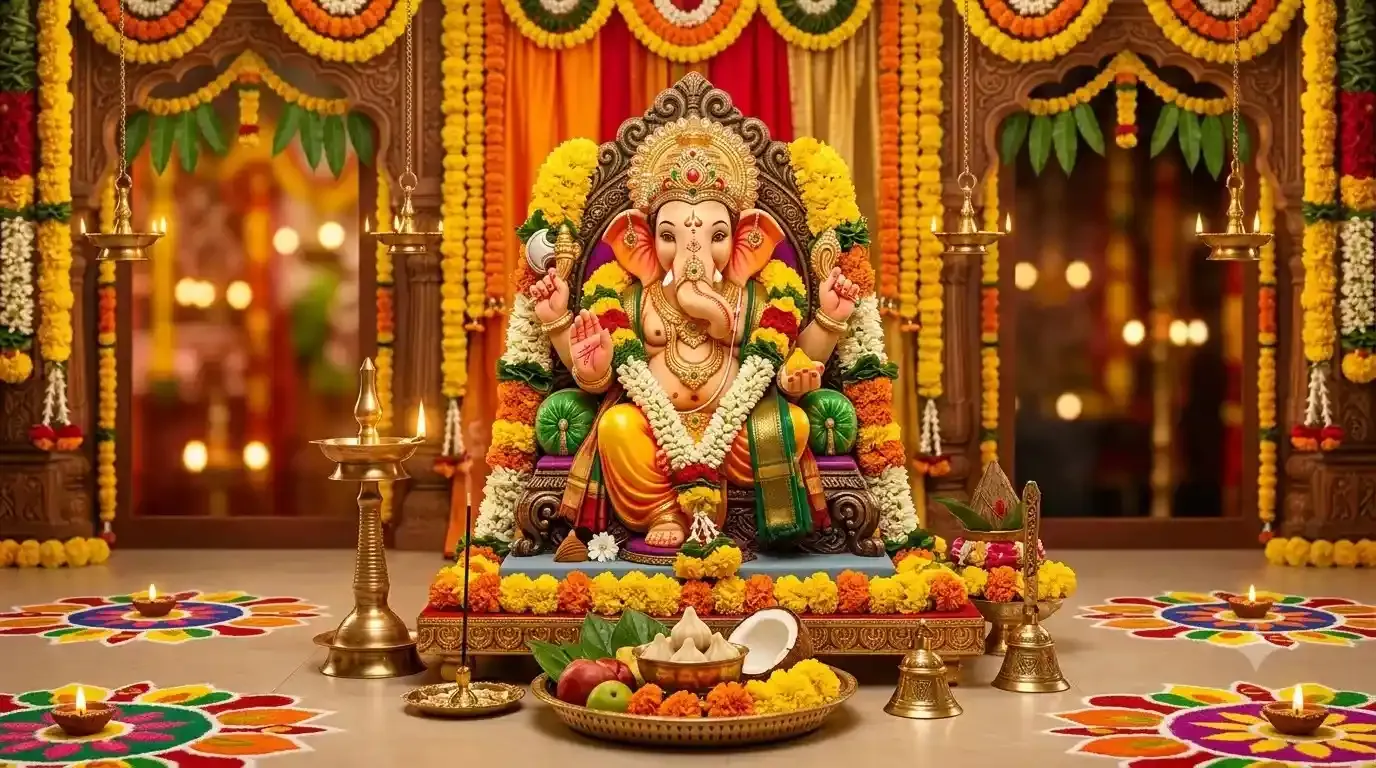
A clear introduction to the Ganesha Sahasranama, the thousand names of Lord Ganesha: where it comes from, how it is structured, a selection of well-known names with their meanings, how to recite it or perform a sahasranama archana at home, and how NRI families can begin.
Quick answer: The Ganesha Sahasranama is a Sanskrit hymn of one thousand names of Lord Ganesha. The most widely recited version is commonly cited as chapter 46 of the Upasana Khanda of the Ganesha Purana. Each name praises a quality or form of Ganesha, such as Vinayaka (the supreme leader), Ekadanta (the one-tusked) or Vighneshvara (lord of obstacles). Devotees recite it, or offer durva and flowers with each name in a sahasranama archana, on Wednesdays, Sankashti and Vinayaka Chaturthi, and during Ganesh Chaturthi. A full recitation usually takes 30 to 60 minutes.
This guide has been restored at its original hindutone.com address. It explains the hymn's source, how it is arranged, a selection of famous names with meanings, and how to recite it at home. We do not reproduce the full thousand names here: please use a reliable printed edition or your temple's publication, which will also include the traditional opening and closing verses.
What does Sahasranama mean?
Sahasra means thousand and nama means name. A sahasranama stotra is a hymn listing a thousand names of a deity. The best-known examples are the Vishnu Sahasranama from the Mahabharata and the Lalita Sahasranama from the Brahmanda Purana. Ganesha, Shiva, Devi, Surya and other deities have their own sahasranamas.
In the Hindu understanding, a deity's name is not just a label. Each name is a small meditation: saying 'Ekadanta' brings to mind the single tusk and its stories, and saying 'Vighnaharta' brings to mind Ganesha as the remover of obstacles. Reciting a thousand names is a way of turning the mind towards the deity again and again.
Source: the Ganesha Purana and other versions
- Ganesha Purana, Upasana Khanda: The Ganesha Purana is one of the two main scriptures of the Ganapatya tradition, the devotional school that worships Ganesha as the supreme deity. Its first part, the Upasana Khanda (section on worship), contains the Ganesha Sahasranama, commonly cited as chapter 46. This is the version most often printed and recited.
- Bhaskararaya's commentary: The 18th-century scholar Bhaskararaya, also known for his commentary on the Lalita Sahasranama, wrote a commentary on the Ganesha Sahasranama titled Khadyota. It explains the meanings of the names and remains an important reference.
- Other versions: Other thousand-name hymns to Ganesha are found in different texts and regional traditions, and printed editions can vary in readings. If you are learning from a temple or teacher, use the version they follow.
For background on the other major Ganapatya scripture and the stories behind many names, see our guide to Ganesha stories and Puranic legends.
How the hymn is structured
Like most sahasranama stotras, the Ganesha Sahasranama has three parts:
- Opening (purva-bhaga): Introductory verses that set the scene within the Purana's narrative, followed by the traditional preliminaries recited before the names: the nyasa (placing the mantra on the body) and dhyana (a verse to visualise Ganesha's form).
- The thousand names (nama-bhaga): Composed in verse, mostly in the anushtubh metre, with several names packed into each line. Names are joined in Sanskrit compounds, which is why a beginner may find it hard to see where one name ends and the next begins.
- Closing (phala-shruti): Verses describing the merit of reciting the names with devotion. These are traditional statements of the hymn's value, not guarantees of worldly results.
For archana, the names are often rearranged into a namavali, a list in which each name is put in the dative case with 'Om' and 'namah', for example 'Om Vinayakaya namah'. This form is used when offering a flower or durva sprig with each name.
Famous names of Ganesha and their meanings
The following are among the best-loved names of Ganesha. You will meet them, or close forms of them, in the Sahasranama, in the 108-name Ashtottara and in shorter hymns. This is a small selection, not the text of the Sahasranama.
| Name | Meaning | What it brings to mind |
|---|---|---|
| Ganapati / Ganesha | Lord of the ganas | Leader of Shiva's hosts; lord of all groups and categories |
| Vinayaka | The supreme leader | One who has no leader above him |
| Vighneshvara / Vighnaraja | Lord of obstacles | He places and removes obstacles |
| Vighnaharta | Remover of obstacles | Invoked before any new beginning |
| Ekadanta | The one-tusked | His single tusk and its stories |
| Vakratunda | The one with the curved trunk | Strength combined with discernment |
| Gajanana | Elephant-faced | His elephant head |
| Lambodara | Big-bellied | Holds the whole universe within him |
| Sumukha | Of pleasing face | Gracious and approachable |
| Heramba | Protector of the weak | A five-headed form riding a lion in some traditions |
| Bhalachandra | Moon on the forehead | Wears the crescent moon |
| Dhumraketu | Smoke-bannered | A fierce form who destroys evil |
| Siddhivinayaka | Leader who grants accomplishment | Associated with Siddhi, accomplishment |
| Mushakavahana | Rider of the mouse | Mastery over restless desire |
| Skandapurvaja | Elder brother of Skanda | Brother of Kartikeya (Murugan) |
The sixteen names (Shodasha Nama)
A short, well-known hymn gives sixteen names of Ganesha, and it is a gentle starting point before the full Sahasranama: Sumukha, Ekadanta, Kapila, Gajakarnaka, Lambodara, Vikata, Vighnaraja, Ganadhipa, Dhumraketu, Ganadhyaksha, Bhalachandra, Gajanana, Vakratunda, Shurpakarna, Heramba and Skandapurvaja. It is commonly recited at the start of studies, journeys and other undertakings.
How to recite the Ganesha Sahasranama at home
Family and temple practice varies; where you have a teacher or priest, follow that guidance. A simple method:
- Choose a reliable printed edition or temple publication with Devanagari or your script plus transliteration. Avoid unverified copies with many errors.
- Bathe, wear clean clothes and sit before a Ganesha murti or picture. Light a lamp and incense if your home allows.
- Begin with a short prayer to your guru and the opening verses, including the dhyana verse, from your edition.
- Recite the names steadily and clearly. It is better to recite slowly with attention than to rush.
- Finish with the phala-shruti and a short aarti, and offer naivedyam such as modaka, laddu or fruit.
Sahasranama archana
In an archana, the namavali form is used and a flower, a pinch of akshata (rice) or a sprig of durva grass is offered at Ganesha's feet with each name. Many temples offer Ganesha Sahasranama archana on Chaturthi days; if you would like one, ask your temple office. At home, durva is especially appropriate; see our guide on why 21 durva grass blades are offered to Ganesha.
Sankashti, Chaturthi and Wednesday practice
- Sankashti Chaturthi: the fourth lunar day after the full moon. Many devotees fast until moonrise and recite the Sahasranama in the evening before breaking the fast. See our Sankashti Chaturthi moon rules.
- Vinayaka Chaturthi: the fourth lunar day after the new moon, each month.
- Wednesdays: the weekday many families associate with Ganesha.
- Ganesh Chaturthi: the annual festival, when some families recite the Sahasranama on each day of the celebration. In 2027 it falls on Saturday 4 September (India date, per Drik Panchang).
Sankashti and Vinayaka Chaturthi dates and moonrise times vary by location. Check Drik Panchang for your own city rather than following India's dates.
Tips for NRI families and beginners
- Start small: Begin with the sixteen names or the 108-name Ashtottara, then move to the full Sahasranama on Sankashti days.
- Chant along with a recording: Choose a clear recording by a trained chanter or your temple, and follow it with your book until the rhythm becomes familiar.
- Split it up: Recite 250 names a day over four days, or 100 names a day over ten days, such as the ten days of Ganesh Chaturthi.
- Join a group: Many temples and community groups abroad hold group recitations on Sankashti or during Ganesh Chaturthi. Check your local temple's official website or notice board.
- Learn meanings gradually: Pick one name a week to discuss with children, starting with the table above.
For a shorter daily mantra, see the Ganesha Gayatri mantra.
Frequently asked questions
What is the Ganesha Sahasranama?
It is a Sanskrit hymn of one thousand names of Lord Ganesha (sahasra = thousand, nama = name). Each name describes a quality, form, deed or symbol of Ganesha, and reciting them is a form of praise and meditation.
Which scripture contains the Ganesha Sahasranama?
The most widely recited version is commonly cited as chapter 46 of the Upasana Khanda of the Ganesha Purana. The 18th-century scholar Bhaskararaya wrote a well-known commentary on it called Khadyota. Other sahasranamas of Ganesha exist in different texts and regional traditions, so printed editions may differ.
How long does it take to recite the Ganesha Sahasranama?
Most people take roughly 30 to 60 minutes for a full recitation, depending on pace and familiarity. A sahasranama archana, where a flower or durva sprig is offered with each name, takes longer.
Can I recite it if I do not know Sanskrit?
Yes. Use a reliable printed book or temple publication with transliteration, recite slowly, and follow along with a recording by a trained chanter. Understanding grows with repetition; meanings of individual names are given in many editions.
What if I cannot recite all thousand names?
Many devotees recite the Ganesha Ashtottara Shatanamavali (108 names) or the short sixteen-name hymn on ordinary days, and the full Sahasranama on Sankashti, Chaturthi or festival days. Some divide the thousand names over several days.
When is the best day to recite the Ganesha Sahasranama?
Wednesdays, Sankashti Chaturthi, Vinayaka Chaturthi and the Ganesh Chaturthi festival are the most popular days. Ganesh Chaturthi 2027 is Saturday 4 September 2027 (India date, per Drik Panchang). For monthly Sankashti dates, check Drik Panchang for your city.
Editor's note
Editor's note (6 October 2026): This guide has been restored at its original address after the earlier version was lost. We have deliberately not reproduced the thousand names, because readings differ between editions and an error-free text is best taken from a reliable printed edition or your temple. The Ganesha Purana source is given as it is commonly cited. The names in our table are well-known names of Ganesha found across his name-lists, with general meanings. Recitation is presented as devotional practice, without promises of specific results. The only date given is Ganesh Chaturthi 2027, Saturday 4 September 2027 (India, per Drik Panchang).
Related guides
You might also like
Ganesha Gayatri Mantra: Text, Meaning, Source and How to Chant
Nirvana Shatakam (Atma Shatakam): Full Sanskrit Text, Transliteration and Meaning
Lakshmi Ashtottara Shatanamavali — 108 Names of Goddess Lakshmi (with Meanings)